What is the water cycle?
Short answer
The water cycle, or hydrologic cycle, is the continuous movement of water on, above, and below the Earth's surface. Driven by solar energy and gravity, water transitions between liquid, vapor, and ice states. This essential process recycles the planet's finite water supply, sustaining all life by redistributing moisture across global ecosystems.
On this page
What are the stages of the water cycle?
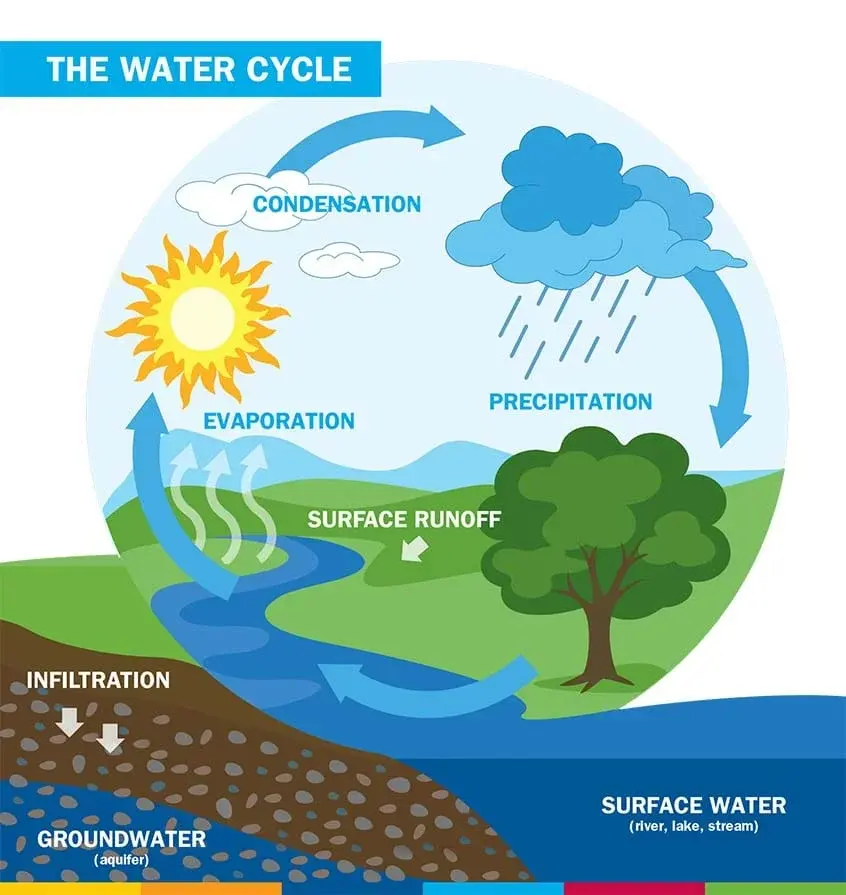
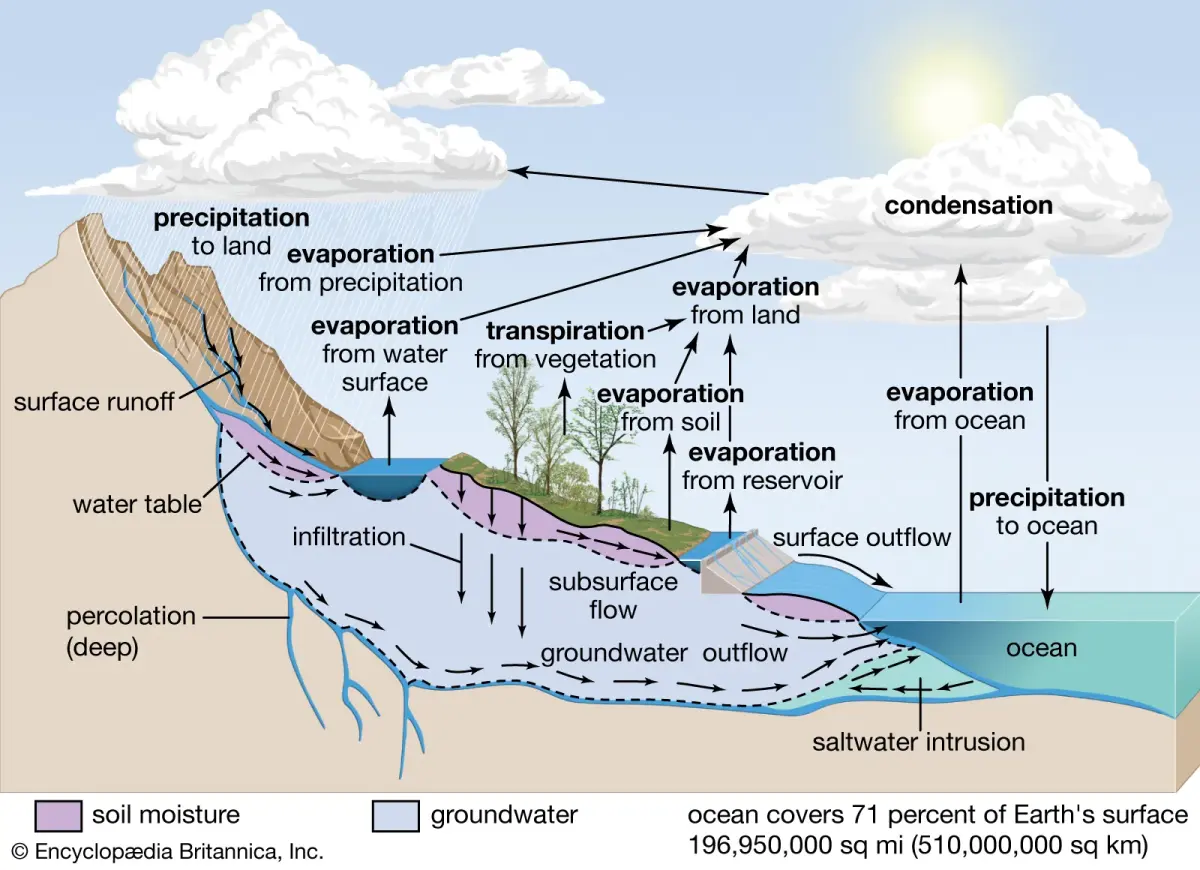
The water cycle functions as a closed system, meaning the total amount of water on Earth remains relatively constant over time. The process begins with evaporation, where solar radiation heats liquid water in oceans, lakes, and rivers, converting it into water vapor. This invisible gas rises into the atmosphere, where cooler temperatures cause it to condense into clouds. Eventually, when these droplets become heavy enough, they fall back to the surface as precipitation, such as rain, snow, or hail.
Once water reaches the ground, it follows several paths to complete the cycle. Some water flows over the surface as runoff, eventually returning to larger bodies of water. Other portions infiltrate the soil, replenishing groundwater aquifers or being absorbed by plant roots. Plants then release this water back into the atmosphere through a process called transpiration. Together, these mechanisms ensure that water is constantly redistributed across the globe.
- Evaporation: Solar energy turns liquid water into gas.
- Condensation: Water vapor cools to form clouds.
- Precipitation: Water returns to Earth as rain, snow, or sleet.
- Collection: Water gathers in oceans, soil, or underground aquifers.
How long does it take for water to cycle?
The duration of the water cycle varies significantly depending on where the water is stored. Water molecules in the atmosphere have a very short residence time, typically remaining there for only about nine days before falling as precipitation. In contrast, water trapped in deep groundwater aquifers or massive polar ice sheets can remain in place for thousands or even tens of thousands of years. The ocean acts as the largest reservoir, holding water for an average of 3,000 years.
These varying timescales illustrate the complexity of the Earth's climate system. While the cycle is continuous, it does not happen at a uniform speed across the globe. A drop of water might evaporate from a tropical sea and return as rain within a week, while another molecule might be locked in a glacier for an entire epoch. Understanding these residence times is crucial for managing water resources and predicting how climate change might affect regional rainfall patterns.
Why does the water cycle matter for the climate?
The water cycle is the primary engine of Earth’s climate and weather patterns. As water changes state, it absorbs or releases massive amounts of latent heat, which helps regulate global temperatures. When water evaporates, it cools the surface; when it condenses into clouds, it releases heat into the atmosphere. This energy transfer influences everything from local thunderstorms to large-scale ocean currents, effectively acting as a global thermostat that prevents extreme temperature fluctuations.
Furthermore, the cycle dictates the availability of freshwater, which is essential for human civilization and biodiversity. By moving water from the oceans to the land, the cycle provides the moisture necessary for agriculture, drinking water, and the maintenance of forests and wetlands. Changes in the cycle, such as increased evaporation due to global warming, can lead to more intense droughts in some regions and catastrophic flooding in others. Protecting the integrity of this cycle is vital for environmental stability.
Common mistakes when studying the water cycle
A frequent error is assuming that the water cycle is a simple, circular path that every molecule follows in sequence. In reality, the cycle is a complex web of interconnected reservoirs and pathways. A molecule does not necessarily move from the ocean to a cloud and then to a river; it might evaporate from a leaf, fall into a lake, and then be consumed by an animal before re-entering the atmosphere. Viewing it as a rigid loop oversimplifies the dynamic nature of Earth's hydrology.
Another common misconception is that all precipitation eventually returns to the ocean. Much of the water that falls on land is stored in soil, lakes, or ice caps for extended periods. Additionally, people often forget the role of transpiration, focusing only on evaporation from oceans. Recognizing that biological processes are just as important as physical ones is key to a complete understanding. To study the cycle effectively, follow these logical steps:
- Identify the primary reservoirs, such as oceans, glaciers, and groundwater.
- Trace the energy source, which is almost exclusively solar radiation.
- Observe how gravity pulls water downward through rivers and infiltration.
- Account for human impacts, such as deforestation and dam construction.
How do humans influence the water cycle?
Human activity has significantly altered the natural flow of water across the landscape. Large-scale deforestation reduces the rate of transpiration, which can lead to decreased local rainfall and drier climates. Similarly, the construction of dams and reservoirs traps water that would otherwise flow into oceans, changing the timing and volume of river discharge. These interventions can disrupt local ecosystems and affect the availability of water for downstream communities that rely on natural river cycles.
Urbanization also creates major disruptions by replacing permeable soil with concrete and asphalt. This prevents water from infiltrating the ground to recharge aquifers, instead forcing it to run off into storm drains. This leads to increased flood risks and the pollution of waterways, as runoff carries chemicals and debris into the ocean. By understanding these human-induced changes, societies can implement better water management strategies, such as permeable pavement and reforestation, to help restore the natural balance of the global water cycle.
Key facts
- The total amount of water on Earth remains constant, effectively recycling the same supply for billions of years.
- Approximately 97% of Earth's water is stored in oceans, which provide the primary source for atmospheric evaporation.
- Water molecules can remain in the atmosphere for about nine days before falling back to the surface as precipitation.
- Glaciers and ice caps hold nearly 69% of the world's freshwater, acting as long-term storage in the cycle.
- Transpiration is the process where plants release water vapor through their leaves, contributing significantly to atmospheric moisture.
- Avoid the common mistake of thinking the cycle is a perfect circle; water can be trapped in deep groundwater aquifers or ice for thousands of years.
The bottom line
The water cycle is the continuous movement of water between the Earth’s surface and the atmosphere, driven primarily by solar energy. Through evaporation, condensation, and precipitation, water is purified and redistributed globally. Understanding this process is essential for managing our limited freshwater resources, as human actions significantly influence the speed and quality of this vital, life-sustaining system that has functioned for billions of years.
People also ask
How does temperature affect the water cycle?
Higher temperatures increase the rate of evaporation from oceans and lakes, leading to more moisture in the atmosphere. This intensified cycle can result in more frequent and severe weather events, such as heavy rainfall or prolonged droughts.
What is the role of clouds in the water cycle?
Clouds are formed when water vapor cools and condenses around tiny particles like dust or salt. They act as transport mechanisms, moving water across the globe before releasing it as rain, snow, or hail.
Can human activity disrupt the water cycle?
Yes, activities like deforestation, urbanization, and excessive groundwater pumping alter natural flow patterns. These changes can reduce local rainfall and lead to the depletion of essential freshwater reserves.
What is the difference between evaporation and sublimation?
Evaporation is the transition of liquid water into gas, while sublimation is the process where ice turns directly into water vapor without melting first. Both processes contribute to the total amount of moisture entering the atmosphere.
How long does it take for water to complete the cycle?
There is no set timeframe, as the duration depends on where the water is stored. A molecule might spend a few days in the atmosphere or thousands of years locked within a deep underground aquifer.
Why is the water cycle important for life?
The cycle continuously purifies and redistributes water across the planet, making it available for plants, animals, and humans. Without this constant movement, terrestrial ecosystems would lack the hydration necessary for survival.
This answer was created with the help of AI research tools and reference sources. Spotted an error? Let us know — we correct mistakes quickly. See our editorial policy.