What is the largest city in the world?
Short answer
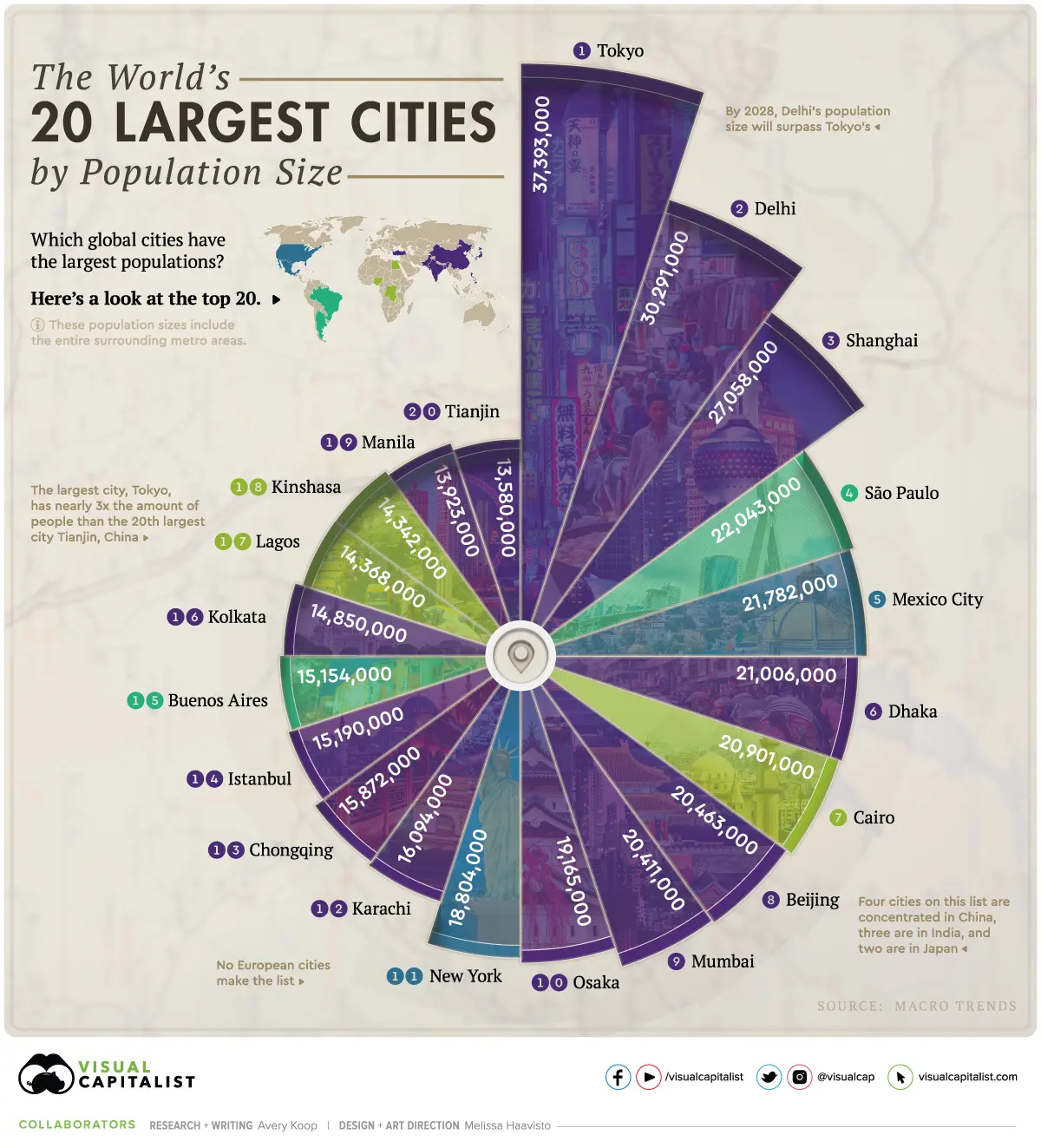
Tokyo, Japan, is the world’s largest city. As of 2026, the Greater Tokyo Area hosts approximately 37 million residents. While definitions of city size vary based on administrative boundaries versus metropolitan sprawl, Tokyo consistently ranks first in global population metrics, serving as a massive, integrated hub of commerce, technology, and culture.
On this page
How is city size measured?
Determining the largest city is complex because geographers use different criteria to define urban boundaries. The most common method is the "metropolitan area," which includes the central city and its surrounding suburbs that are economically linked. This approach captures the true scale of human activity and infrastructure, as people frequently commute across municipal lines.
Another method is the "city proper," which refers only to the area under the jurisdiction of a single local government. This definition often excludes massive suburban populations, making cities like Tokyo or Shanghai appear smaller than they actually are. When researchers rank cities, they must specify whether they are measuring the urban agglomeration or the strictly defined administrative zone to ensure accuracy.
- Metropolitan area: Includes the city and its functional, integrated suburbs.
- City proper: Includes only the area governed by a specific municipality.
- Urban agglomeration: Includes continuous built-up areas, often ignoring political borders.
Why is Tokyo considered the largest?
Tokyo’s status as the world’s largest city stems from its role as a global economic powerhouse. Following the rapid industrialization of Japan in the 20th century, Tokyo became the primary destination for labor, education, and innovation. The city’s infrastructure, particularly its world-class rail network, allows millions of people to live in surrounding prefectures while working in the central business districts.
The Greater Tokyo Area functions as a single, cohesive unit despite being composed of multiple smaller cities and towns. This density is supported by high-rise developments and efficient public transit systems that accommodate the massive daily influx of commuters. Unlike many other global megacities, Tokyo has maintained a high standard of living and safety, which continues to attract residents despite its immense population density.
What are other contenders for the largest city?
While Tokyo holds the top spot, several other cities are rapidly closing the gap. Delhi, India, is currently the second-largest urban area and is projected to overtake Tokyo in the coming decade due to higher growth rates. Other major contenders include Shanghai, Dhaka, and São Paulo, all of which feature massive populations exceeding 20 million people.
These cities face unique challenges compared to Tokyo, such as rapid, often unplanned, urban expansion. In many of these regions, infrastructure development struggles to keep pace with the influx of new residents. Consequently, while these cities are enormous, their urban footprints and population densities are managed differently, often resulting in distinct socio-economic environments that contrast sharply with the highly structured nature of Japanese urban planning.
- Delhi, India: Rapid growth driven by migration and high birth rates.
- Shanghai, China: A massive financial hub with significant vertical development.
- Dhaka, Bangladesh: One of the most densely populated cities on the planet.
- São Paulo, Brazil: The largest city in the Southern Hemisphere.
Common mistakes when comparing city populations
A frequent error is comparing the population of a city proper to the population of a metropolitan area. For example, comparing Tokyo’s metropolitan area to a city like London, which is often measured by its municipal boundaries, leads to a skewed understanding of relative size. Always ensure you are comparing the same metrics, such as "metropolitan population," to get a fair assessment.
Another mistake is ignoring the rate of change. A city might be the largest today but could be surpassed quickly if its growth has plateaued. Always check the date of the census or the estimate being cited, as urban data can become outdated within a few years. Relying on static, decade-old statistics will inevitably lead to an incorrect ranking of the world’s most populous urban environments.
How to find accurate population data
If you are researching city populations, start by identifying the source of the data. Reputable organizations like the United Nations Population Division provide standardized estimates that account for regional variations in how cities are defined. These reports are updated regularly and provide a consistent framework for comparing cities across different continents and political systems.
When looking for information, follow these steps to ensure reliability:
- Identify the source: Check if the data comes from a census bureau or a recognized international body.
- Check the date: Ensure the statistics are from the current year or the most recent available census.
- Verify the definition: Confirm whether the number represents the city proper or the entire metropolitan area.
- Compare like-to-like: Use the same metric for every city you are evaluating to maintain consistency.
By following these steps, you can avoid the common pitfalls of anecdotal evidence and ensure your understanding of global demographics is grounded in verifiable, current, and scientifically gathered data.
Key facts
- Tokyo, Japan, is widely recognized as the world's largest city by metropolitan area population, home to approximately 37 million residents.
- Population statistics vary significantly depending on whether researchers define a city by its administrative city limits or its broader metropolitan area.
- Shanghai, China, holds the record for the largest city proper, with over 24 million people living within its official municipal boundaries.
- When comparing city sizes, always verify if the data refers to "city proper" (legal boundaries) or "metropolitan area" (urban sprawl and suburbs).
- Avoid relying on outdated census data, as rapid urbanization in regions like South Asia and Africa changes rankings frequently.
- Delhi, India, is currently the fastest-growing major urban center and is projected to surpass Tokyo in total population by 2030.
The bottom line
Determining the world’s largest city depends entirely on how you define urban boundaries. While Tokyo consistently leads in metropolitan population, Shanghai holds the title for the largest city proper. When researching urban size, always distinguish between administrative limits and metropolitan sprawl to avoid confusion. As global urbanization shifts toward Africa and South Asia, these rankings will continue to evolve, reflecting the dynamic nature of modern human settlement patterns.
People also ask
Is Tokyo still the most populous city in the world?
Yes, as of 2026, the Greater Tokyo Area remains the most populous metropolitan region globally, housing over 37 million people.
Why do different sources give different rankings for the world's largest cities?
Discrepancies arise because some organizations measure only the population within official city limits, while others include the entire commuter belt and surrounding suburbs.
What is the difference between a city proper and a metropolitan area?
A city proper refers to the population within a specific legal or administrative boundary, whereas a metropolitan area includes the city and its surrounding economically integrated suburbs.
Which city has the highest population density?
Manila, Philippines, is frequently cited as the most densely populated city in the world, cramming millions of people into a very small land area.
Are there any cities in Africa that will soon be the largest in the world?
Lagos, Nigeria, and Kinshasa, Democratic Republic of the Congo, are experiencing explosive growth and are expected to become some of the world's largest megacities by 2050.
How can I find the most accurate current population data?
Consult the United Nations World Urbanization Prospects report, which provides standardized data and projections for urban centers globally.
This answer was created with the help of AI research tools and reference sources. Spotted an error? Let us know — we correct mistakes quickly. See our editorial policy.