What is the deepest part of the ocean?
Short answer
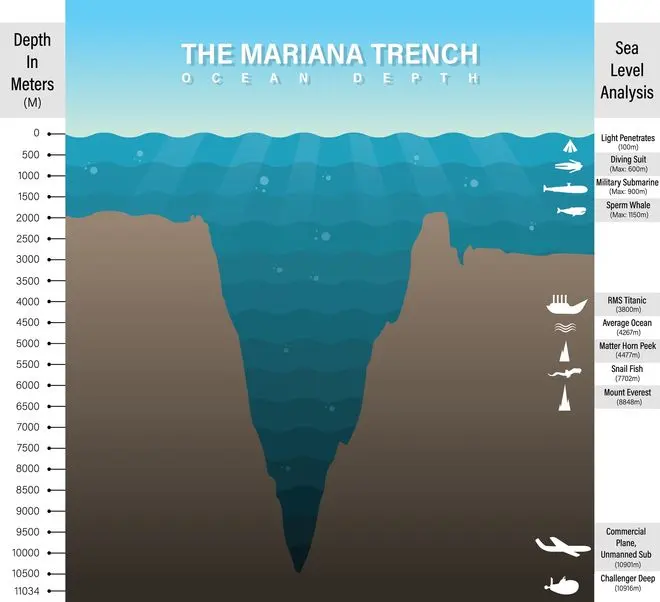
The Challenger Deep is the deepest known point in Earth’s oceans, located at the southern end of the Mariana Trench in the western Pacific. It reaches a depth of approximately 10,935 meters (35,876 feet) below sea level. This extreme abyss remains one of the most challenging and least explored environments on our planet.
On this page
Where is the deepest part of the ocean located?
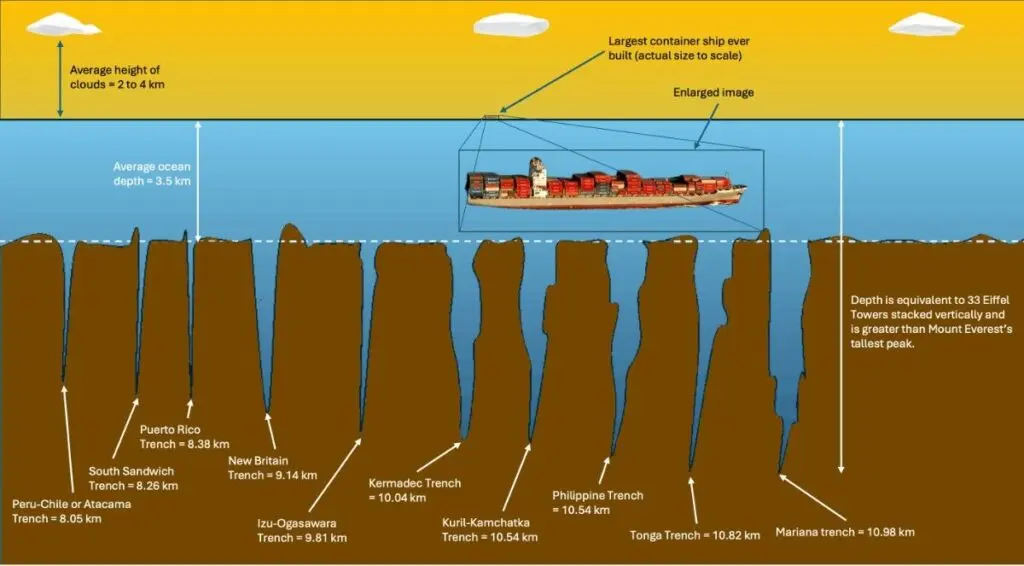
The Challenger Deep sits within the Mariana Trench, a crescent-shaped scar in the Earth’s crust that stretches over 2,500 kilometers. It is situated about 200 kilometers east of the Mariana Islands. This region is a subduction zone, where the massive Pacific Plate is forced beneath the smaller Mariana Plate, creating a deep-sea canyon that plunges far deeper than the height of Mount Everest.
Geographers and oceanographers categorize the ocean into distinct zones based on depth and light penetration. The Challenger Deep lies within the Hadal zone, named after Hades, the Greek god of the underworld. This zone begins at 6,000 meters and extends to the very bottom of the ocean trenches. Because sunlight cannot reach these depths, the environment is perpetually dark, near freezing, and subject to immense hydrostatic pressure that would crush most conventional deep-sea equipment.
How do scientists measure ocean depth?
Measuring the precise depth of the Challenger Deep is a complex task that has evolved significantly over the last century. Early explorers used weighted lines dropped from ships, but modern technology relies on sophisticated acoustic methods. Today, researchers primarily use multibeam echosounders mounted on the hulls of research vessels to map the seafloor with high precision.
These systems emit sound pulses that bounce off the bottom and return to the ship. By measuring the time it takes for the signal to travel, scientists calculate the distance to the seafloor. However, accuracy depends on several variables:
- The speed of sound in water, which changes based on temperature, salinity, and pressure.
- The precise calibration of the sonar equipment to account for the angle of the seafloor.
- The integration of satellite altimetry data to fill gaps between ship-based surveys.
Why is the deep ocean so difficult to explore?
Exploring the bottom of the Challenger Deep presents extreme engineering challenges due to the crushing pressure. At the bottom, the pressure is over 1,000 times greater than at sea level, roughly equivalent to an elephant standing on a human thumb. Any vessel sent to these depths must be constructed from specialized materials, such as titanium alloys or syntactic foam, to prevent structural failure or implosion.
Beyond the physical pressure, the environment is hostile in other ways. The water temperature hovers just above freezing, necessitating advanced thermal insulation for both equipment and human occupants. Communication is also severely limited because radio waves do not travel well through water. Researchers must rely on acoustic modems to transmit data, which are slow and prone to interference. These barriers ensure that fewer people have visited the Challenger Deep than have walked on the surface of the Moon.
Who has visited the Challenger Deep?
Human exploration of the deepest point began in 1960 when Jacques Piccard and Don Walsh descended in the bathyscaphe Trieste. Their historic mission proved that life could exist at such extreme depths, despite the lack of light and high pressure. Since that time, only a select few individuals have successfully reached the bottom, mostly using specialized deep-submergence vehicles designed for scientific research and exploration.
If you are interested in the timeline of human descent, consider these milestones:
- 1960: The Trieste reaches the bottom, marking the first human contact with the Hadal zone.
- 2012: Filmmaker James Cameron completes the first solo dive in the Deepsea Challenger.
- 2019: Victor Vescovo sets a record for the deepest solo dive, reaching approximately 10,928 meters.
- 2020: Dr. Kathy Sullivan becomes the first woman to reach the Challenger Deep, also having previously walked in space.
Common mistakes when researching ocean depths
A common error when researching the Challenger Deep is confusing the depth of the trench with the depth of the specific point. The Mariana Trench is a long feature with varying depths, and not every part of it is as deep as the Challenger Deep. Another mistake is assuming that the seafloor is a flat, sandy plain. In reality, the bottom of the trench is characterized by complex geological features, including steep rock walls, sediment-filled basins, and active volcanic vents.
When studying this topic, avoid these frequent pitfalls:
- Relying on outdated depth measurements from the mid-20th century, which often lacked modern calibration.
- Assuming that all deep-sea trenches are connected; they are often isolated, distinct geological formations.
- Overlooking the role of tectonic plate movement, which is the primary driver behind the formation of these deep-sea features.
- Misinterpreting the "Hadal" classification, which refers specifically to the deepest trenches rather than the entire deep ocean.
Key facts
- The deepest point in the world's oceans is known as the Challenger Deep.
- It is located at the southern end of the Mariana Trench in the western Pacific Ocean.
- The depth is approximately 10,935 meters (35,876 feet) below sea level.
- Pressure at the bottom exceeds 1,000 times the standard atmospheric pressure at sea level.
- To visualize the depth, if you placed Mount Everest inside the trench, its peak would still be over 2 kilometers underwater.
- Avoid confusing the Mariana Trench with the Challenger Deep; the trench is the entire canyon, while the Deep is the specific lowest point.
The bottom line
The Challenger Deep remains the most profound location on Earth, representing the extreme limit of our planet's topography. Located within the Mariana Trench, this site serves as a critical frontier for scientific exploration and biological research. Understanding its immense depth and crushing pressure highlights the vast, mysterious nature of the deep sea, which remains largely unexplored despite significant technological advancements in modern marine science.
People also ask
How long does it take to reach the bottom of the Mariana Trench?
A descent to the Challenger Deep typically takes between three to five hours depending on the submersible used. The ascent often takes a similar amount of time to ensure safety during the pressure transition.
Is it possible for humans to visit the Challenger Deep?
Yes, humans have visited the bottom using specialized deep-sea submersibles designed to withstand extreme pressure. These vessels are constructed with thick titanium hulls or reinforced ceramics to prevent implosion.
What kind of life exists at the bottom of the ocean?
Despite the crushing pressure and total darkness, life forms such as amphipods, xenophyophores, and small sea cucumbers thrive there. These organisms have evolved unique biological adaptations to survive in the extreme environment.
Why is the water so dark at those depths?
Sunlight cannot penetrate beyond the first 1,000 meters of the ocean, known as the aphotic zone. Below this depth, the ocean is in a state of perpetual darkness, requiring organisms to rely on bioluminescence or chemical energy.
What is the temperature at the bottom of the trench?
The water temperature at the bottom of the Challenger Deep typically ranges between 1 and 4 degrees Celsius (34 to 39 degrees Fahrenheit). This frigid environment is maintained by the constant circulation of cold, dense water from the poles.
How do scientists measure the depth of the ocean?
Scientists primarily use multibeam echosounders, which bounce sound waves off the seafloor to calculate depth based on the time it takes for the echo to return. Older methods used weighted lines, but modern sonar provides much higher accuracy.
This answer was created with the help of AI research tools and reference sources. Spotted an error? Let us know — we correct mistakes quickly. See our editorial policy.