What is light made of?
Short answer
Light is composed of fundamental particles called photons, which possess no mass and travel as both particles and waves. These massless packets of energy carry electromagnetic radiation across the universe. Because they lack mass, photons travel at the constant speed of light, approximately 299,792 kilometers per second in a vacuum.
On this page
What are photons and how do they work?
Photons are the elementary particles that serve as the quantum of the electromagnetic field. They are the smallest discrete units of light, meaning light cannot be divided into smaller pieces. Unlike protons or electrons, photons have zero rest mass and no electric charge. This lack of mass allows them to reach the absolute speed limit of the universe, which is defined by the constant c.
When an electron in an atom drops from a higher energy state to a lower one, it releases energy in the form of a photon. The frequency of the light produced depends entirely on the amount of energy released during this transition. High-energy transitions produce ultraviolet or X-ray photons, while lower-energy transitions result in visible light or infrared radiation. This process is the fundamental mechanism behind how stars shine, how neon signs glow, and how lasers function in modern technology.
Why does light behave like a wave and a particle?
Light exhibits a phenomenon known as wave-particle duality, a cornerstone of quantum mechanics. In some experiments, such as the double-slit experiment, light behaves like a wave, creating interference patterns as it passes through barriers. In other scenarios, such as the photoelectric effect, light acts as a stream of individual particles that can knock electrons off a metal surface. This dual nature is not a contradiction but a description of how quantum objects interact with the physical world.
The wave-like behavior is defined by its wavelength and frequency, which determine the color of visible light. The particle-like behavior is defined by the energy each photon carries, calculated by multiplying Planck’s constant by the frequency of the light. Understanding this duality is essential for technologies like solar panels, which rely on individual photons hitting silicon atoms to generate electricity.
- Wavelength: The distance between consecutive peaks of a wave.
- Frequency: The number of wave cycles that pass a point per second.
- Energy: Proportional to frequency; higher frequency light carries more energy.
- Polarization: The orientation of the light wave's oscillation in space.
How fast does light travel through space?
In a perfect vacuum, light travels at exactly 299,792,458 meters per second. This speed is a fundamental constant of physics that dictates how information propagates through the universe. Because nothing can travel faster than this limit, light acts as the cosmic speed limit for all matter and energy. When light passes through different mediums, such as water or glass, it slows down because it interacts with the atoms of the material.
The time it takes for light to travel is often measured in light-years, which is the distance light covers in one year, roughly 9.46 trillion kilometers. For example, light from the Sun takes about eight minutes and twenty seconds to reach Earth. When we look at distant stars, we are seeing them as they appeared years or even centuries ago. This delay means that observing the night sky is effectively looking back in time into the history of the cosmos.
Common mistakes when studying light
Many people mistakenly believe that light requires a medium to travel through, similar to sound waves. Sound requires air or water to vibrate, but light is an electromagnetic wave that propagates through the vacuum of space without any physical support. Another common error is assuming that all light is visible to the human eye. In reality, visible light is only a tiny fraction of the electromagnetic spectrum, which includes radio waves, microwaves, infrared, ultraviolet, X-rays, and gamma rays.
To avoid confusion when learning about light, follow these guidelines:
- Distinguish between the speed of light in a vacuum and its speed in materials like glass or water.
- Remember that light does not need a "carrier" medium to travel through space.
- Recognize that photons have energy and momentum, even though they have zero mass.
- Avoid thinking of light as purely a wave or purely a particle; it is a quantum object that displays both properties depending on the observation.
How to observe the properties of light
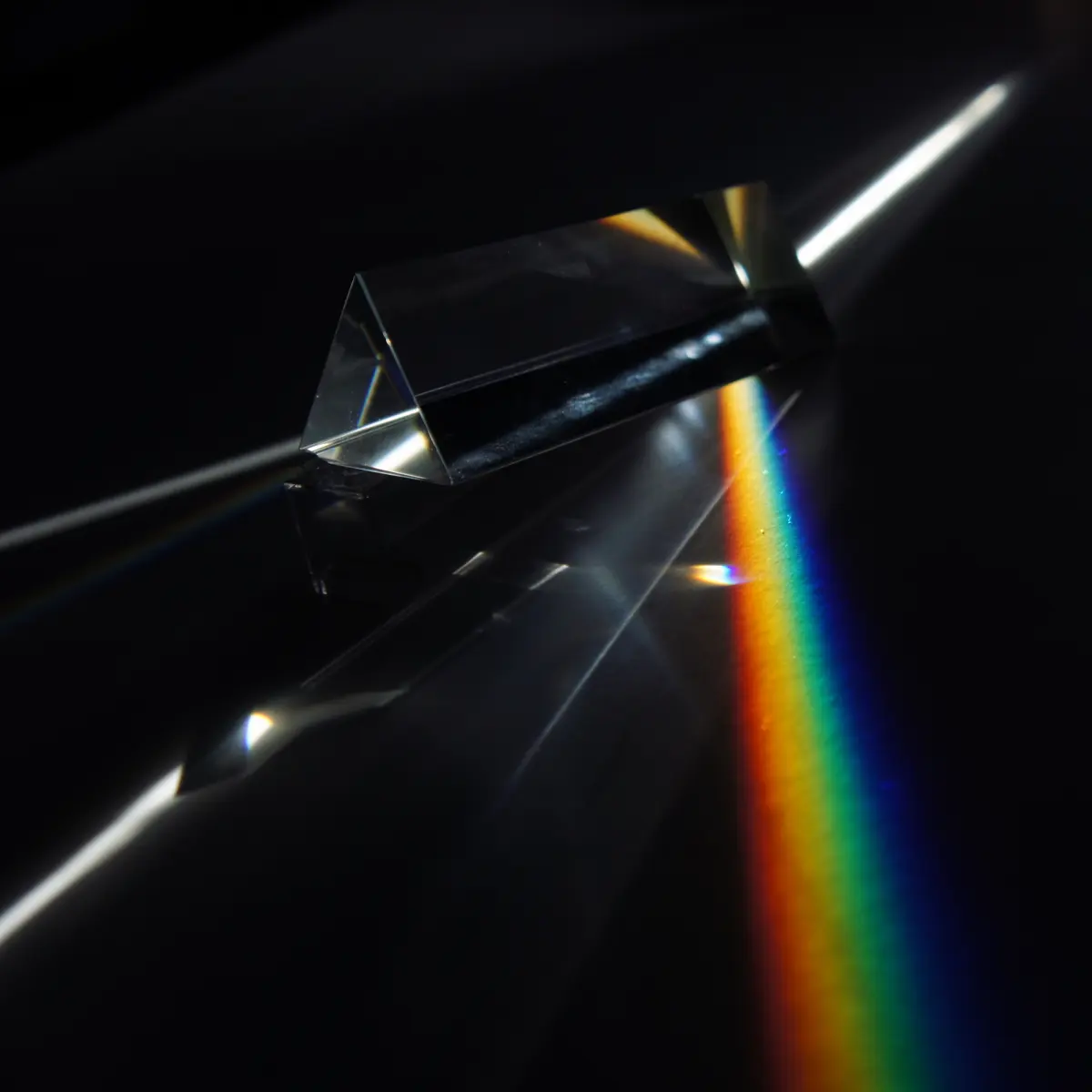
You can observe the behavior of light at home using simple household items. One classic experiment involves using a prism or a clear glass of water to refract white light into a rainbow. This demonstrates that white light is actually a combination of different wavelengths, each corresponding to a specific color. Another way to observe the wave nature of light is to look at a distant streetlamp through a fine mesh fabric, which creates a diffraction pattern that highlights the wave-like interference of light.
If you want to explore the particle nature of light, consider how digital cameras function. Each pixel on a camera sensor acts as a tiny bucket that collects photons. When you take a photo, the sensor counts the number of photons that hit each pixel to determine the brightness and color of the image. This practical application shows that light is indeed made of discrete, countable units that carry information from the source to the sensor, allowing us to capture the world in high resolution.
Key facts
- Light is composed of fundamental particles called photons, which have no mass and travel at the speed of light.
- Photons exhibit wave-particle duality, meaning they behave as both localized particles and spread-out electromagnetic waves.
- Visible light is just a tiny sliver of the electromagnetic spectrum, ranging from approximately 380 to 750 nanometers in wavelength.
- Light does not require a physical medium like air or water to travel, allowing it to traverse the vacuum of space.
- You can observe the wave nature of light by looking at thin films of oil on water, which create interference patterns.
- To avoid confusion, remember that while light carries energy and momentum, it does not possess physical substance or matter.
The bottom line
Light is a fascinating phenomenon defined by photons, which function as both particles and waves. It travels at a constant, immense speed through the vacuum of space, carrying energy without possessing physical mass. By understanding that light is essentially electromagnetic radiation, you can better appreciate how it interacts with the world, from the colors you perceive to the way lenses focus images for your eyes.
People also ask
How fast does light travel?
Light travels at a constant speed of approximately 299,792 kilometers per second in a vacuum. This speed is the ultimate cosmic speed limit defined by Albert Einstein’s theory of relativity.
Why do objects have different colors?
Objects appear colored because they absorb certain wavelengths of light and reflect others. The reflected light enters your eyes, and your brain interprets those specific wavelengths as distinct colors.
Can light be bent?
Yes, light bends when it passes through different materials, such as glass or water, in a process called refraction. It can also be bent by strong gravitational fields, a phenomenon known as gravitational lensing.
What is the difference between light and heat?
Light is electromagnetic radiation that is visible to the human eye, while heat is the transfer of thermal energy. While light can carry energy that generates heat when absorbed, they are distinct physical phenomena.
Does light have a weight?
Light has no mass, so it does not have weight in the traditional sense. However, it does possess momentum, which allows it to exert pressure on objects it strikes, a concept used in solar sail technology.
Why can we see through glass but not wood?
Glass is transparent because its atomic structure allows photons to pass through without being absorbed or scattered. Wood is opaque because its atoms absorb or reflect the incoming photons, preventing them from passing through.
This answer was created with the help of AI research tools and reference sources. Spotted an error? Let us know — we correct mistakes quickly. See our editorial policy.