What is Ivan Aivazovsky known for?
Short answer
Ivan Aivazovsky was a 19th-century Russian Romantic painter celebrated as the world's greatest maritime artist. He is best known for his dramatic, realistic depictions of the sea, particularly his ability to capture the transparency of waves and the interplay of light on water in over 6,000 paintings created during his prolific career.
On this page
Why is Ivan Aivazovsky famous for seascapes?
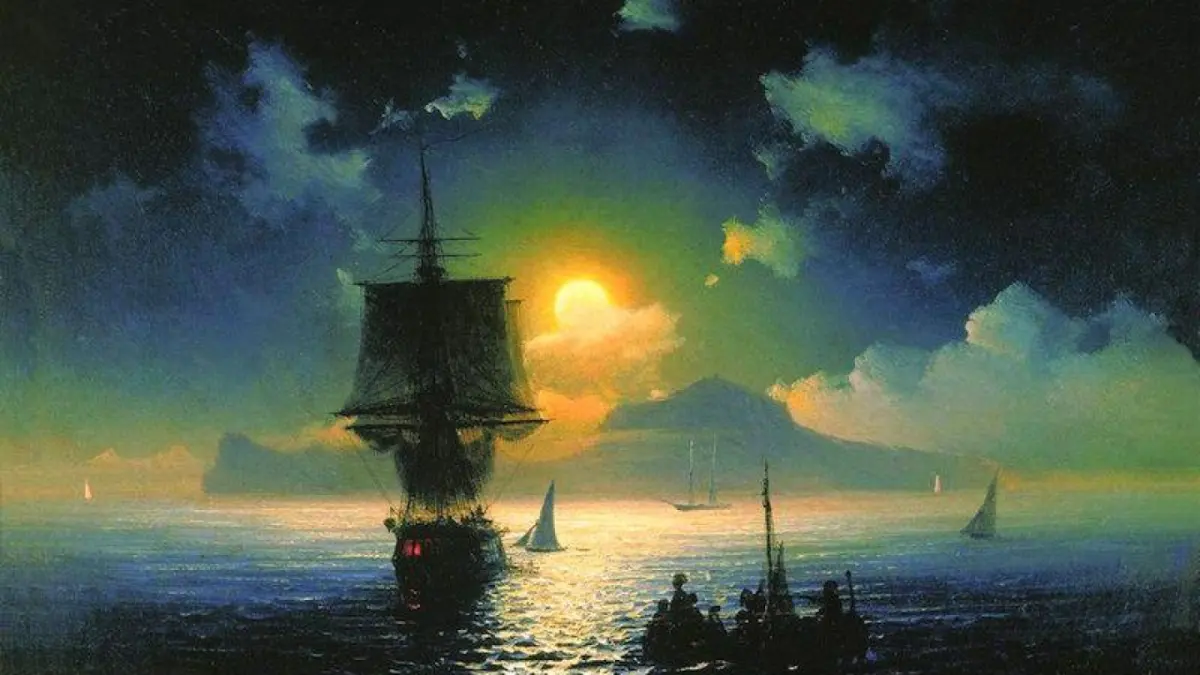
Aivazovsky’s fame rests on his unparalleled ability to render the movement and atmosphere of the ocean. Unlike many of his contemporaries who painted from sketches, Aivazovsky possessed an exceptional visual memory, allowing him to paint complex maritime scenes entirely from his imagination in his studio. He focused on the raw power of nature, often depicting ships in distress or the serene calm of a moonlit bay.
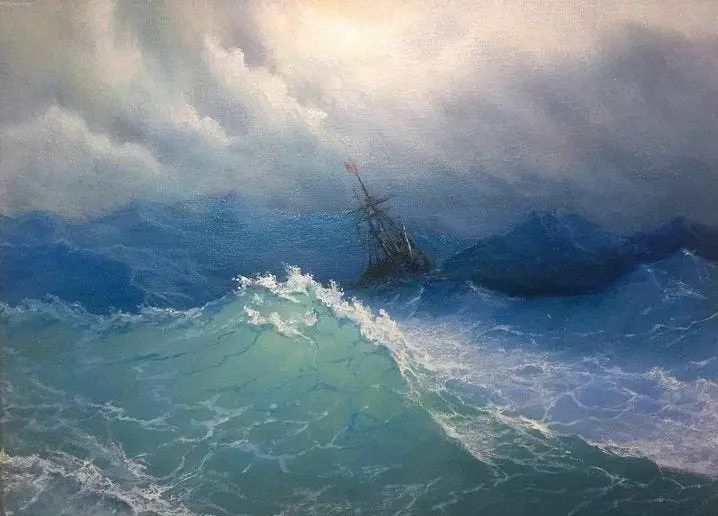
His technical mastery involved layering thin glazes of oil paint to create a sense of depth and luminosity. This technique made the water appear translucent, as if light were shining through the crest of a wave. By emphasizing the contrast between the dark, turbulent depths and the shimmering surface, he transformed the sea from a mere background element into the primary subject of his narrative art.
What are his most famous paintings?
The artist produced thousands of works, but a few stand out as definitive examples of his Romantic style. These pieces demonstrate his range, from the terrifying intensity of a storm to the quiet majesty of a sunset over the water. His works are housed in major museums, most notably the State Tretyakov Gallery in Moscow and the Aivazovsky National Art Gallery in Feodosia.
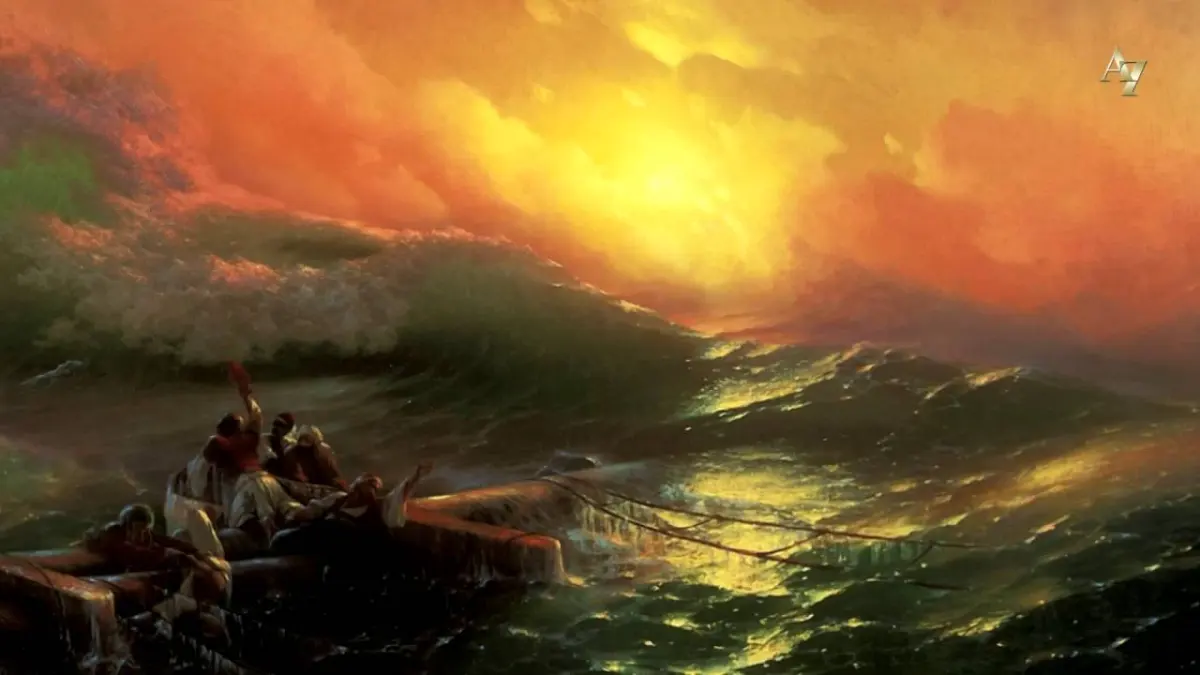
- The Ninth Wave (1850): His most iconic work, showing survivors clinging to a mast amidst a massive, sunlit storm wave.
- The Black Sea (1881): A study of a vast, churning sea under a heavy, overcast sky, noted for its lack of human presence.
- Chaos (1841): A depiction of the biblical creation, which earned him international acclaim early in his career.
- Battle of Chesma (1848): A dramatic historical scene capturing the destruction of the Ottoman fleet during the Russo-Turkish War.
How did he develop his painting technique?
Aivazovsky’s training at the Imperial Academy of Arts in Saint Petersburg provided him with a rigorous foundation in classical composition. However, his true education occurred through his extensive travels across Europe and his role as the official painter for the Russian Navy. By observing the sea in all its conditions—calm, stormy, arctic, and tropical—he internalized the physics of light and motion.
He followed a structured approach to ensure his large-scale canvases maintained their impact. To achieve his signature style, he often followed these steps:
- Sketching the composition lightly in charcoal to establish the horizon line and the main wave structures.
- Applying a dark, monochromatic underpainting to define the shadows and the deepest parts of the sea.
- Layering translucent glazes of blue, green, and grey pigments to build up the volume of the water.
- Using a dry brush to apply white highlights, capturing the spray and the foam of crashing waves.
What was his relationship with the Russian Navy?
Aivazovsky held the unique title of "Painter of the Main Naval Staff of the Russian Empire." This position allowed him to accompany the fleet on numerous expeditions, providing him with firsthand experience of naval maneuvers and combat. His art served as a visual record of Russian maritime history, bridging the gap between fine art and historical documentation.
Because of his status, he was one of the few artists permitted to witness naval battles from the deck of a warship. This proximity gave his battle scenes an authenticity that few other painters could replicate. He did not just paint ships; he painted the environment of the sea as a character that dictated the outcome of human conflict. This unique perspective cemented his legacy as both a military chronicler and a master of marine landscape.
Common mistakes when studying Aivazovsky
Many enthusiasts make the mistake of assuming his work is purely photorealistic. While his paintings are precise, they are deeply rooted in Romanticism, meaning he often exaggerated colors and lighting to evoke specific emotions. Expecting his work to be a literal, scientific representation of the ocean ignores the artistic license he took to create drama.
Another frequent error is overlooking his non-maritime work. While he is known for the sea, he also painted landscapes, portraits, and scenes of Armenian history. To truly understand Aivazovsky, one must look beyond the waves:
- Do not ignore the human element; he frequently included small figures to provide scale to the vastness of the ocean.
- Do not mistake his speed for carelessness; he was known to finish paintings in a single sitting, which was a testament to his immense skill rather than a lack of effort.
- Do not overlook the influence of his Armenian heritage, which often appeared in his later, more introspective works.
Key facts
- Ivan Aivazovsky (1817–1900) was a Russian Romantic painter of Armenian descent, globally renowned as one of the greatest masters of marine art.
- He painted approximately 6,000 works during his lifetime, the vast majority of which depict the sea, ships, and coastal landscapes.
- His most famous painting, The Ninth Wave (1850), illustrates a group of shipwrecked people clinging to a mast amidst a turbulent, sunlit ocean.
- Aivazovsky possessed a photographic memory, allowing him to observe waves in nature and recreate their complex motion in his studio without preliminary sketches.
- He was the first Russian artist to be exhibited in the Louvre in Paris and held over 120 solo exhibitions across Europe and the United States.
- To appreciate his work, look for his signature "Aivazovsky light," a technique where he painted transparent, glowing waves that appear to be illuminated from behind.
The bottom line
Ivan Aivazovsky remains the definitive master of marine painting, celebrated for his unparalleled ability to capture the volatile beauty of the ocean. By combining technical precision with a deep, emotional connection to the sea, he transformed maritime art into a powerful medium for Romantic expression. His legacy persists through thousands of vibrant canvases that continue to influence how we perceive the majesty and danger of water.
People also ask
Did Aivazovsky paint subjects other than the sea?
While 90 percent of his output focused on seascapes, he also painted Armenian landscapes, scenes from the Crimean War, and portraits of naval officers. He occasionally depicted historical events and biblical scenes, though these are less iconic than his maritime works.
How did Aivazovsky achieve such realistic water effects?
He utilized a unique layering technique, applying thin glazes of oil paint to create the illusion of depth and transparency in the water. By carefully controlling the contrast between dark, stormy shadows and bright, ethereal light, he mimicked the way sunlight penetrates ocean waves.
Where can I see Aivazovsky’s paintings today?
The Aivazovsky National Art Gallery in Feodosia, Crimea, holds the largest collection of his work, including some of his largest canvases. Significant pieces are also displayed at the State Tretyakov Gallery in Moscow and the State Russian Museum in St. Petersburg.
Was Aivazovsky a sailor himself?
He was not a career sailor, but he held the official title of "Painter to the Russian Naval Staff." This position granted him access to naval maneuvers and allowed him to travel extensively on warships, providing him with firsthand experience of the sea in various weather conditions.
What is the significance of the "Ninth Wave" in his work?
The title refers to a maritime superstition that the ninth wave in a series is the largest and most dangerous. The painting serves as a masterpiece of Romanticism, symbolizing the struggle between human fragility and the overwhelming, sublime power of nature.
How should I identify an authentic Aivazovsky painting?
Authentic works are typically signed in both Latin and Cyrillic scripts, often including the date and the location of the painting's creation. Because of his immense popularity, many forgeries exist; always consult a professional provenance expert or a major museum curator before assuming a piece is genuine.
This answer was created with the help of AI research tools and reference sources. Spotted an error? Let us know — we correct mistakes quickly. See our editorial policy.