What is J.M.W. Turner known for?
Short answer
J.M.W. Turner was a visionary English Romantic landscape painter known for his mastery of light, atmosphere, and color. Often called "the painter of light," he revolutionized landscape art by moving toward abstraction. His dramatic depictions of storms, seascapes, and industrial progress profoundly influenced the development of Impressionism and modern landscape painting.
On this page
What is J.M.W. Turner’s artistic style?
Joseph Mallord William Turner is primarily celebrated for his unique approach to light and atmosphere, which transformed traditional landscape painting into an emotional experience. Unlike his contemporaries who focused on rigid, topographical accuracy, Turner prioritized the "sublime"—the feeling of awe and terror inspired by the power of nature. He often used thin glazes of paint and vigorous brushwork to create ethereal, mist-filled scenes that seemed to dissolve into pure color.
His later works, in particular, pushed the boundaries of representation. By blurring the lines between sea, sky, and land, he anticipated the abstract movements of the 20th century. His style was characterized by:
- A focus on the interaction between light and weather conditions.
- The use of vibrant, often non-naturalistic color palettes.
- A technique of applying paint in layers to create depth and luminosity.
- An emphasis on movement, such as swirling clouds or turbulent ocean waves.
Why are his seascapes so famous?
Turner’s obsession with the sea was a defining feature of his career. Having grown up in London near the Thames, he spent his life observing the shifting patterns of water and weather. His seascapes are not merely records of ships or coastlines; they are dramatic narratives about the vulnerability of humanity when faced with the overwhelming force of the natural world.
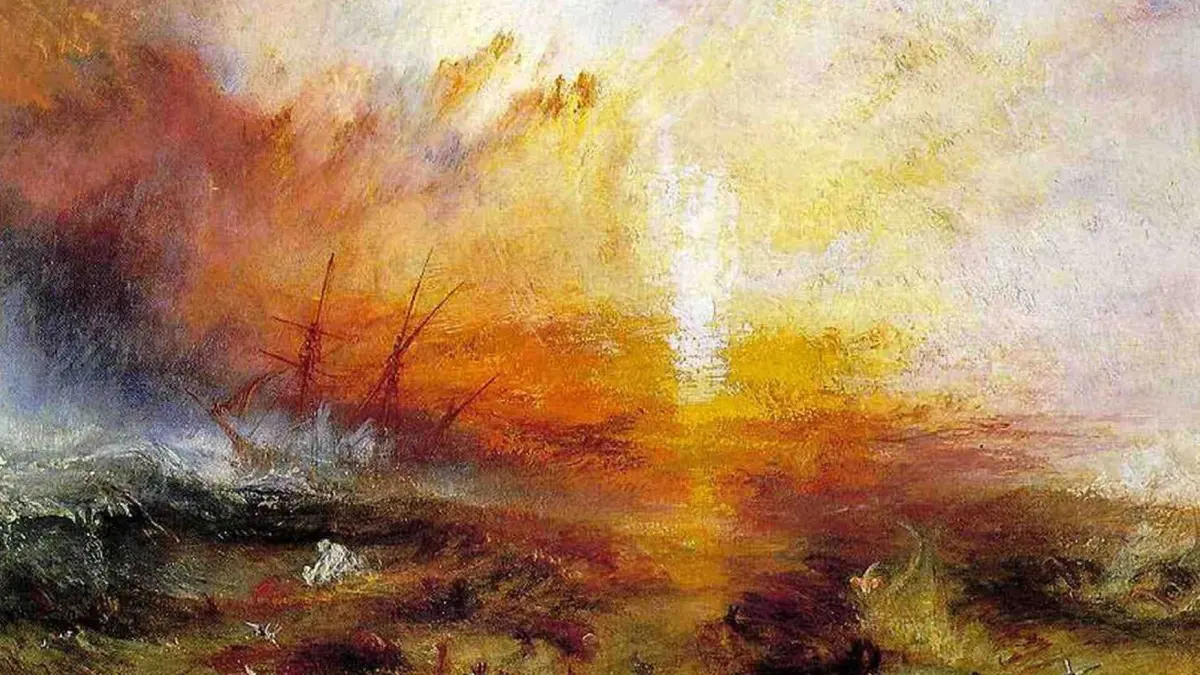
Works such as "The Slave Ship" (1840) demonstrate his ability to combine environmental grandeur with social commentary. In this painting, the turbulent, blood-red sunset mirrors the horrific events occurring at sea, forcing the viewer to confront both the beauty and the cruelty of the world. His technical approach to these scenes involved:
- Sketching directly from nature during storms to capture authentic motion.
- Applying thick impasto to represent the crests of waves.
- Using light-colored underpainting to make the water appear to glow from within.
How did he influence Impressionism?
Although Turner died in 1851, his influence on the Impressionist movement in France was profound. Artists like Claude Monet and Camille Pissarro studied Turner’s late works, which emphasized the fleeting effects of light over detailed form. By breaking down objects into color and light, Turner provided a blueprint for the Impressionists to capture "impressions" rather than static, photographic representations of reality.
Turner’s influence is visible in the way Impressionists handled the canvas. They adopted his practice of working outdoors and his interest in how atmospheric conditions—such as fog, steam, or sunset—alter the appearance of a subject. Key similarities include:
- The rejection of dark, muddy shadows in favor of colorful light.
- A preference for subjects that change rapidly, such as steam trains or harbor scenes.
- A shared belief that the artist's perception is more important than the literal subject matter.

Common mistakes when analyzing Turner’s work
When studying Turner, many beginners make the mistake of viewing his work as purely abstract or lacking in technical skill. It is a common misconception that his blurry, indistinct forms were the result of poor draftsmanship. In reality, Turner was a classically trained artist who excelled at precise, detailed architectural drawing early in his career. His later "blurriness" was a deliberate, sophisticated stylistic choice intended to evoke atmosphere rather than a lack of ability.
Another error is ignoring the industrial context of his era. Viewers often see his paintings as purely romantic nature scenes, overlooking his fascination with the Industrial Revolution. He was one of the first artists to depict the arrival of the machine age, often juxtaposing the raw power of nature with the man-made strength of steamships and locomotives. To understand Turner, one must look past the paint to the technological and societal shifts he was documenting.
Where can you see Turner’s paintings today?
The most significant collection of Turner’s work is held by the Tate Britain in London, which houses the Turner Bequest. This massive collection includes thousands of sketches, watercolors, and finished oil paintings that were left to the nation upon his death. Beyond the Tate, his work is displayed in major museums worldwide, including the National Gallery in London, the Metropolitan Museum of Art in New York, and the Getty Center in Los Angeles.
If you are planning to visit these collections, keep these tips in mind:
- Check museum websites for specific exhibition dates, as many of his fragile watercolors are rotated to prevent light damage.
- Look for the "Turner’s Modern World" series, which highlights his interest in technology.
- Use a magnifying glass or zoom in on digital archives to appreciate the intricate texture of his brushwork.
- Compare his early classical landscapes with his late, abstract works to see the full evolution of his artistic vision.
Key facts
- Joseph Mallord William Turner (1775–1851) was a prolific English Romantic painter known as "the painter of light."
- He produced over 550 oil paintings, 2,000 watercolors, and 30,000 works on paper during his career.
- His technique often involved applying thin glazes of paint over white grounds to create luminous, atmospheric effects.
- He bequeathed his entire personal collection of roughly 300 paintings and 30,000 sketches to the British nation.
- To study his work, visit the Clore Gallery at Tate Britain in London, which holds the largest collection of his art.
- When viewing his paintings, stand back to appreciate the overall atmospheric composition before inspecting his loose, expressive brushwork up close.
The bottom line
J.M.W. Turner revolutionized landscape painting by prioritizing emotional atmosphere and light over rigid realism. His transition from detailed topographical scenes to abstract, light-infused compositions paved the way for modern art. By donating his massive collection to the public, he ensured his legacy as Britain's greatest painter, leaving behind a profound body of work that continues to challenge how viewers perceive the natural world.
People also ask
Why is Turner considered a precursor to Impressionism?
Turner’s later works abandoned precise detail in favor of capturing the fleeting effects of light, color, and atmosphere. This radical departure from traditional realism influenced later French Impressionists like Claude Monet, who studied Turner’s techniques.
What was Turner’s relationship with the Royal Academy?
He was a child prodigy who entered the Royal Academy schools at age 14 and became its youngest member at 27. He remained deeply involved with the institution throughout his life, eventually serving as its Professor of Perspective.
How did Turner create his dramatic seascapes?
He spent significant time sketching outdoors in harsh weather conditions to observe the movement of waves and clouds. He famously claimed he had himself lashed to the mast of a ship to experience a snowstorm firsthand.
What is the significance of "The Fighting Temeraire"?
This 1839 painting depicts a historic warship being towed to its final berth to be broken up. It symbolizes the end of the age of sail and the rise of the industrial steam era.
Did Turner paint only landscapes?
While primarily a landscape and marine painter, he also produced historical, mythological, and architectural works. His travels across Europe provided him with a vast range of subjects, including Italian cities and Swiss mountains.
How can I identify a genuine Turner painting?
Authentic works are characterized by a unique "Turner glow," achieved through complex layering and light-filled palettes. Because of his immense output and influence, professional authentication by experts is required to distinguish his work from his many imitators.
This answer was created with the help of AI research tools and reference sources. Spotted an error? Let us know — we correct mistakes quickly. See our editorial policy.