What is design thinking?
Short answer
Design thinking is a human-centered, iterative methodology used to solve complex problems and foster innovation. By prioritizing empathy for the end user, it combines creative brainstorming with systematic testing to develop functional solutions. Organizations utilize this framework to align business goals with user needs, ensuring that products are both desirable and viable.
On this page
What are the stages of design thinking?
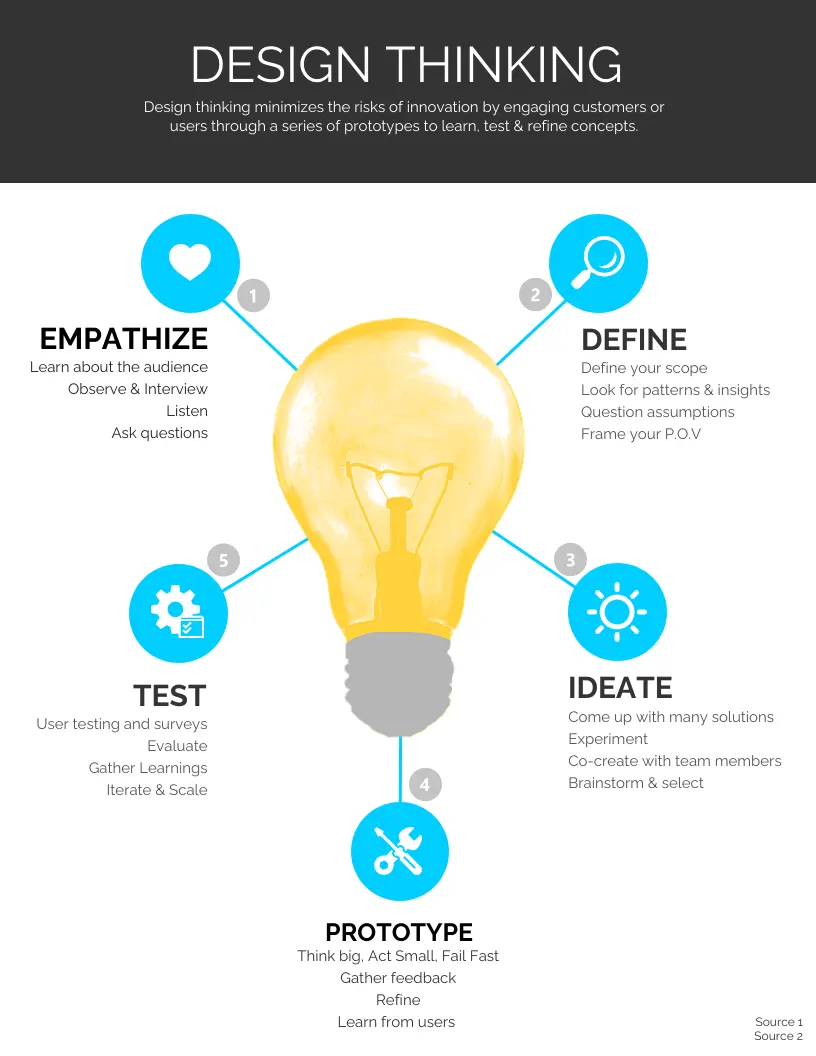
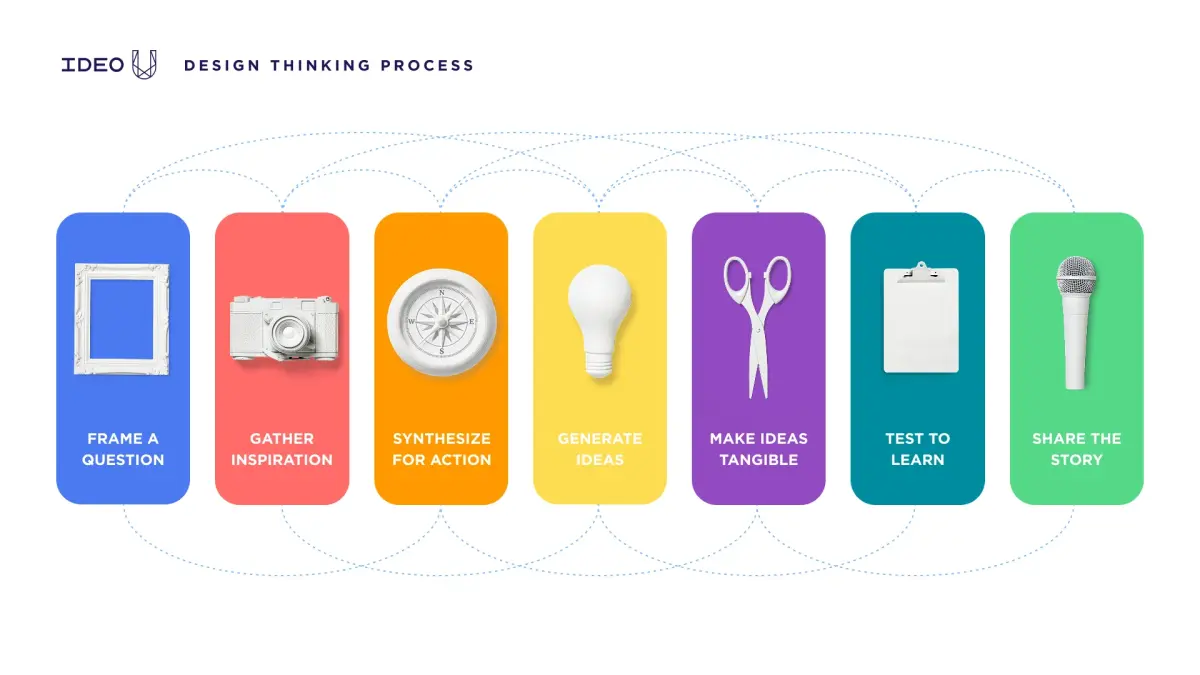
The design thinking process typically follows five distinct phases, popularized by the Hasso Plattner Institute of Design at Stanford, also known as the d.school. These stages provide a structured path for teams to move from ambiguity to a concrete solution. While the process is presented linearly, practitioners often jump between stages as new information surfaces.
- Empathize: Conduct research to understand the user’s needs, motivations, and pain points through observation and interviews.
- Define: Synthesize research findings to create a clear, actionable problem statement that focuses on the user.
- Ideate: Generate a wide range of creative ideas and potential solutions without immediate judgment or filtering.
- Prototype: Build scaled-down, inexpensive versions of the product to explore the ideas generated in the previous step.
- Test: Present prototypes to real users to gather feedback, identify flaws, and refine the solution for future iterations.
This framework is not a rigid set of rules but a flexible mindset. It encourages teams to remain open to failure, viewing it as a necessary step toward discovering the most effective solution.
How do you apply design thinking in business?
Businesses implement design thinking to reduce the risk of launching products that nobody wants. By involving users early in the development cycle, companies avoid costly investments in features that do not solve actual problems. This approach shifts the focus from purely technical specifications to the emotional and practical requirements of the customer.
To successfully apply this in a professional setting, organizations often form cross-functional teams comprising designers, engineers, and business strategists. This diversity ensures that the final product is technically feasible, economically viable, and human-centric. Common applications include:
- Redesigning customer service workflows to reduce friction.
- Developing new mobile applications based on specific user behavior patterns.
- Restructuring internal office environments to improve employee collaboration.
- Creating sustainable packaging solutions that meet consumer environmental values.
By centering the user, businesses foster stronger brand loyalty and discover unique market opportunities that competitors might overlook. It transforms the product development lifecycle from a guesswork-driven process into one based on evidence and empathy.
Why is empathy important in design thinking?
Empathy is the cornerstone of design thinking because it prevents designers from projecting their own biases onto the user. Without a deep understanding of the user’s lived experience, a product may be technically impressive but ultimately useless. Empathy requires active listening and the suspension of judgment to uncover unspoken needs that users might not even be able to articulate themselves.
Practitioners often use tools like empathy maps to categorize what a user says, thinks, does, and feels. This helps the team move beyond surface-level observations to identify underlying motivations. For instance, if a user complains about a slow interface, empathy might reveal that their frustration stems from a lack of confidence in using technology rather than just the speed of the software.
When a team truly empathizes with their audience, they gain a competitive advantage. They can design solutions that feel intuitive and supportive, creating a positive emotional connection. This human-centric focus is what distinguishes design thinking from traditional engineering or analytical approaches that prioritize efficiency over the user experience.
Common mistakes when using design thinking
One of the most frequent errors is rushing through the empathy phase to get to the "solution" stage. Teams often feel pressured to produce results quickly and skip the deep research required to understand the problem fully. This leads to building the wrong solution for a problem that was never properly defined. Another common mistake is failing to prototype early enough, resulting in "analysis paralysis" where teams spend too much time debating ideas instead of testing them.
To avoid these pitfalls, keep these guidelines in mind:
- Do not fall in love with your first idea; always generate multiple alternatives.
- Avoid treating the process as a one-time event; it is meant to be iterative.
- Do not ignore negative feedback during the testing phase; it is the most valuable data you can collect.
- Ensure that the problem statement remains focused on the user, not on internal company goals.
By maintaining a focus on the user and remaining willing to discard ineffective prototypes, teams can avoid the trap of sunk-cost bias. Success in design thinking is measured by how well you solve the user's problem, not by how clever your initial concept was.
Best tools for design thinking beginners
Beginners do not need expensive software to start practicing design thinking; simple tools are often the most effective. Sticky notes, whiteboards, and markers are the industry standard for brainstorming and mapping user journeys. These physical tools encourage collaboration and allow ideas to be rearranged easily. Digital whiteboarding tools have also become essential for remote teams, providing a shared space to organize thoughts and visualize complex systems in real-time.
For those just starting, focus on mastering these three techniques:
- User Personas: Create fictional characters that represent your target audience to keep the user at the center of discussions.
- Journey Mapping: Visualize the step-by-step experience a user has when interacting with a service or product.
- Rapid Prototyping: Use paper, cardboard, or simple digital wireframes to test concepts before investing in high-fidelity development.
As you become more comfortable with these methods, you can incorporate more sophisticated research techniques and design software. The goal is to keep the barrier to entry low so that the team can focus on creativity and problem-solving rather than technical hurdles. With consistent practice, these techniques become second nature, enabling teams to tackle increasingly complex challenges with confidence and clarity.
Key facts
- Design thinking is a human-centered methodology for innovation that integrates the needs of people, the possibilities of technology, and the requirements for business success.
- The process was popularized by David Kelley and Tim Brown of the design firm IDEO and Stanford University’s Hasso Plattner Institute of Design (the d.school).
- It follows five non-linear stages: Empathize, Define, Ideate, Prototype, and Test.
- A core principle is "bias toward action," which encourages building low-fidelity prototypes early to learn from failure rather than waiting for a perfect solution.
- Successful design thinking requires a multidisciplinary team to ensure diverse perspectives are considered throughout the problem-solving process.
- Common mistakes include skipping the empathy phase, focusing on the solution before understanding the user, and failing to iterate based on test feedback.
The bottom line
Design thinking is a powerful, human-centered approach to solving complex problems by prioritizing empathy and rapid experimentation. By observing users, defining their core challenges, and iteratively testing simple prototypes, organizations can create solutions that are truly meaningful and effective. The primary takeaway is that innovation is not a sudden spark of genius but a disciplined, repeatable process of learning through constant engagement with real people.
People also ask
How does design thinking differ from traditional problem-solving?
Traditional methods often start with a defined problem and seek a logical solution, whereas design thinking begins by deeply observing user behavior to identify the actual root problem. It prioritizes empathy and iterative experimentation over linear planning.
Can design thinking be applied outside of the creative industries?
Yes, it is widely used in healthcare, education, government, and corporate management to improve services and internal workflows. Any field that requires understanding human behavior to improve an experience can benefit from this framework.
What is the most important stage in the design thinking process?
The Empathize stage is generally considered the most critical because it provides the foundational insights necessary for all subsequent steps. Without a deep understanding of the user's needs, the resulting solution may be technically sound but ultimately irrelevant to the audience.
How long does a typical design thinking project take?
The duration varies significantly based on the complexity of the problem, ranging from a few hours for a "design sprint" to several months for large-scale organizational changes. The framework is designed to be flexible and adaptable to the specific constraints of the project.
What is a low-fidelity prototype?
A low-fidelity prototype is a simple, inexpensive version of a product or service, such as a paper sketch or a cardboard model. Its purpose is to test core concepts and gather user feedback quickly without investing significant time or money into development.
Is design thinking a linear process?
No, it is highly iterative and non-linear, meaning teams often move back and forth between stages. For example, testing a prototype might reveal a new user need that requires returning to the Empathize or Ideate phases.
This answer was created with the help of AI research tools and reference sources. Spotted an error? Let us know — we correct mistakes quickly. See our editorial policy.