What is an altarpiece?
Short answer
An altarpiece is a work of art, such as a painting, sculpture, or relief, designed to be placed above or behind an altar in a Christian church. These devotional objects serve as visual aids for worship, often depicting scenes from the life of Christ, the Virgin Mary, or various saints and biblical narratives.
On this page
What is the history of altarpieces?
The tradition of the altarpiece emerged during the early Middle Ages as church liturgy became more complex. Initially, relics were kept beneath the altar, but as the focus shifted toward the Eucharist, the area behind the altar became a focal point for artistic expression. By the 12th and 13th centuries, these works evolved from simple crosses into elaborate painted panels or carved wooden structures.
During the Renaissance, altarpieces reached their peak of technical sophistication and artistic ambition. Master artists like Jan van Eyck, Leonardo da Vinci, and Titian were commissioned by wealthy patrons and religious institutions to create monumental works. These pieces often utilized complex iconography to communicate theological concepts to illiterate congregations. As the Protestant Reformation took hold in the 16th century, the role of the altarpiece was challenged, leading to shifts in style and subject matter that reflected changing religious doctrines across Europe.
How are altarpieces structured?
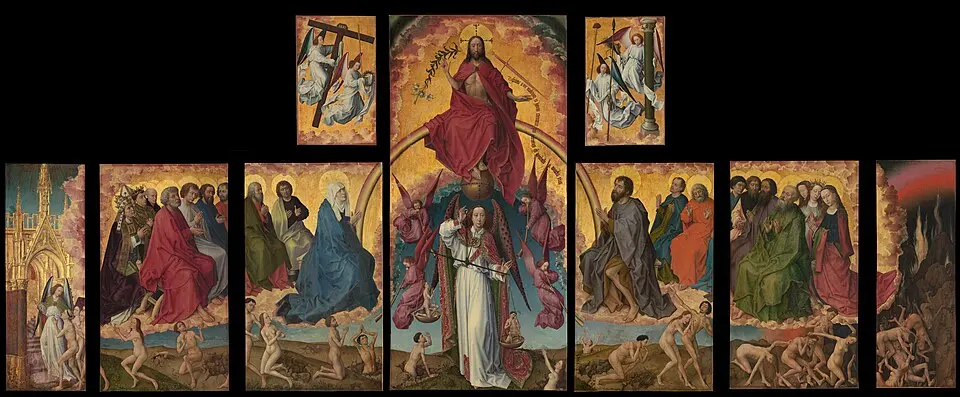
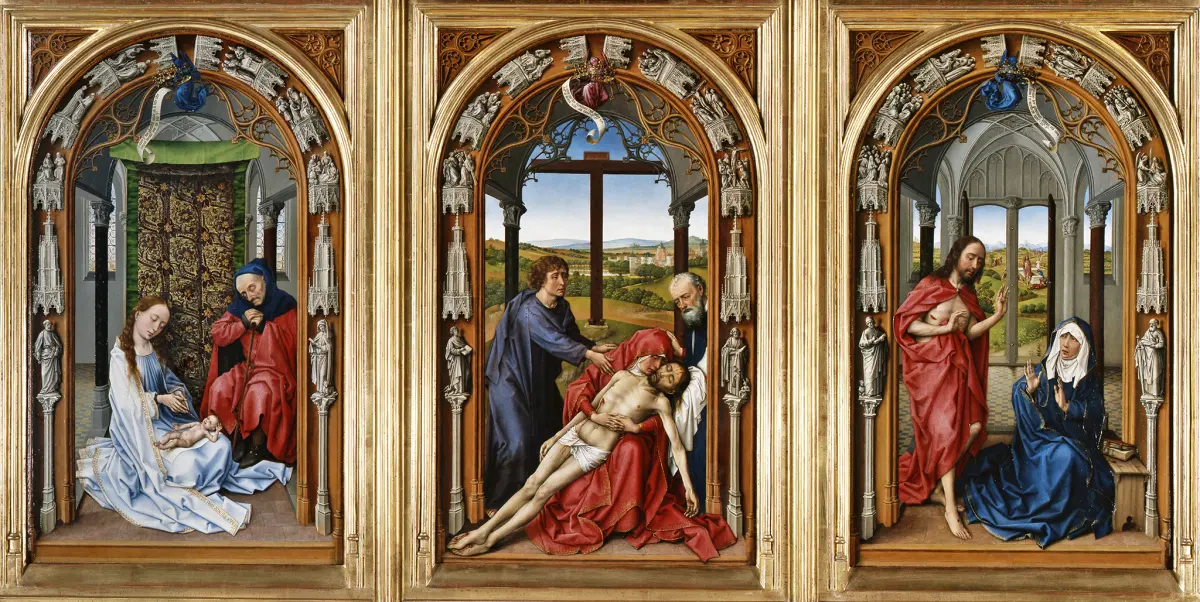
Altarpieces vary significantly in their physical configuration, ranging from single panels to massive, multi-hinged constructions. The most common forms include the diptych, triptych, and polyptych, which allow the artwork to be opened or closed depending on the liturgical calendar. These structures often feature a central panel, side wings, and a base known as a predella.
Common structural types include:
- Diptych: Two hinged panels that fold together like a book.
- Triptych: A central panel flanked by two smaller, folding side wings.
- Polyptych: A complex arrangement consisting of four or more panels.
- Predella: A decorative horizontal base panel often featuring smaller narrative scenes.
The use of wings allowed artists to present different imagery for daily use versus feast days. When closed, the exterior might be painted in monochrome or feature less significant figures, while opening the piece revealed a vibrant, gilded, or highly detailed interior scene meant for major religious celebrations.
What materials were used to make them?
Artists utilized a wide array of materials to ensure their work was both durable and visually striking. In Northern Europe, wood—specifically oak or linden—was the preferred medium for carved and painted panels. In Italy, artists more frequently painted on poplar wood panels, which were often prepared with a layer of gesso to create a smooth surface for tempera or oil paints.
The production process typically followed these steps:
- Selecting and seasoning high-quality timber to prevent warping.
- Applying a ground of gesso (a mixture of glue and gypsum) to the panel.
- Incising the preliminary design into the surface or using a charcoal sketch.
- Applying gold leaf for halos or backgrounds to reflect candlelight.
- Painting the final image using pigments mixed with egg yolk or oil binders.
The inclusion of gold leaf was not merely decorative; it served to signify the divine nature of the subjects. The reflective quality of the gold also helped the artwork glow under the dim, flickering light of church candles, enhancing the spiritual experience of the viewer.
How to identify an altarpiece?
Identifying an altarpiece requires looking for specific visual cues and spatial context within a church. Most authentic examples are positioned directly on or immediately behind the altar table. They often feature a "sacra conversazione" composition, where the Virgin Mary and the Christ Child are surrounded by various saints who appear to be in a shared, unified space.
Key identifying features include:
- Hierarchical scaling, where the most important figures are depicted larger than others.
- The presence of specific attributes, such as keys for Saint Peter or a wheel for Saint Catherine.
- A predella at the bottom containing scenes from the lives of the saints depicted above.
- A frame that is often architectural in design, mimicking the style of the church building itself.
If you are viewing a piece in a museum, look for information regarding its original provenance. Many altarpieces were dismantled over the centuries, with individual panels being sold off or moved to private collections, which can make it difficult to visualize the original, complete structure.
Common mistakes when studying altarpieces
One common error is viewing these works solely as aesthetic objects rather than functional liturgical tools. It is important to remember that they were designed to be viewed from a specific distance and angle, often in low light. Ignoring the original intended environment can lead to misunderstandings about the artist's use of color, perspective, and scale, which were calibrated for the church interior.
Another mistake is assuming that all panels in a polyptych were painted by the same hand. In many large workshops, master artists would design the composition while apprentices executed the background details or the less prominent figures. Additionally, viewers often overlook the importance of the predella, assuming it is merely a decorative footer. In reality, the predella often contains the most intimate and narrative-driven scenes of the entire work, providing essential context for the larger, more iconic images depicted in the main register above. Finally, avoid judging the work by modern lighting standards, as the original intent was for the art to interact with the natural and artificial light of the sacred space.
Key facts
- An altarpiece is a work of art, such as a painting, sculpture, or relief, placed above and behind an altar in a Christian church.
- The earliest altarpieces emerged in the 11th century, evolving from simple reliquaries to complex, multi-paneled structures known as polyptychs.
- They serve both a liturgical function, focusing the congregation's attention during the Mass, and a didactic one, illustrating biblical narratives for the faithful.
- A common mistake is confusing a reredos—a large, often stone screen covering the entire wall behind the altar—with an altarpiece, which is typically a smaller, portable unit.
- When viewing an altarpiece, look for the "predella," the small horizontal panels at the base that often depict scenes from the lives of saints.
- To identify the era of an altarpiece, check for the presence of gold leaf, which was standard in the Middle Ages to symbolize divine light.
The bottom line
An altarpiece is a significant devotional object that bridges the gap between theology and visual storytelling. By organizing narrative scenes into panels, these works guided worshippers through complex religious histories. Whether standing in a historic cathedral or a gallery, these pieces remain vital artifacts of European art history, reflecting the intersection of faith, artistic innovation, and the socio-economic influence of their original patrons.
People also ask
What is the difference between a diptych, triptych, and polyptych?
These terms refer to the number of panels in the altarpiece. A diptych has two panels, a triptych has three, and a polyptych consists of four or more panels, often hinged to fold.
Why were many altarpieces designed to fold shut?
Folding panels allowed the church to change the artwork based on the liturgical calendar. The elaborate interior images were often reserved for feast days, while the exterior might feature simpler, somber decorations.
Who commissioned these expensive works of art?
Altarpieces were typically commissioned by wealthy patrons, religious guilds, or the church hierarchy. Donors often included their own portraits within the painting to demonstrate their piety and social status.
What materials were used to create historical altarpieces?
Artists primarily used oil or tempera paint on wood panels, though carved altarpieces made of wood or stone were also common. Some featured intricate gilding with gold leaf or inserts of precious stones.
Did the Protestant Reformation affect the production of altarpieces?
Yes, the Reformation led to widespread iconoclasm in many parts of Europe, where altarpieces were destroyed or removed because they were viewed as objects of idolatry. This shifted the focus of religious art toward simpler, text-based displays.
Can you still see original altarpieces in their intended locations?
While many have been moved to museums for preservation, some remain in their original churches. It is essential to respect local customs and photography restrictions when visiting these active places of worship.
This answer was created with the help of AI research tools and reference sources. Spotted an error? Let us know — we correct mistakes quickly. See our editorial policy.