What is a solar eclipse?
Short answer
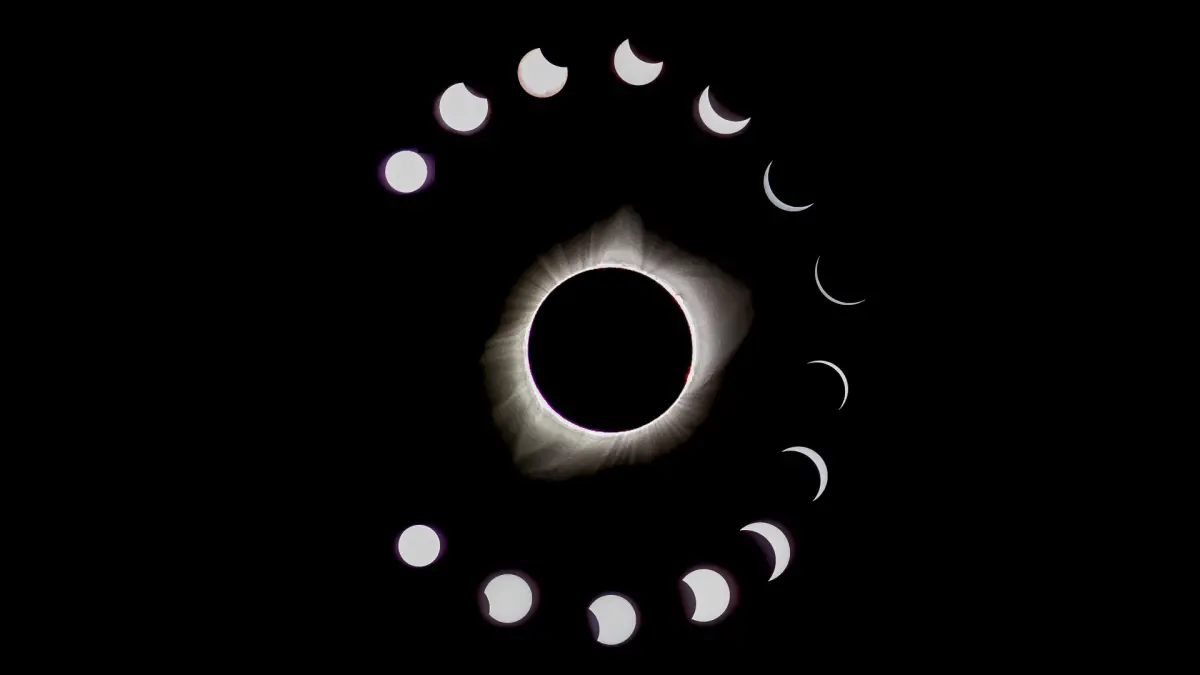
A solar eclipse occurs when the Moon passes directly between the Sun and Earth, casting a shadow on our planet. This celestial alignment temporarily blocks the Sun's light, either partially or entirely. It happens only during a new moon phase when the orbital paths of the Sun, Moon, and Earth perfectly intersect.
On this page
Why a solar eclipse happens
A solar eclipse is a result of precise orbital mechanics. While the Moon orbits Earth every 27.3 days, its path is tilted about five degrees relative to Earth's orbit around the Sun. Because of this tilt, the Moon usually passes above or below the Sun from our perspective. An eclipse occurs only when the Moon crosses the ecliptic plane—the path the Sun appears to take across the sky—at the same time it is in the new moon phase.
The phenomenon relies on a remarkable cosmic coincidence. The Sun is approximately 400 times larger than the Moon, but it is also about 400 times farther away. This scale makes them appear almost identical in size in our sky. When the alignment is perfect, the Moon can cover the Sun's bright disk, revealing the solar corona, which is the Sun's faint outer atmosphere.
Types of solar eclipses
There are four distinct ways the Moon can obscure the Sun, depending on the alignment and distance of the celestial bodies. The visibility of these events depends heavily on your geographic location on Earth.
- Total solar eclipse: The Moon completely obscures the Sun, allowing observers to see the corona.
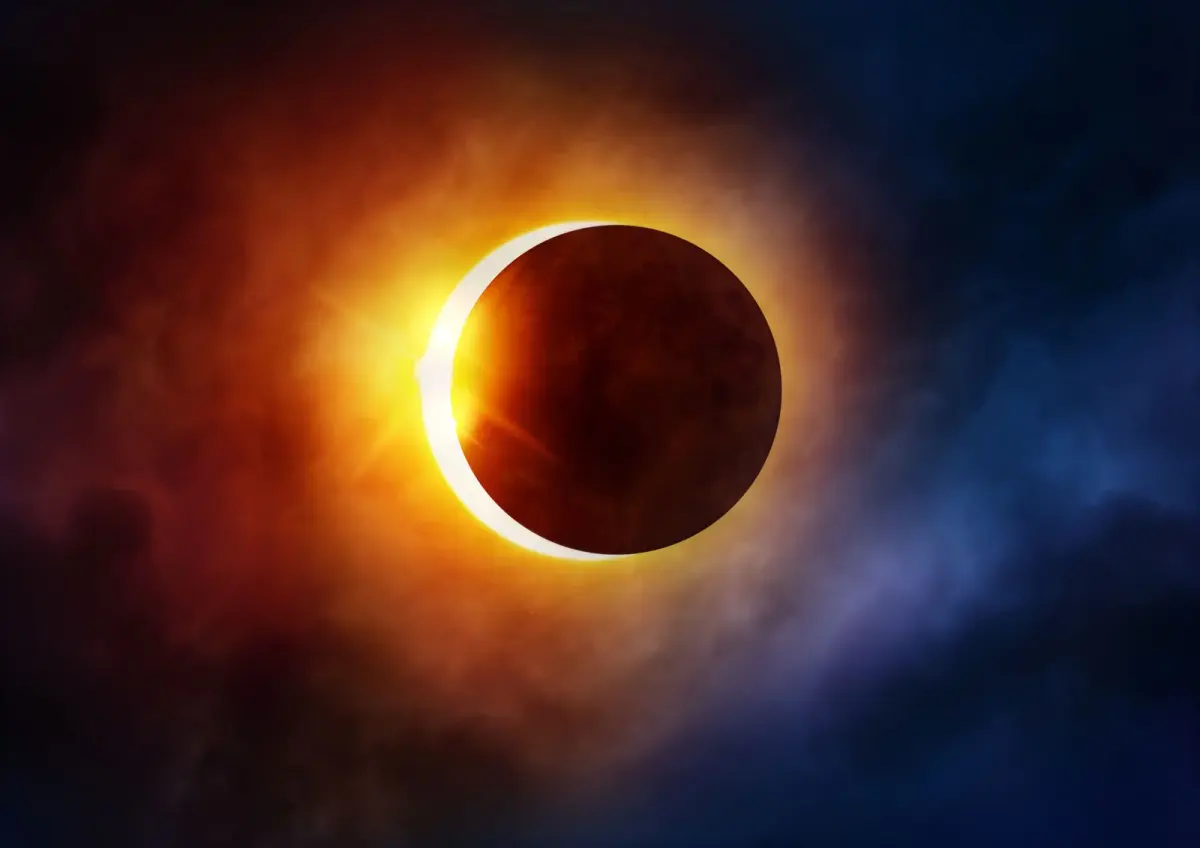
- Annular solar eclipse: The Moon is too far from Earth to cover the Sun fully, leaving a "ring of fire" visible.
- Partial solar eclipse: The Moon covers only a portion of the Sun, creating a crescent shape.
- Hybrid solar eclipse: A rare event where the eclipse shifts between total and annular as the Moon's shadow moves across Earth's curved surface.
The type of eclipse you experience depends on whether you are standing in the umbra, the darkest part of the shadow, or the penumbra, the lighter outer shadow.
How long does a solar eclipse last
The duration of a solar eclipse varies significantly based on the observer's position and the orbital distance of the Moon. A total solar eclipse is fleeting, with the period of "totality"—when the Sun is fully blocked—rarely lasting more than seven and a half minutes. Most total eclipses last between two and four minutes, as the Moon's shadow moves across Earth's surface at speeds exceeding 1,000 miles per hour.
The entire event, from the moment the Moon first touches the edge of the Sun until it leaves the opposite side, can last several hours. This process includes the partial phases before and after totality. Because the Moon's shadow is relatively narrow, the path of totality is often only about 100 miles wide. If you are outside this path, you will see only a partial eclipse, which lasts longer but lacks the dramatic darkness and corona visibility of a total event.
Best safety practices for viewing
Observing a solar eclipse requires strict adherence to safety protocols to prevent permanent eye damage. Looking directly at the Sun, even when it is partially covered, can cause solar retinopathy, where intense light burns the retinal tissue. Never look at the Sun through binoculars, telescopes, or camera lenses without a professional-grade solar filter attached to the front of the device.
- Purchase ISO 12312-2 certified solar eclipse glasses from a reputable vendor.
- Inspect your glasses for scratches, punctures, or tears before use; if damaged, discard them immediately.
- Put on your glasses while looking away from the Sun, then turn to view the event.
- Remove your glasses only after looking away from the Sun again.
- Use a pinhole projector as a safe, indirect way to view the eclipse by projecting the Sun's image onto a piece of paper or the ground.
Common mistakes when watching an eclipse
One of the most frequent errors is assuming that regular sunglasses provide adequate protection. Standard sunglasses, even those with high UV protection, are insufficient to block the concentrated infrared and ultraviolet radiation emitted by the Sun during an eclipse. Using homemade filters, smoked glass, or exposed film negatives is also extremely dangerous and should be avoided at all costs.
Another mistake is failing to prepare for the sudden drop in temperature and light levels. During a total eclipse, the environment changes rapidly, and many observers become so distracted by the visual spectacle that they miss the subtle environmental shifts. Additionally, many people wait until the last minute to secure viewing equipment. Because demand spikes during major eclipse events, reliable solar glasses often sell out weeks in advance. Planning your travel and equipment needs well ahead of time ensures you can enjoy the experience without the stress of last-minute logistics or unsafe viewing methods.
Key facts
- A solar eclipse occurs when the Moon passes directly between the Earth and the Sun, casting a shadow on our planet.
- Total solar eclipses are only visible from a narrow path on Earth called the "path of totality," which is typically about 100 miles wide.
- You must never look directly at the Sun without ISO 12312-2 certified eclipse glasses, as permanent eye damage can occur in seconds.
- The Moon appears to be the same size as the Sun in our sky because, although the Sun is 400 times larger, it is also 400 times farther away.
- During a total eclipse, the temperature can drop significantly, birds may stop singing, and the sky darkens enough to see bright stars and planets.
- A solar eclipse can only happen during a new moon phase when the orbital planes of the Earth and Moon align.
The bottom line
A solar eclipse is a remarkable celestial alignment where the Moon temporarily obscures the Sun, casting a shadow across Earth. While witnessing totality is a rare and awe-inspiring experience, safety remains the highest priority for observers. By utilizing certified protective eyewear and following proper viewing protocols, you can safely enjoy this natural phenomenon, which serves as a powerful reminder of the precise mechanics governing our solar system.
People also ask
How long does a solar eclipse last?
While the entire process of the Moon moving across the Sun can take several hours, the period of "totality"—when the Sun is completely blocked—usually lasts only a few minutes.
What is the difference between a total and an annular eclipse?
A total eclipse happens when the Moon completely covers the Sun, whereas an annular eclipse occurs when the Moon is too far from Earth to cover the Sun entirely, leaving a bright "ring of fire" visible.
Can I use sunglasses to view an eclipse?
No, standard sunglasses do not provide sufficient protection against solar radiation. You must use specialized solar filters or eclipse glasses that meet international safety standards.
How often do solar eclipses occur?
Solar eclipses happen somewhere on Earth at least twice a year, but a total eclipse is a rare event for any specific location, occurring on average once every 375 years.
What happens to the environment during an eclipse?
As the Sun is obscured, the sudden loss of light causes temperatures to drop, winds may shift, and nocturnal animals often begin their evening routines, thinking night has arrived.
Is it safe to take a photo of an eclipse with a smartphone?
You should not point a phone camera directly at the Sun without a proper solar filter over the lens, as the concentrated light can permanently damage the phone's sensor.
This answer was created with the help of AI research tools and reference sources. Spotted an error? Let us know — we correct mistakes quickly. See our editorial policy.