What is a red giant?
Short answer
A red giant is a luminous, aging star that has exhausted the hydrogen fuel in its core. As the core contracts and heats up, the outer layers expand significantly and cool down, causing the star to appear reddish. These massive celestial objects represent a late stage in the evolution of stars like our Sun.
On this page
Why a star becomes a red giant
A star spends the vast majority of its life on the "main sequence," where it steadily fuses hydrogen into helium within its core. This process creates an outward pressure that perfectly balances the inward pull of gravity. Once the hydrogen in the core is depleted, this delicate equilibrium is disrupted, and the star begins its transformation.
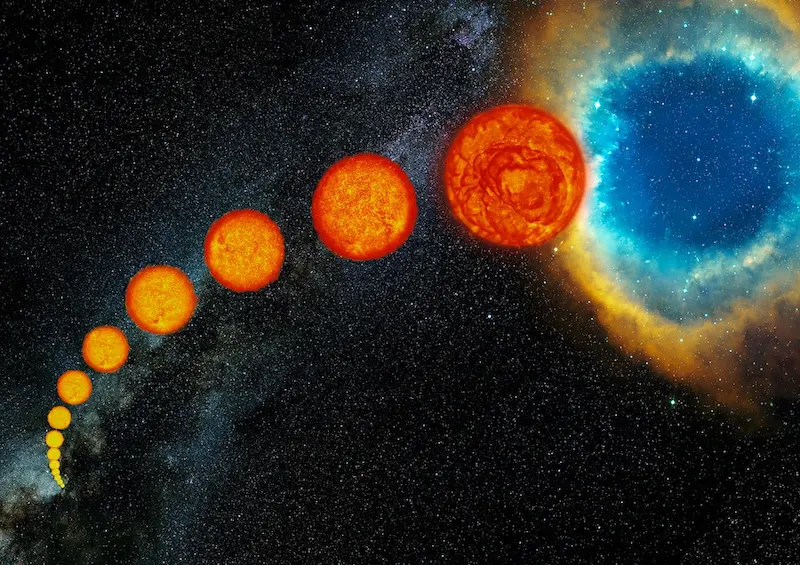
Without hydrogen fusion to support it, the core collapses under its own weight, becoming denser and hotter. This intense heat causes a shell of hydrogen surrounding the core to begin fusing, which releases vast amounts of energy. The outer layers of the star absorb this energy, causing them to expand outward to many times their original size. As these layers move further from the core, they cool down, shifting the star’s light toward the red end of the spectrum.
- The star grows to 100 to 1,000 times its original radius.
- Surface temperatures drop to between 3,000 and 4,000 Kelvin.
- Luminosity increases dramatically due to the massive surface area.
How long does the red giant phase last
The red giant stage is a relatively short chapter in the life of a star compared to its main sequence lifespan. For a star like the Sun, which lives for about 10 billion years, the red giant phase lasts only a few hundred million years. This period is characterized by rapid internal changes as the star prepares for its final evolutionary stages.
During this time, the star undergoes several distinct phases of internal burning. Once the core temperature becomes high enough, it begins fusing helium into carbon and oxygen, a process known as the helium flash in lower-mass stars. This provides a temporary reprieve from collapse, stabilizing the star for a short duration. Eventually, the helium is also exhausted, and the star becomes unstable, shedding its outer layers into space.
- Hydrogen shell burning begins, causing initial expansion.
- Helium core ignition stabilizes the star temporarily.
- Helium depletion leads to final instability and mass loss.
What happens to the solar system
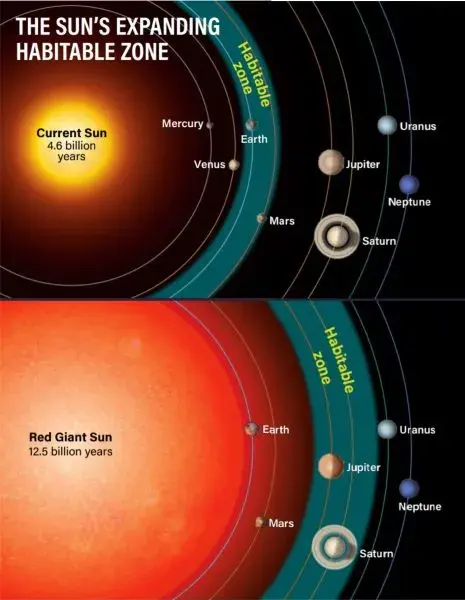
When our Sun eventually becomes a red giant in about five billion years, the consequences for the inner solar system will be catastrophic. As the Sun expands, its radius will extend past the orbits of Mercury and Venus, likely engulfing them entirely. Earth will face extreme heat, causing its oceans to boil away and its atmosphere to be stripped into space.
Even if Earth is not physically swallowed by the Sun's outer envelope, the planet will become completely uninhabitable long before the expansion is complete. The increased solar luminosity will cause the habitable zone to shift outward toward the outer planets. Moons of gas giants, such as Europa or Enceladus, might temporarily thaw, though they will not remain hospitable for long. The solar system will be permanently transformed into a graveyard of scorched inner rocks and drifting gas clouds.
How to identify a red giant
Amateur astronomers can easily spot red giants in the night sky using basic equipment or even the naked eye. These stars are among the brightest in the sky because their immense size makes them highly luminous. Their distinct orange or reddish hue is often visible without magnification, providing a stark contrast to the blue-white light of younger main sequence stars.
To identify these stars, look for bright, steady points of light that exhibit a clear color difference from their neighbors. Famous examples include Aldebaran in the constellation Taurus and Arcturus in Boötes. Using binoculars or a small telescope will enhance the color perception, allowing you to distinguish the deep red hues more clearly. Comparing these targets to nearby stars like Vega or Sirius helps confirm the unique spectral signature of an aging giant.
Common mistakes when studying stars
One common mistake is assuming that all red stars are red giants. Many small, cool stars called red dwarfs are also red, but they are much smaller and dimmer than giants. Red dwarfs are the most common type of star in the universe and are currently in their main sequence phase, burning hydrogen very slowly. Confusing these two types can lead to significant errors in understanding stellar evolution and galactic history.
Another frequent error is believing that all stars end their lives as red giants. Only stars with a mass similar to or slightly larger than the Sun go through this specific expansion process. Much more massive stars become red supergiants, while very small stars bypass the giant phase entirely. Always check the mass and current evolutionary stage of a star before drawing conclusions about its future or its classification within the Hertzsprung-Russell diagram.
Key facts
- A red giant is a luminous, evolved star that has exhausted the hydrogen fuel in its core.
- These stars expand to sizes 100 to 1,000 times larger than the Sun as they cool and redden.
- Our Sun will become a red giant in approximately 5 billion years, eventually engulfing Mercury, Venus, and possibly Earth.
- Despite their massive size, red giants are relatively cool, with surface temperatures typically between 3,000 and 4,000 Kelvin.
- Astronomers identify them on the Hertzsprung-Russell diagram as stars that have moved off the main sequence toward the upper right.
- To observe one, look for the reddish star Aldebaran in the constellation Taurus or Betelgeuse in Orion.
The bottom line
A red giant represents the dramatic twilight of a star’s life, occurring after it depletes its core hydrogen. By expanding into a massive, cool, and luminous sphere, the star undergoes a fundamental transformation that reshapes its surrounding solar system. Understanding this process provides essential insight into the life cycles of stars and offers a sobering preview of the long-term future of our own Sun and Earth.
People also ask
Do all stars become red giants?
No, only stars with a mass similar to or slightly larger than the Sun evolve into red giants. Very massive stars become supergiants, while very small red dwarfs do not expand into giants at all.
How long does the red giant phase last?
This phase usually lasts for a few hundred million years, which is a relatively short period in the total lifespan of a star. Once the star exhausts its helium, it sheds its outer layers to become a white dwarf.
Are red giants hotter than the Sun?
No, red giants are significantly cooler than the Sun. Their distinctive red color is a direct result of their lower surface temperatures compared to the yellow-white light of main-sequence stars.
Can we see red giants with the naked eye?
Yes, many of the brightest stars in the night sky are red giants or supergiants. Because of their immense size and high luminosity, they are easily visible even without a telescope.
What happens to the planets orbiting a red giant?
As a star expands into a red giant, it consumes nearby planets. Any remaining outer planets would likely experience extreme temperature increases and lose their atmospheres due to the intense stellar wind.
Why do red giants turn red?
As the star expands, its outer layers move further from the core and cool down. This cooling shifts the peak of the star's light emission toward the red end of the visible spectrum.
This answer was created with the help of AI research tools and reference sources. Spotted an error? Let us know — we correct mistakes quickly. See our editorial policy.