How do you draw a Ferris wheel?
Short answer
Drawing a Ferris wheel requires constructing a perfect circle supported by a sturdy, triangular base. You achieve this by establishing a central axis, radiating spokes outward, and attaching uniform passenger cabins. By maintaining geometric symmetry and consistent spacing, you create a realistic representation of this iconic amusement park structure.
On this page
How to sketch the basic structure
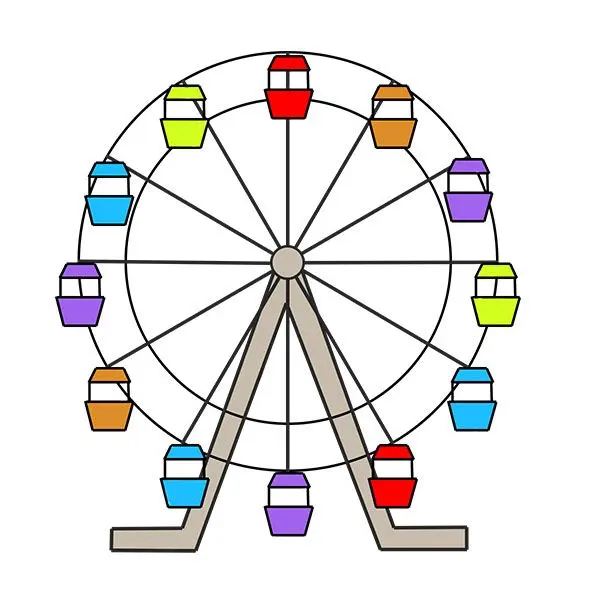
The foundation of a Ferris wheel is its circular frame. Begin by drawing a large circle using a compass or a circular object to ensure perfect symmetry. Mark the exact center point, as this serves as the anchor for all structural elements. From this center, draw a series of straight lines extending to the edge of the circle, acting as the primary spokes.
To add depth, draw a second, smaller circle inside the first one to represent the inner hub. Connect the spokes to this inner ring rather than just the center point. This creates a realistic axle assembly. Ensure your lines are light at this stage, as you will need to erase overlapping marks once the passenger cars are positioned.
- Use a compass to draw an outer circle with a radius of at least four inches.
- Place a small dot in the center to designate the axle.
- Draw eight to twelve evenly spaced lines radiating from the center to the outer rim.
- Add a smaller concentric circle around the center point to define the hub.
How to design the support base
A Ferris wheel cannot float; it requires a robust support system. The most common design involves two large A-frame structures positioned on either side of the wheel. Draw two triangles that meet at the center point of your wheel, extending downward to the ground. These legs should be thick and sturdy to suggest the weight of the steel construction.
Cross-bracing is essential for structural realism. Draw a series of small, diagonal lines between the two main legs of the A-frame. This creates a lattice pattern that mimics real-world engineering. Ensure the base of these legs is wider than the top to provide visual stability. If the legs are too narrow, the structure will appear top-heavy and unrealistic.
- Use a ruler to ensure your support legs are perfectly straight.
- Add horizontal bars connecting the two A-frames for extra stability.
- Keep the base wider than the wheel's diameter to suggest a solid foundation.
- Draw the ground line slightly below the base to anchor the structure in space.
How to draw the passenger cabins
Passenger cabins are the most recognizable feature of a Ferris wheel. These should be drawn as small, uniform rectangles or rounded capsules hanging from the outer rim. It is vital that every cabin hangs vertically, regardless of its position on the wheel. Use a small vertical line to represent the pivot point where the cabin attaches to the rim.
Consistency is the key to a professional look. If you decide on twelve cabins, ensure they are placed at the end of each spoke. If you draw them between the spokes, maintain equal distance between every cabin. Avoid tilting the cabins; they should always appear to be pulled downward by gravity. This detail is what separates a amateur sketch from a technically accurate drawing.
- Draw a small circle or square at the end of each spoke.
- Add a tiny vertical line connecting the cabin to the rim.
- Ensure each cabin is the exact same size and shape.
- Check that every cabin hangs straight down toward the bottom of the page.
Common mistakes when drawing Ferris wheels
The most frequent error is failing to maintain geometric symmetry. When the spokes are unevenly spaced, the wheel looks warped or broken. Always use a protractor if you are struggling to space the lines by eye. A wheel with twelve spokes should have exactly thirty degrees between each line. If the spacing is off, the entire structure loses its circular integrity.
Another common mistake is neglecting the perspective of the axle. Beginners often draw the supports as if they are attached to the front of the wheel, rather than behind it. Remember that the wheel rotates between the two support legs. You should erase the parts of the support legs that would be hidden behind the wheel's rim to create a sense of depth and spatial accuracy.
- Do not draw the spokes at irregular angles.
- Avoid making the support legs look like simple sticks; add thickness to show steel beams.
- Do not forget to erase the lines of the support structure that pass through the wheel.
- Ensure the center hub is clearly defined to show where the rotation occurs.
Best techniques for adding detail
Once the structure is complete, you can add texture to make the drawing look like industrial steel. Use cross-hatching or small dots to add shading to the legs and the hub. This creates a metallic sheen. You can also draw thin cables connecting the cabins to one another, which is a feature found on many vintage Ferris wheel models to prevent excessive swaying.
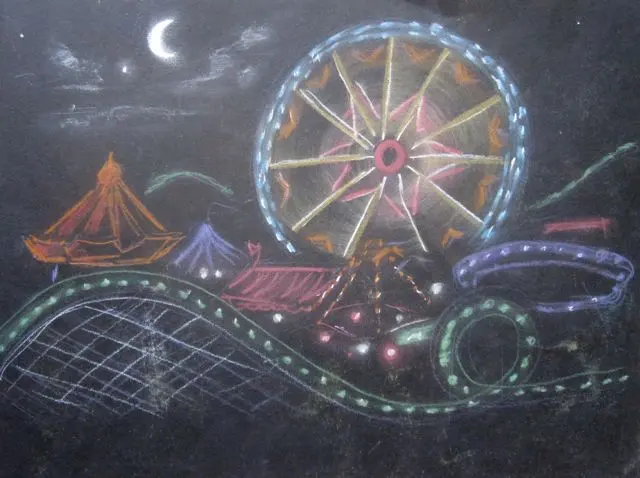
Finally, consider the background. Adding a horizon line or a few clouds can help ground the structure. If you want to depict the wheel at night, use a darker pencil to shade the interior and add small, bright circles along the rim to represent light bulbs. This simple addition transforms a basic structural drawing into a lively, atmospheric scene of an amusement park at night. The key is to keep the lines clean and the proportions consistent throughout the entire process.
Key facts
- Start by drawing a large, perfect circle to serve as the main wheel, using a compass or a circular object for precision.
- Divide the circle into equal segments using light pencil lines to ensure the passenger cars are spaced symmetrically.
- Draw the central hub as a smaller circle in the middle, connecting it to the outer rim with straight lines representing the spokes.
- Place the passenger cars at the ends of the spokes, ensuring they remain oriented vertically so they appear to hang correctly.
- Add a sturdy triangular or A-frame support structure beneath the wheel to provide a realistic base.
- Avoid drawing too many spokes, as this can clutter the design; 8 to 16 spokes are usually sufficient for a clean look.
The bottom line
Drawing a Ferris wheel requires a balance of geometric precision and structural logic. By starting with a centered, circular framework and systematically adding spokes and suspended cars, you create a believable mechanical object. Remember that symmetry is the most vital element; take your time with the initial layout to ensure the final result looks stable, functional, and aesthetically pleasing to the viewer's eye.
People also ask
What is the most important part of a Ferris wheel's structure?
The central hub and the support towers are the most critical components. Without a strong, centered axle and stable base, the wheel would not appear structurally sound or functional.
How do you make the passenger cars look realistic?
Draw them as small rectangles or rounded boxes suspended from the outer rim. Always ensure the bottom of the car is parallel to the ground to mimic gravity's effect.
Should I use a ruler for the spokes?
Yes, using a ruler is essential for drawing the spokes. If the lines are not perfectly straight or centered, the wheel will look lopsided and distorted.
How do I draw the wheel's perspective?
To add depth, draw two identical circles slightly offset from each other and connect them with diagonal lines. This creates the appearance of a three-dimensional structure rather than a flat disc.
What is a common mistake when drawing the support frame?
A common error is making the base too narrow. A Ferris wheel requires a wide, heavy-duty foundation to support its height and the weight of the passenger cars.
Can I add detail to the spokes?
You can add cross-bracing by drawing small "X" patterns between the main spokes. This adds a technical, industrial aesthetic that makes the drawing look more like a real engineering project.
This answer was created with the help of AI research tools and reference sources. Spotted an error? Let us know — we correct mistakes quickly. See our editorial policy.