How do you draw a chimpanzee step by step?
Short answer
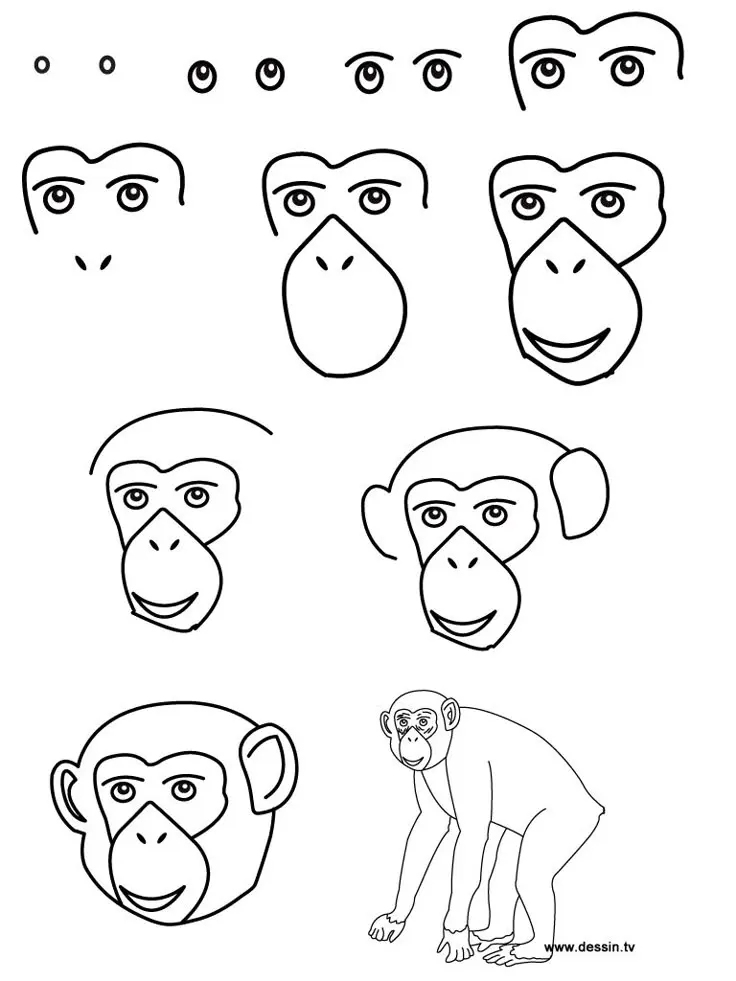
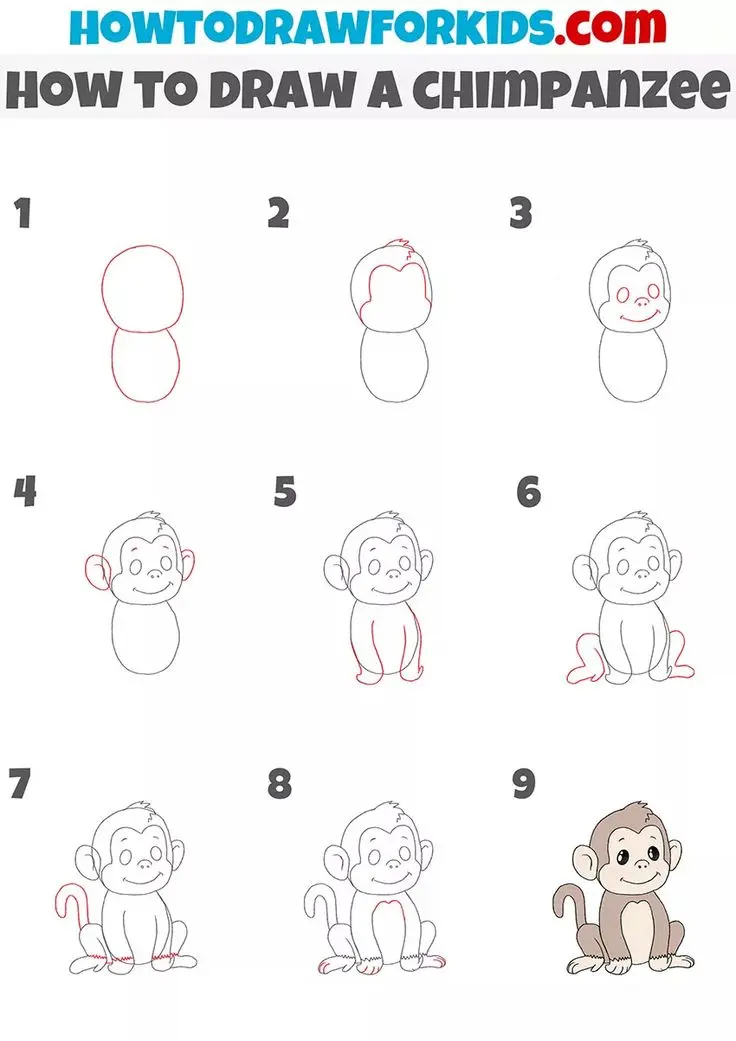
Drawing a chimpanzee involves capturing their distinct anatomy, specifically the prominent brow ridge, forward-thrusting muzzle, and expressive, rounded ears. Begin by sketching simple geometric shapes to establish the head and torso proportions. Gradually refine the facial features and add fur texture to achieve a realistic, lifelike representation of this primate.
On this page
How to sketch chimpanzee anatomy for beginners
To draw a chimpanzee accurately, you must first understand their skeletal structure, which differs significantly from human proportions. Start by sketching a large circle for the cranium and a smaller, rectangular shape extending forward for the muzzle. Chimpanzees have a pronounced brow ridge that sits directly above their eyes, creating a deep-set appearance. Connect these shapes with fluid lines to form the neck and shoulders, keeping in mind that chimpanzees have exceptionally strong, broad upper bodies compared to their lower limbs.
Focusing on the proportions of the facial features is essential for a convincing drawing. The eyes are positioned relatively close together under the brow, while the ears are large, rounded, and set lower on the head than human ears. Use these steps to establish your initial guide:
- Draw a circle for the skull and a horizontal oval for the snout.
- Mark the brow line with a heavy, curved arch.
- Place the eyes in the recessed space between the brow and the snout.
- Sketch the nose as a wide, flat triangle at the end of the muzzle.
Best tools for drawing realistic primates
Selecting the right graphite pencils allows you to build depth and texture, which is vital for rendering primate fur. Use an HB pencil for light initial sketches, as it can be easily erased without damaging the paper. Move to 2B and 4B pencils for the darker, denser areas of the face and the deep shadows around the eyes and ears. A kneaded eraser is particularly useful for lifting graphite to create highlights in the eyes or along the edges of the fur.
For the final touches, consider using a charcoal pencil or a dark carbon pencil to achieve the deep, velvety blacks found in chimpanzee hair. Bristol board or heavy-weight drawing paper provides a smooth surface that holds graphite well, preventing smudging during the layering process. Follow these tips for effective material usage:
- Use a sharp pencil point for fine details like the iris and nostrils.
- Employ a blending stump or a soft tissue to smooth out the transition between shadows on the skin.
- Keep a piece of scrap paper under your hand to prevent oils from your skin from transferring to the drawing.
Why chimpanzee facial expressions are difficult to capture
Capturing the personality of a chimpanzee relies heavily on the subtle muscles around the mouth and eyes. Unlike humans, chimpanzees have highly mobile lips that can stretch into a wide "grin" or purse into a tight, focused pout. The skin around their eyes and mouth is often wrinkled and leathery, requiring careful shading to convey texture. If the lines around the mouth are too stiff, the drawing will look like a mask rather than a living, breathing animal.
Pay close attention to the way light hits the face, as this defines the three-dimensional volume of the muzzle. Chimpanzees often have sparse hair on their faces, meaning the underlying bone structure and skin folds should be clearly visible. Avoid drawing perfectly straight lines; instead, use short, rhythmic strokes that follow the contours of the face. By observing how the skin bunches when the chimpanzee looks to the side, you can add a sense of movement and realism that brings the portrait to life.
Common mistakes when drawing chimpanzee fur
One of the most frequent errors is drawing individual hairs as uniform, straight lines. Chimpanzee fur is coarse and grows in irregular patches, often appearing matted or messy. Instead of drawing every single strand, focus on grouping the hair into larger clumps or "shadow shapes." Use varying lengths and thicknesses of strokes to suggest the direction of growth, which typically radiates outward from the center of the chest or the top of the head.
Another mistake is failing to account for the contrast between the dark fur and the skin. The skin on a chimpanzee’s face, hands, and feet is much lighter than the surrounding coat. Ensure you leave enough white space or light shading on the face to maintain this contrast. If you shade the face too darkly, the animal will lose its defining features and appear as a flat, dark silhouette. Always check your reference images to see how the light interacts with the different textures of the coat.
How to add detail to chimpanzee hands and feet
Chimpanzee hands and feet are highly expressive and share a similar structure to human hands, but with longer, more slender fingers and an opposable thumb that is set lower. When drawing the hands, emphasize the length of the fingers and the leathery texture of the palms. The knuckles are prominent, and the skin often folds deeply when the hand is curled. Use a series of small, curved lines to indicate these wrinkles, which add age and character to your subject.
The feet are particularly unique because the big toe functions like a thumb, allowing for gripping. When sketching the feet, ensure the big toe is separated from the other four digits, which are usually shorter and more curled. Focus on the following details to improve your rendering:
- Outline the long, narrow shape of the palm or sole.
- Add the knuckles as rounded, protruding bumps.
- Define the nails, which are often flat and broad.
- Use cross-hatching to emphasize the toughness of the skin on the palms and soles.
By carefully observing these anatomical nuances, you can create a drawing that is both scientifically accurate and artistically compelling, successfully capturing the essence of the chimpanzee in your final work.
Key facts
- Chimpanzees have longer arms than legs, with their knuckles reaching past their knees when standing.
- The brow ridge is a prominent feature, creating a deep-set eye socket and a serious facial expression.
- Focus on the "T-shape" of the face, where the brow line meets the bridge of the nose.
- Use rounded, organic shapes for the torso, as chimpanzees have barrel-shaped chests rather than flat ones.
- Ears are large and protrude from the side of the head, positioned roughly level with the eyes and nose.
- Avoid drawing human-like noses; chimpanzees have flat, wide nostrils that sit close to the upper lip.
The bottom line
Drawing a chimpanzee requires a focus on anatomical proportions, specifically their long arms, barrel-shaped torsos, and distinct facial features like the heavy brow and wide muzzle. By starting with simple geometric shapes to map out the body, you can ensure the posture remains accurate. Avoid humanizing the facial features, as capturing the raw, powerful essence of the animal is key to a successful, realistic illustration.
People also ask
Should I use a skeleton or basic shapes to start my drawing?
Start with basic shapes like circles for the head and chest and ovals for the limbs. This helps you establish the correct proportions before adding muscle and fur details.
How do I make the chimpanzee look realistic rather than cartoonish?
Focus on the anatomy of the face, specifically the protruding muzzle and the heavy brow. Keep the eyes dark and avoid adding human-like eyelashes or pupils.
What is the most common mistake when drawing chimpanzee hands?
Many artists make the fingers too short or human-like. Remember that chimpanzee fingers are long, curved, and powerful for gripping branches.
How do I represent chimpanzee fur effectively?
Use short, directional strokes rather than long lines. Focus your shading on the folds of the skin and the areas where muscle meets bone.
Are there differences between male and female chimpanzee anatomy?
Males are generally larger with more pronounced brow ridges and muscular builds. Females tend to have slightly more slender features and less prominent facial bone structures.
What is the best way to draw the chimpanzee’s sitting posture?
Place the weight on the hips and have the long arms resting on the ground or knees. This creates a natural, grounded look that reflects how they move in the wild.
This answer was created with the help of AI research tools and reference sources. Spotted an error? Let us know — we correct mistakes quickly. See our editorial policy.