How do you draw a carousel?
Short answer
Drawing a carousel requires constructing a cylindrical perspective frame, adding a central rotating pole, and placing evenly spaced animal figures. Focus on the circular roof’s geometry and the vertical support rods. By establishing a vanishing point and using radial symmetry, you can create a realistic, three-dimensional representation of this classic amusement ride.
On this page
How to structure the perspective of a carousel
A carousel is essentially a large cylinder, so your drawing must rely on elliptical perspective. Begin by drawing a horizontal line to represent the horizon, then sketch a large, flattened oval to serve as the base platform. Directly above this, draw a matching oval for the roof, ensuring the vertical distance between them remains consistent. Connect the two ovals with vertical lines at the edges to define the outer boundary of the ride.
To create depth, divide your ovals into equal segments using radial lines originating from the center. These lines act as guides for the support poles that hold the roof. Remember that the ellipses should appear narrower as they get closer to the eye level. If you place the horizon line near the middle of the carousel, the top of the roof will appear as a flat line, while the base will curve upward.
- Sketch a light center point to serve as the axis of rotation.
- Draw two identical ellipses, one for the roof and one for the floor.
- Use a ruler to draw vertical lines connecting the perimeter of the ellipses.
- Divide the circle into eight or twelve equal pie-shaped wedges to space the animals correctly.
How to draw the central mechanism and poles
The core of every carousel is the central pillar, which houses the gears and motor. Draw a thick vertical line running from the center of the floor ellipse to the center of the roof ellipse. This pillar is often decorated with mirrors or ornate carvings, so you can add rectangular panels or circular motifs along its length. The poles that support the horses or other animals must run parallel to this central axis.
When placing the animal poles, ensure they are spaced evenly around the perimeter. These poles do not always reach the roof; some may be attached to a secondary, smaller inner circle. Use varying heights for these poles to suggest the up-and-down motion of the ride. If you draw the poles at slightly different vertical positions, you will successfully simulate the rhythmic movement characteristic of a traditional carousel.
- Draw the central pillar thicker than the outer support poles.
- Add small horizontal brackets where the poles meet the roof.
- Ensure all poles are perfectly vertical to maintain the structural integrity of your drawing.
Best drawing techniques for carousel animals
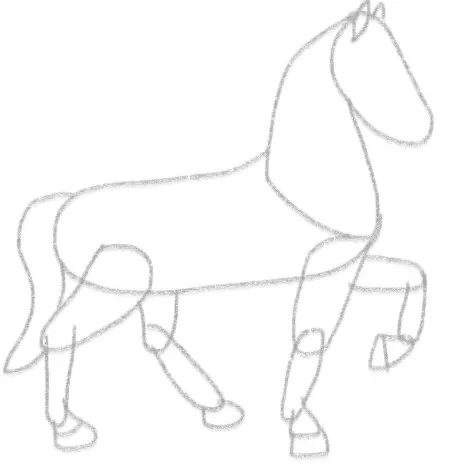
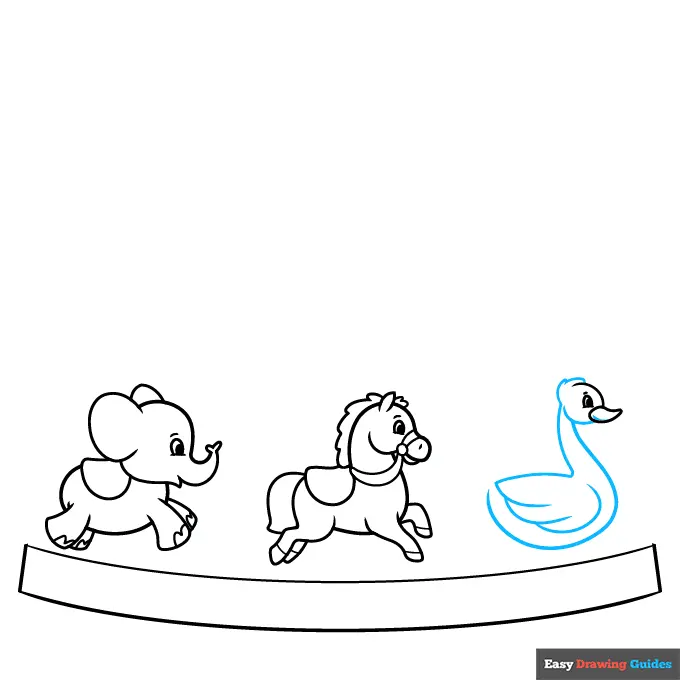
The animals are the most complex part of the drawing, as they require anatomical accuracy and a sense of motion. Most carousel figures are horses, but you can also include zebras, lions, or mythical creatures. Start by sketching a simple oval for the body and a smaller circle for the head. Connect these with a curved neck line and add simple cylinders for the legs, bent at the joints to imply a galloping posture.
Focus on the decorative saddle and bridle, which are hallmarks of carousel craftsmanship. These elements should follow the contour of the animal’s body, wrapping around the torso and head. Use bold, sweeping lines for the mane and tail to add a sense of wind and speed. Keep the anatomy slightly stylized, as carousel figures are traditionally carved wood rather than realistic animals. Avoid drawing the legs too thin, as they must look sturdy enough to support the weight of the rider.
How to add detail to the roof and base
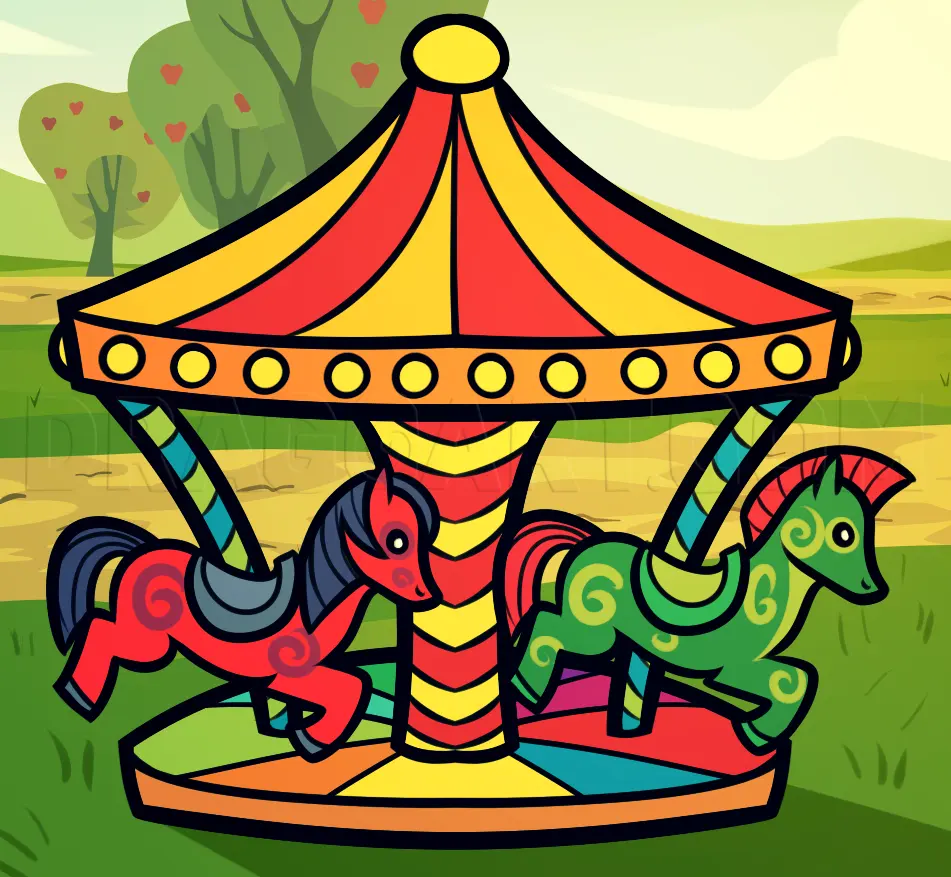
The roof of a carousel is typically a conical or scalloped structure that adds significant visual interest. Draw a series of triangles or curved segments radiating from the central pillar to the outer edge of the roof. You can add a decorative valance or fringe hanging from the edge of the roof to hide the mechanical track. This fringe often features painted panels or lightbulbs, which you can represent with small, repeating circles.
The base platform also requires detail to ground the structure in the scene. Draw a thick rim around the bottom ellipse to represent the edge of the floorboards. You can add a small staircase or a ticket booth near the entrance to provide a sense of scale. If you are drawing a night scene, add small, evenly spaced dots along the roof’s edge to represent the classic glowing lights that define the carousel’s silhouette in the dark.
Common mistakes when drawing a carousel
One of the most frequent errors is failing to maintain the radial symmetry of the ride. If the poles are not spaced equally, the carousel will look lopsided and structurally impossible. Always use a compass or a light grid to ensure that your divisions are mathematically consistent around the center point. Another common mistake is drawing the ellipses too round; if the ellipses are too wide, the carousel will look like a flat disk rather than a three-dimensional cylinder.
Avoid cluttering the drawing with too many figures, which can obscure the mechanical structure of the ride. A carousel with four to six visible animals is usually sufficient to convey the theme without overwhelming the viewer. Finally, check that all vertical lines—the central pillar, the animal poles, and the roof supports—are perfectly parallel to each other. If these lines slant, the entire structure will appear to be collapsing rather than standing firmly on the ground.
Key facts
- A carousel is defined by its circular platform and vertical central axis, which serves as the structural anchor for the ride.
- Start your drawing by sketching a perfect circle to represent the platform, then add a vertical line through the center for the pole.
- Use one-point perspective to ensure the horses or seats appear to recede toward the center of the ride.
- The roof of a carousel is typically a shallow cone; draw this by creating a triangle shape above the central pole.
- Space your figures evenly around the circle to maintain visual balance and represent the rotational nature of the ride.
- Avoid drawing the horses all at the same height; staggering their vertical positions creates the illusion of movement.
The bottom line
Drawing a carousel requires a solid grasp of circular perspective and symmetrical spacing. By establishing a central axis and a consistent platform shape, you provide a stable foundation for the decorative elements. Focus on the vertical poles and the conical roof to define the ride's structure. With careful attention to shading and the placement of the horses, you can effectively capture the nostalgic charm of this classic attraction.
People also ask
What is the best way to draw the horses on a carousel?
Draw the horses as if they are mid-gallop to convey action. Ensure each horse is attached to a vertical pole that connects the platform to the roof.
How do I create the illusion of rotation in a static drawing?
Use curved, sweeping lines on the ground to suggest movement. You can also add motion blur effects to the background or the poles to imply the ride is spinning.
Should I use a ruler for the carousel poles?
Yes, using a ruler for the vertical poles is essential for structural accuracy. If the poles are crooked, the entire carousel will look unstable and poorly constructed.
What is the purpose of the canopy on a carousel?
The canopy, or rounding board, protects the machinery and riders from the elements. In a drawing, it serves as a decorative frame that adds height and complexity to the composition.
How do I make the carousel look three-dimensional?
Apply shading to the side of the poles and the horses that is furthest from your light source. Consistent shading across all elements will unify the drawing and create depth.
What are the most common mistakes when drawing a carousel?
A frequent error is misaligning the perspective, which makes the circular platform look like an oval. Another mistake is forgetting to draw the central axis, which makes the ride look like it is floating.
This answer was created with the help of AI research tools and reference sources. Spotted an error? Let us know — we correct mistakes quickly. See our editorial policy.