How do you become an animator?
Short answer
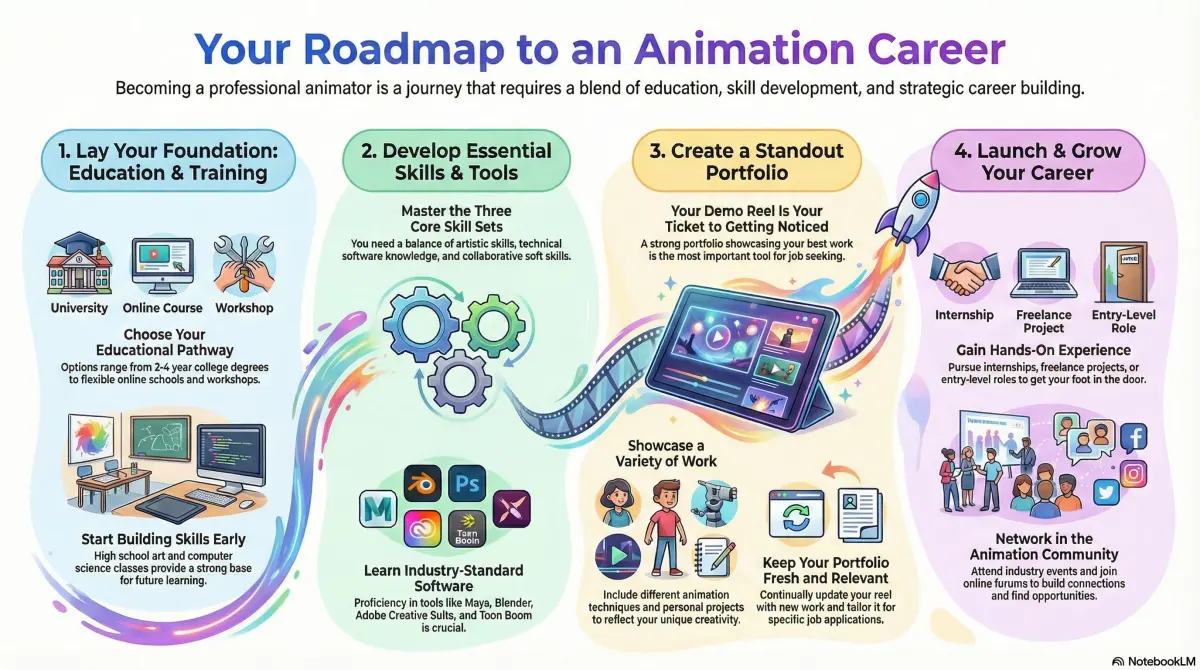
Becoming an animator requires mastering artistic fundamentals, learning industry-standard software, and building a professional portfolio. You can pursue formal education through a degree program or engage in self-directed study. Success depends on consistent practice, understanding movement principles, and networking within the creative industry to secure entry-level roles or freelance opportunities.
On this page
How to learn animation fundamentals
Animation is the art of creating the illusion of movement through a sequence of frames. Before diving into complex software, you must understand the "12 Principles of Animation," a concept introduced by Disney animators Ollie Johnston and Frank Thomas in their 1981 book, The Illusion of Life. These principles, which include concepts like squash and stretch, timing, and anticipation, form the bedrock of all motion design.
To begin, practice traditional drawing or basic 2D motion exercises. You do not need expensive equipment to start; a simple light box, paper, and a pencil are sufficient for learning frame-by-frame techniques. Focus on weight, balance, and arcs, as these elements dictate how believable a character's movement appears to the audience.
- Study anatomy and life drawing to understand how bodies move.
- Practice "bouncing ball" exercises to master timing and spacing.
- Observe real-world motion to analyze how physics affects objects.
- Sketch daily to build muscle memory and observational skills.
Best software for beginners
Choosing the right software depends on your specific goals, such as 2D character animation, 3D modeling, or motion graphics. For 2D animation, industry standards include Toon Boom Harmony and Adobe Animate. If you are interested in 3D animation, Blender is a powerful, free, and open-source tool that is widely used by independent creators and small studios alike.
For those focusing on 3D character work, Autodesk Maya is the professional standard used by major film studios like Pixar and DreamWorks. While the learning curve for these professional tools is steep, online tutorials and community forums provide extensive support for beginners. Start by mastering one software package thoroughly before attempting to learn others, as the core logic of animation often translates across different platforms.
- Blender: Excellent for 3D modeling, rigging, and rendering.
- Adobe Animate: The go-to tool for vector-based 2D animation.
- Toon Boom Harmony: Professional-grade software for high-end 2D productions.
- After Effects: Essential for motion graphics and visual effects compositing.
How long does it take to become an animator
The timeline for becoming a professional animator varies based on your dedication and learning path. A formal bachelor’s degree in animation or digital arts typically takes four years to complete. These programs provide structured environments, access to professional software, and networking opportunities. Conversely, self-taught animators may take two to five years to reach a professional level, depending on how many hours they dedicate to practice each week.
Regardless of the path, you should expect to spend at least one to two years building a high-quality portfolio. Employers prioritize your "demo reel"—a short video showcasing your best work—over academic credentials. A strong reel demonstrates your ability to handle complex character acting, lip-syncing, and technical problem-solving. Consistency is the most important factor in this timeline; those who animate daily progress significantly faster than those who study intermittently.
Common mistakes when starting out
A frequent error for beginners is attempting to animate complex scenes before mastering simple movements. Many novices try to create long, intricate action sequences, which often leads to frustration and poor-quality results. Instead, focus on short, polished clips that demonstrate your command of timing and character personality. Quality consistently outweighs quantity in the professional world.
Another mistake is neglecting the "graph editor" or the technical side of movement curves. Animators often rely too heavily on automated software features, resulting in motion that looks robotic or "floaty." Always manually adjust your keyframes to ensure the spacing feels natural and deliberate. Furthermore, failing to seek feedback is a major setback. Share your work with peers or mentors early and often to identify issues with weight, silhouette, and timing that you might have missed.
How to build a career in animation
Building a career requires more than just technical skill; it requires a professional presence and a proactive approach to networking. Start by creating a website or a profile on platforms like ArtStation or Behance to host your demo reel. Ensure your reel is concise, usually between 60 and 90 seconds, and features only your strongest, most recent work.
Networking is vital in the creative industries. Attend animation festivals, industry conferences, or local meetups to connect with professionals. Many jobs are filled through referrals rather than public postings. When applying for roles, tailor your resume to highlight your specific software proficiency and any relevant project experience. Stay adaptable, as the industry frequently evolves, and be prepared to start as a junior animator or production assistant to gain experience within a studio environment.
Key facts
- Most professional animators hold a bachelor’s degree in animation, fine arts, or computer graphics.
- Mastery of industry-standard software like Adobe Animate, Toon Boom Harmony, or Maya is essential for employability.
- A strong demo reel, typically 60 to 90 seconds long, is the most important component of a job application.
- Understanding the 12 Principles of Animation, established by Disney animators in 1981, remains the foundation of professional practice.
- Networking at industry events like the Annecy International Animation Film Festival can lead to critical job opportunities.
- Animators must constantly update their skills to keep pace with evolving software updates and new production pipelines.
The bottom line
Becoming an animator requires a blend of artistic intuition and technical discipline. You must master the core principles of movement while gaining proficiency in industry-standard software. By building a focused demo reel and networking within the community, you can transition from an enthusiast to a professional. Success relies on consistent practice, a willingness to accept constructive criticism, and an endless curiosity for how things move in reality.
People also ask
Do I need to be an expert at drawing to be an animator?
While traditional drawing skills provide a strong foundation for understanding anatomy and movement, they are not strictly required for 3D animation. Many modern animators focus on technical skills, rigging, and character performance rather than paper-and-pencil illustration.
How long does it take to become a professional animator?
Most animators spend three to four years in a dedicated degree program followed by several months building a portfolio. Entry-level positions often require additional on-the-job training to master studio-specific workflows and production pipelines.
What is the difference between 2D and 3D animation?
2D animation involves creating movement in a two-dimensional space, often using frame-by-frame techniques or digital puppet rigs. 3D animation involves building digital models in a virtual space and manipulating them using complex skeletal systems and keyframes.
Is a college degree necessary to get hired by a major studio?
While a degree is preferred, studios prioritize a high-quality demo reel that demonstrates technical proficiency and artistic timing. If your portfolio proves you can perform the work, the lack of a formal degree is rarely a barrier to entry.
What is a demo reel?
A demo reel is a short video compilation showcasing your best work and technical capabilities. It should highlight your ability to convey emotion, weight, and personality through movement rather than just showing finished scenes.
What are the most common mistakes beginners make?
Beginners often ignore the principles of "squash and stretch" or fail to observe real-life physics. Another frequent error is including too much mediocre work in a demo reel instead of focusing on a few high-quality, polished clips.
This answer was created with the help of AI research tools and reference sources. Spotted an error? Let us know — we correct mistakes quickly. See our editorial policy.