What was the Cold War?
Short answer
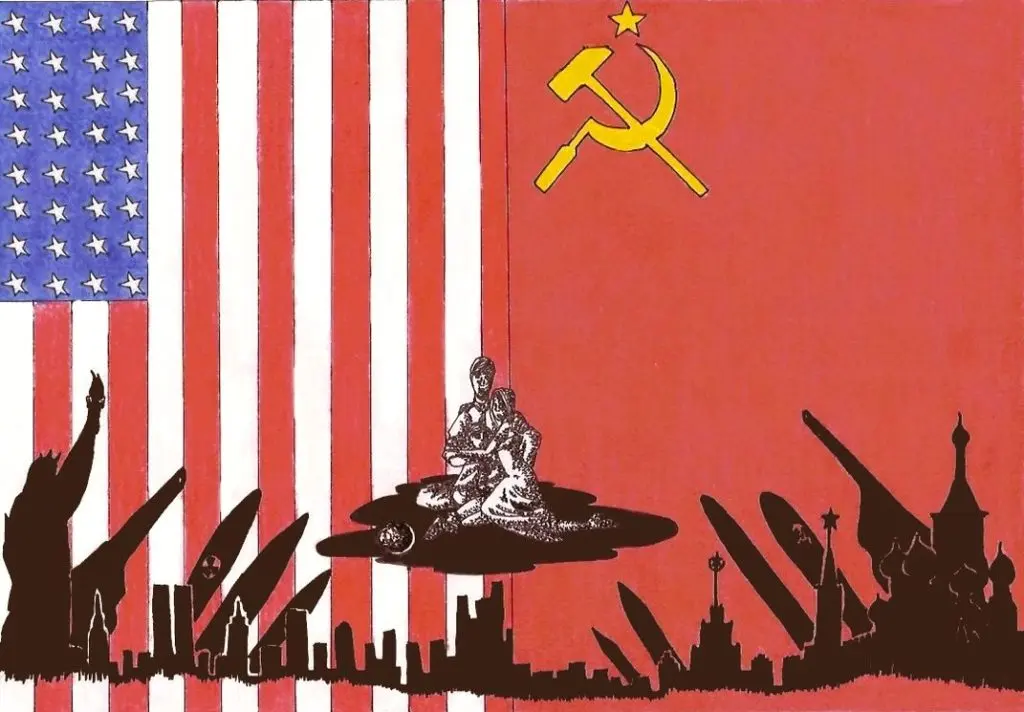
The Cold War was a decades-long period of geopolitical tension between the United States and the Soviet Union following World War II. It featured a global struggle for ideological dominance between capitalism and communism, characterized by proxy wars, an intense nuclear arms race, and espionage rather than direct military conflict.
On this page
Why did the Cold War start?
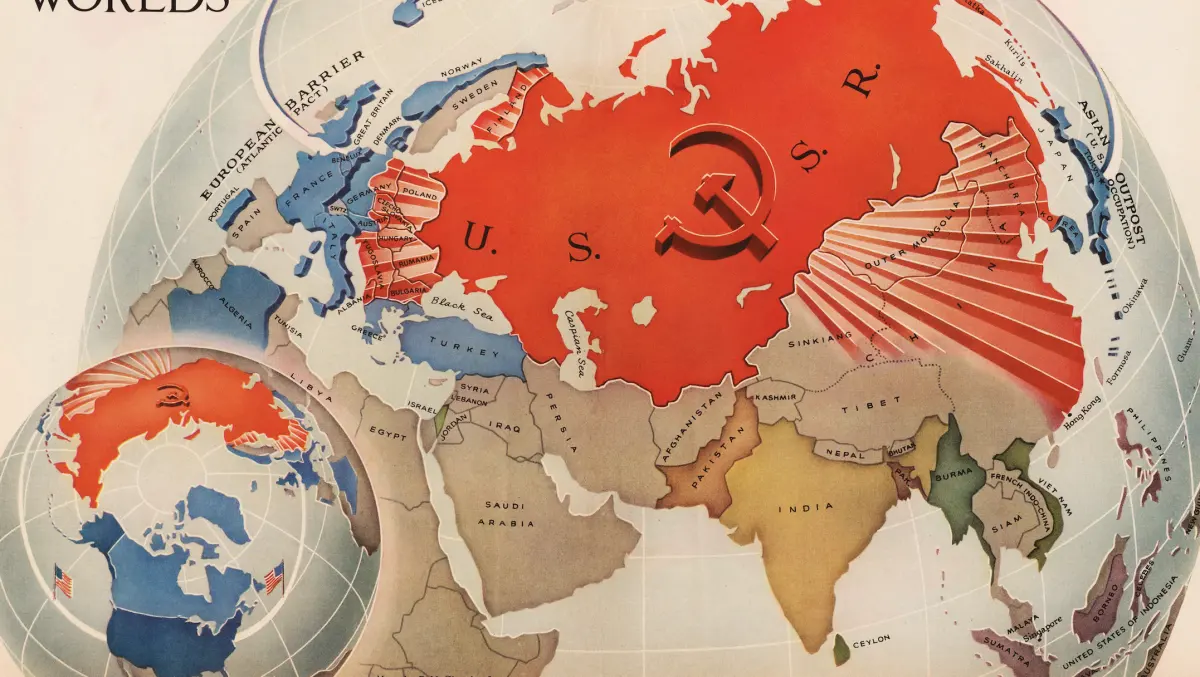
The Cold War emerged from the power vacuum left by the defeat of Nazi Germany in 1945. The United States and the Soviet Union, once allies against Hitler, held fundamentally incompatible visions for the postwar world. The U.S. championed democratic capitalism and free markets, while the Soviet Union sought to expand its communist influence across Eastern Europe. This ideological divide created deep mutual suspicion, exacerbated by the development of atomic weapons and the rapid expansion of Soviet control over satellite states.
Tensions solidified into a permanent state of hostility through several key geopolitical shifts. The Truman Doctrine of 1947 established the policy of "containment," aiming to prevent the spread of communism globally. Simultaneously, the Marshall Plan provided massive economic aid to Western Europe to stabilize nations against Soviet influence. The Soviet Union responded by consolidating its grip on the Eastern Bloc, creating a divided Europe separated by what Winston Churchill famously termed the "Iron Curtain."
How did the Cold War affect the world?
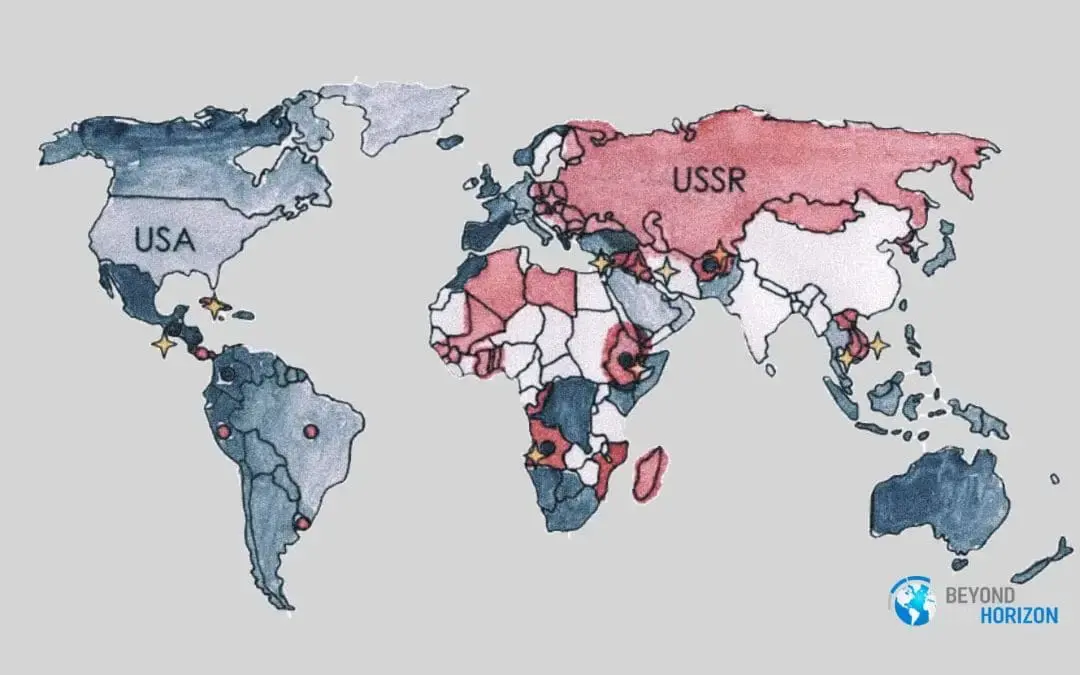
The conflict fundamentally reshaped global politics, forcing most nations to align with either the American-led NATO alliance or the Soviet-led Warsaw Pact. This bipolar world order led to a series of "proxy wars" where the superpowers supported opposing sides in regional conflicts to gain strategic advantages. These wars caused immense destruction and loss of life in developing nations, as the superpowers avoided direct combat to prevent mutually assured destruction.
The global impact of this era included:
- The Korean War (1950–1953), which resulted in the permanent division of the Korean Peninsula.
- The Vietnam War, a prolonged conflict that tested American military and political resolve.
- The space race, which accelerated technological advancements in rocketry, satellite communication, and computing.
- The Cuban Missile Crisis of 1962, the closest the world came to full-scale nuclear war.
What were the main strategies used?
Superpowers relied on a mix of economic pressure, intelligence gathering, and military posturing to gain an edge. Espionage became a primary tool for both the CIA and the KGB, as both sides sought to infiltrate government secrets and influence foreign elections. Propaganda campaigns were also essential, with both nations broadcasting radio programs and producing films to convince the world of their moral superiority and the failures of their rival’s political system.
Nuclear deterrence became the most significant military strategy of the era. Both nations stockpiled thousands of warheads, operating under the theory of Mutually Assured Destruction (MAD). This concept held that if one side launched a nuclear attack, the other would retaliate with enough force to destroy both nations. This grim standoff ensured that while the Cold War remained "cold" in terms of direct superpower combat, it was a period of constant, high-stakes psychological pressure on the global population.
Common mistakes when studying the Cold War
One common error is assuming the Cold War was solely a battle between the U.S. and the Soviet Union. While they were the primary actors, the conflict involved dozens of nations across Africa, Asia, and Latin America. Ignoring the role of non-aligned countries or regional actors leads to an incomplete understanding of how local issues were often manipulated to serve superpower interests. Another mistake is viewing the era as a static period of total silence or inactivity.
To gain a better understanding of this era, follow these steps:
- Research the specific proxy wars in Africa and Asia to see how the conflict played out beyond Europe.
- Examine the economic policies of the Marshall Plan to understand how capitalism was used as a tool of containment.
- Analyze the internal collapse of the Soviet economy during the 1980s to understand why the conflict eventually ended.
- Distinguish between the political rhetoric of the time and the actual military actions taken by both sides.
How did the Cold War end?
The Cold War concluded in the late 1980s and early 1990s, driven by internal economic stagnation within the Soviet Union. Soviet leader Mikhail Gorbachev introduced reforms known as glasnost (openness) and perestroika (restructuring) to modernize the failing communist system. These changes inadvertently loosened the state's control, leading to a wave of revolutions across Eastern Europe. In 1989, the Berlin Wall fell, symbolizing the collapse of the Iron Curtain and the end of Soviet dominance in the region.
The final dissolution occurred in December 1991, when the Soviet Union officially ceased to exist, breaking into fifteen independent republics. This event marked the end of the bipolar world order and left the United States as the world's sole superpower. While the geopolitical landscape changed overnight, the legacy of the Cold War continues to influence modern international relations, particularly regarding nuclear non-proliferation, the structure of global alliances, and the lingering distrust between Russia and many Western nations.
Key facts
- The Cold War was a period of geopolitical tension between the United States and the Soviet Union, lasting roughly from 1947 to 1991.
- It was called "cold" because the two superpowers never engaged in direct, large-scale military conflict, fearing the mutually assured destruction of nuclear war.
- The conflict was defined by an ideological struggle between Western capitalism and Soviet-led communism.
- Major proxy wars occurred in regions like Korea (1950–1953), Vietnam (1955–1975), and Afghanistan (1979–1989).
- The Berlin Wall, constructed in 1961 and dismantled in 1989, served as the most iconic physical symbol of the division between East and West.
- To understand the era, study the formation of NATO in 1949 and the Warsaw Pact in 1955, which created two opposing military alliances.
The bottom line
The Cold War was a defining global struggle that shaped the modern political landscape through ideological competition and nuclear deterrence. By avoiding direct military confrontation, the United States and the Soviet Union instead utilized proxy wars, espionage, and technological races to exert influence. Understanding this era is essential for grasping the origins of modern international alliances and the persistent challenges of global nuclear non-proliferation today.
People also ask
What was the policy of containment?
Containment was a U.S. foreign policy strategy designed to prevent the spread of communism abroad. It guided American involvement in global conflicts to ensure the Soviet sphere of influence did not expand.
What was the Cuban Missile Crisis?
Occurring in 1962, this was a 13-day standoff between the U.S. and the Soviet Union over the placement of Soviet nuclear missiles in Cuba. It is widely considered the closest the world came to full-scale nuclear war.
Who were the leaders of the two superpowers?
The conflict involved numerous leaders, but key figures included U.S. Presidents like Harry Truman, John F. Kennedy, and Ronald Reagan. On the Soviet side, prominent leaders included Joseph Stalin, Nikita Khrushchev, and Mikhail Gorbachev.
What was the Space Race?
This was a competition between the U.S. and the Soviet Union to achieve superior spaceflight capability. It included milestones like the Soviet launch of Sputnik in 1957 and the American moon landing in 1969.
How did the Cold War end?
The Cold War concluded as the Soviet Union faced severe economic stagnation and internal political reforms under Mikhail Gorbachev. By 1991, the Soviet Union formally dissolved into 15 independent republics.
Why did the U.S. and Soviet Union not fight directly?
Both nations possessed massive nuclear arsenals, leading to a doctrine known as Mutually Assured Destruction. They understood that a direct war would result in the total annihilation of both countries and likely global civilization.
This answer was created with the help of AI research tools and reference sources. Spotted an error? Let us know — we correct mistakes quickly. See our editorial policy.