What is the left brain and right brain theory?
Short answer
The left-brain/right-brain theory is a popular psychological myth suggesting that individuals are either "left-brained" (logical and analytical) or "right-brained" (creative and intuitive). While the brain’s two hemispheres do specialize in certain functions, they work in constant, integrated harmony. No scientific evidence supports the idea that personality traits stem from hemispheric dominance.
On this page
What is the left brain and right brain theory?
The theory originated in the 1960s from the "split-brain" experiments conducted by neuropsychologist Roger Sperry. Sperry studied patients who had undergone a corpus callosotomy, a surgical procedure that severs the bridge of nerve fibers connecting the two hemispheres to treat severe epilepsy. By isolating the hemispheres, Sperry discovered that the left side of the brain is typically more involved in language processing and analytical tasks, while the right side often excels at spatial awareness and facial recognition.
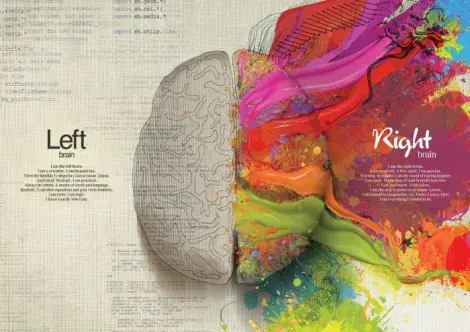
Despite these specific findings, the theory evolved into a cultural metaphor that oversimplifies human cognition. In popular culture, the left hemisphere is often labeled the seat of logic, math, and sequence, while the right is dubbed the home of art, intuition, and emotion. Modern neuroscience, however, has debunked the notion that people possess a "dominant" side that dictates their personality or professional aptitude. The brain functions as a highly interconnected network rather than two independent processing centers.
Why do people believe in brain dominance?
The appeal of the left-brain/right-brain theory lies in its simplicity and its ability to categorize complex human behaviors. Humans have a natural cognitive bias toward binary classification, which makes the idea of a "logical" versus "creative" personality type easy to understand and apply to everyday life. This framework provides a convenient shorthand for explaining why someone might excel at accounting yet struggle with painting, or vice versa.
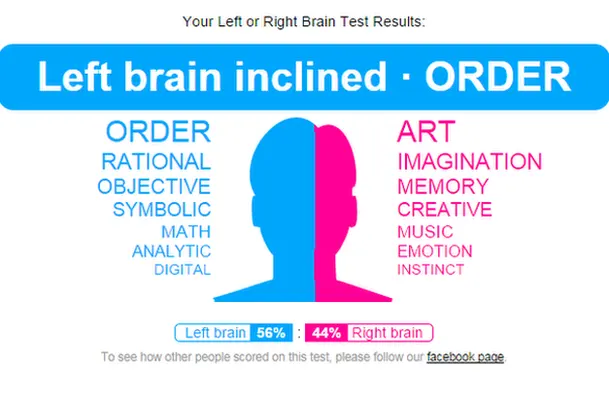
Furthermore, the theory is frequently reinforced by self-help books, personality tests, and educational materials that rely on these archetypes. Because the concept has been ingrained in pop psychology for decades, many people accept it as a biological fact without questioning the underlying evidence. By providing a label for individual differences, the theory offers a sense of clarity, even if that clarity is scientifically inaccurate. It persists because it feels intuitive, even though it obscures the reality of how the brain actually integrates information.
How does the brain actually work?
The human brain is a highly integrated organ where both hemispheres communicate constantly through the corpus callosum. This massive bundle of nerve fibers allows for the rapid exchange of information, ensuring that cognitive tasks are rarely confined to a single side. For example, while the left hemisphere is dominant for language production, the right hemisphere is essential for understanding the emotional tone, irony, and context of speech.
- Information enters the brain through sensory organs and is processed by various regions simultaneously.
- The corpus callosum facilitates communication between the left and right hemispheres to synthesize complex data.
- Complex activities like playing a musical instrument require the integration of motor control, rhythm, spatial awareness, and analytical reading, involving both sides of the brain.
- Neuroplasticity allows the brain to reorganize itself, meaning that skills are developed through practice rather than innate hemispheric bias.
Common mistakes when using the theory
A major error is using the theory to limit one's potential or to stereotype others. Believing you are "right-brained" might discourage you from pursuing analytical careers, while a "left-brained" label might cause someone to neglect their creative development. These labels act as self-fulfilling prophecies, leading individuals to avoid challenges that they believe are outside their "natural" hemisphere's capability.
- Assuming that a person’s career choice is determined by their brain structure.
- Using the theory to justify poor performance in specific academic or professional subjects.
- Ignoring the role of neuroplasticity, which proves that the brain can learn and adapt to any task regardless of its initial state.
- Overlooking the fact that complex problem-solving requires the full, combined capacity of the entire brain.
- Relying on online personality quizzes that lack any empirical or clinical validity.
How to improve your brain health instead
Rather than focusing on which side of your brain is "dominant," focus on activities that promote overall cognitive health and neural connectivity. The brain thrives on novelty, physical exercise, and consistent learning. Engaging in activities that challenge your current skill set is the most effective way to strengthen the connections between various brain regions.
- Engage in "cross-training" your brain by learning a new language, which requires both analytical grammar skills and creative expression.
- Prioritize aerobic exercise, as it increases blood flow and promotes the growth of new neurons across the entire brain.
- Practice mindfulness and meditation to improve focus and emotional regulation, which benefits both hemispheres equally.
- Maintain a balanced diet rich in omega-3 fatty acids to support cognitive function and long-term brain health.
- Seek out diverse experiences that force you out of your comfort zone, as this stimulates neural pathways and enhances cognitive flexibility.
By moving past the myth of hemispheric dominance, you can embrace a more holistic approach to personal development that recognizes the brain's incredible capacity for growth and integration.
Key facts
- The "left-brain vs. right-brain" theory is a popular metaphor, not a literal description of how the human brain functions.
- Both hemispheres are connected by a thick bundle of nerve fibers called the corpus callosum, which allows for constant communication.
- Language processing is primarily localized in the left hemisphere for about 95% of right-handed people and 70% of left-handed people.
- The right hemisphere often plays a critical role in processing spatial awareness, facial recognition, and the emotional tone of speech.
- Neuroimaging studies, such as fMRI, show that complex tasks require the integration of networks distributed across both sides of the brain.
- Avoid labeling yourself as "left-brained" or "right-brained" to justify strengths or weaknesses, as this ignores the brain's inherent neuroplasticity.
The bottom line
While the idea of distinct left-brained and right-brained personalities remains a pervasive cultural myth, it is not supported by modern neuroscience. Your brain is a highly integrated organ where both hemispheres collaborate to perform nearly every complex task. Rather than seeking to balance your "sides," focus on challenging your brain with diverse activities that promote overall cognitive health and strengthen the connections between your neural networks.
People also ask
Can you train one side of your brain to be more dominant?
No, you cannot isolate one hemisphere for training because the brain functions as an integrated whole. Instead of targeting one side, focus on cognitive exercises like learning a new language or musical instrument to improve overall neural connectivity.
Is it true that left-handed people are more right-brained?
While left-handed individuals often show different patterns of language lateralization, they are not strictly "right-brained." Handedness is a complex trait influenced by genetics and development that does not dictate a personality type or specific cognitive style.
Did the Nobel Prize-winning research of Roger Sperry prove the theory?
Roger Sperry’s 1981 Nobel-winning work involved "split-brain" patients who had their corpus callosum severed to treat epilepsy. His research demonstrated functional specialization, but it did not suggest that healthy individuals operate using only one side of the brain.
Does personality type correlate with brain hemisphere dominance?
There is no scientific evidence linking personality traits, such as being analytical or creative, to the dominance of one brain hemisphere. Personality is a multifaceted construct shaped by environment, genetics, and life experience rather than anatomical bias.
How can I improve my creative thinking if I am a logical person?
Creative thinking is not the exclusive domain of the right hemisphere; it involves the coordination of multiple brain regions. Engage in activities that require divergent thinking, such as brainstorming or artistic hobbies, to strengthen the neural pathways associated with innovation.
Why is the left-brain/right-brain myth still so popular?
The theory persists because it offers a simple, binary framework for understanding complex human behavior. People find comfort in categorizing themselves and others, even though this reductionist view contradicts modern neuroscientific findings regarding brain integration.
This answer was created with the help of AI research tools and reference sources. Spotted an error? Let us know — we correct mistakes quickly. See our editorial policy.