What is the difference between a cheetah and a leopard?
Short answer
Cheetahs and leopards are distinct big cats with different physical builds and hunting strategies. Cheetahs are built for speed with slender frames and solid black spots, while leopards are muscular, stocky, and feature rosette-shaped markings. Cheetahs are primarily diurnal hunters, whereas leopards are nocturnal, solitary, and possess superior climbing abilities for stalking prey.
On this page
How to identify cheetahs and leopards by sight
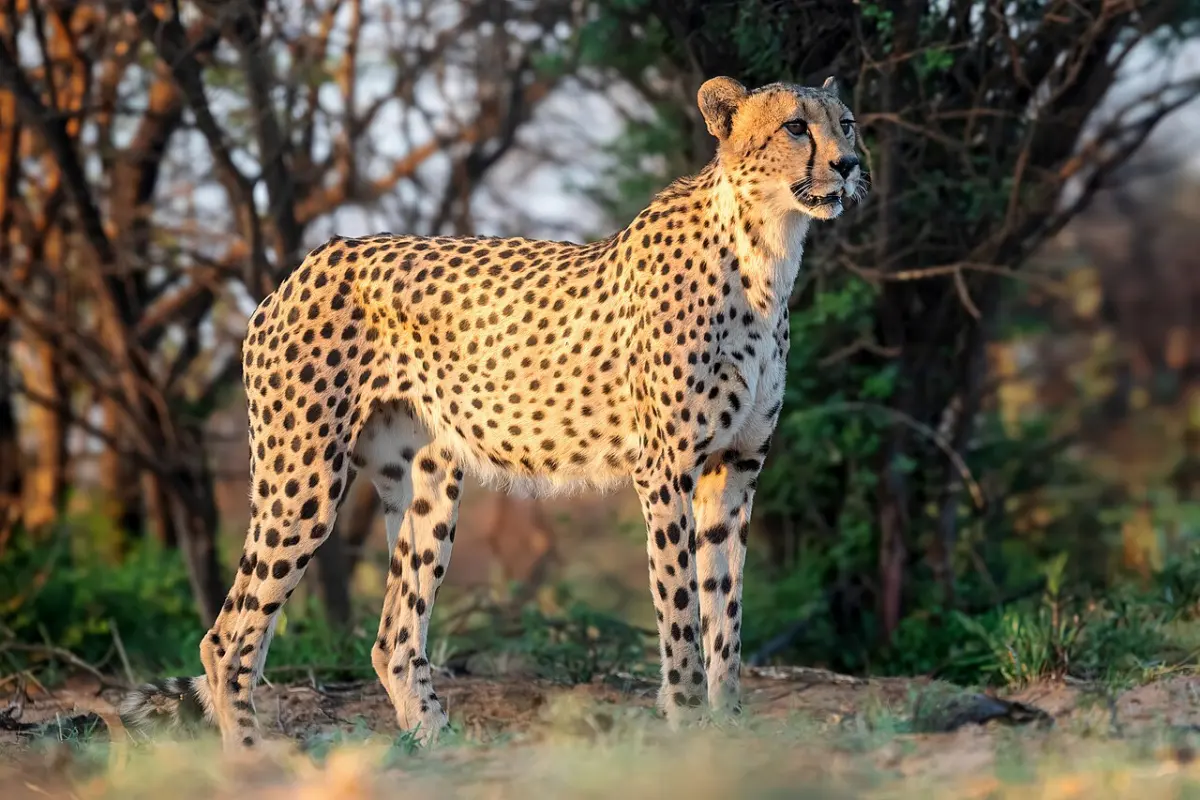
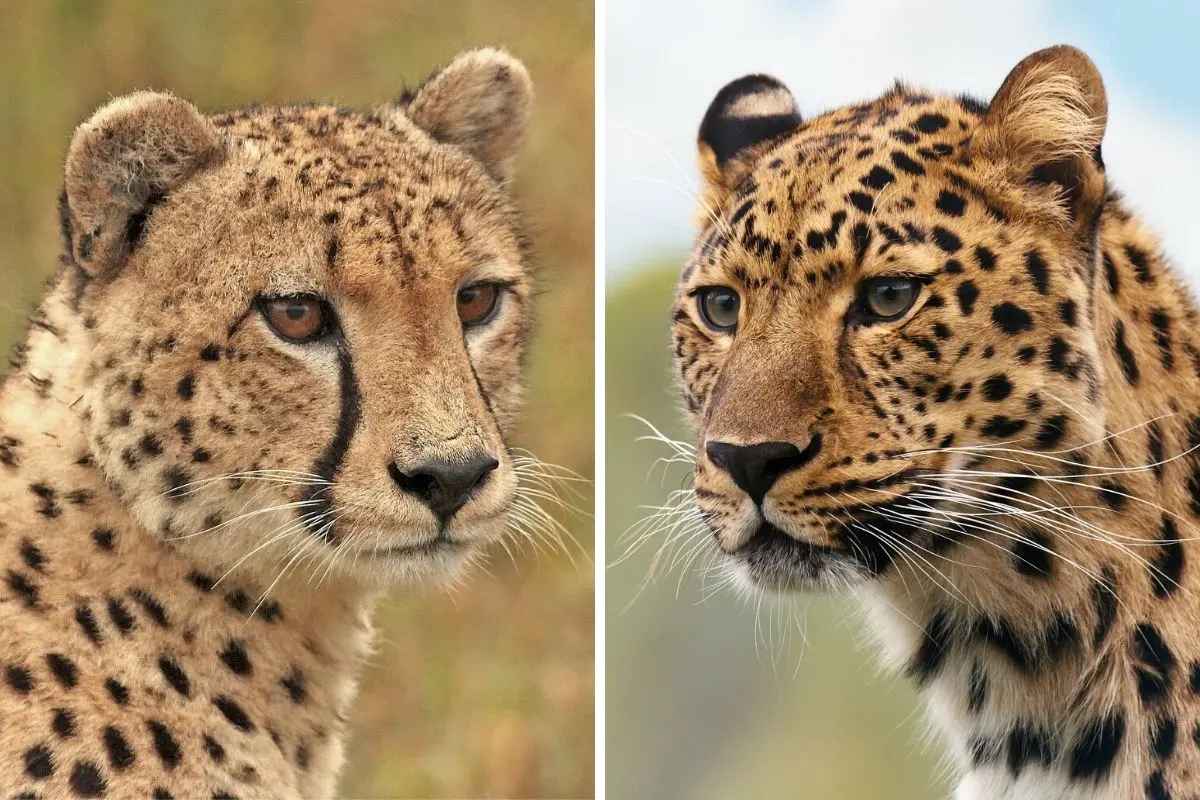
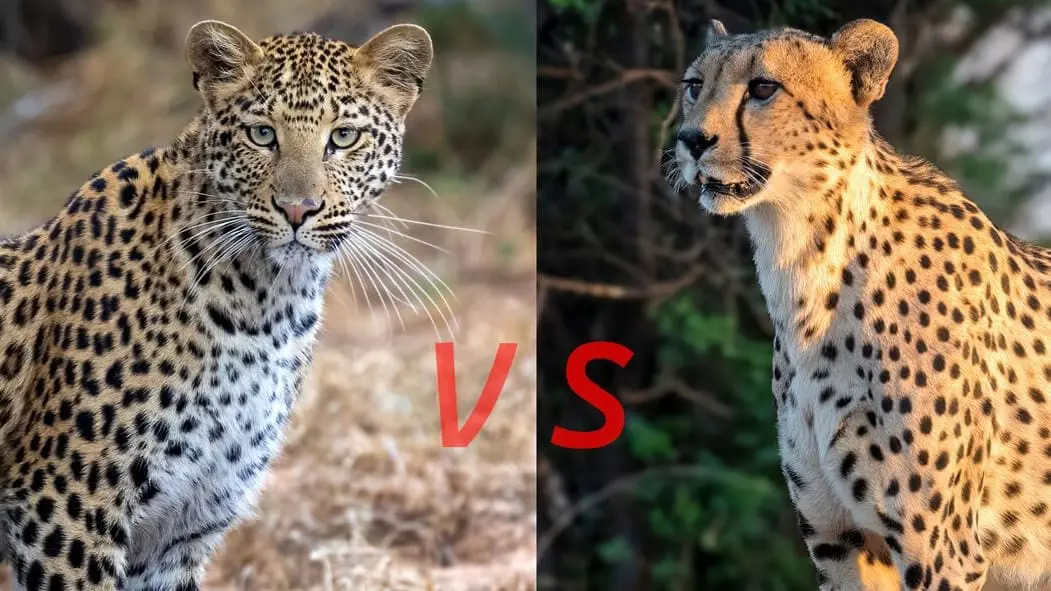
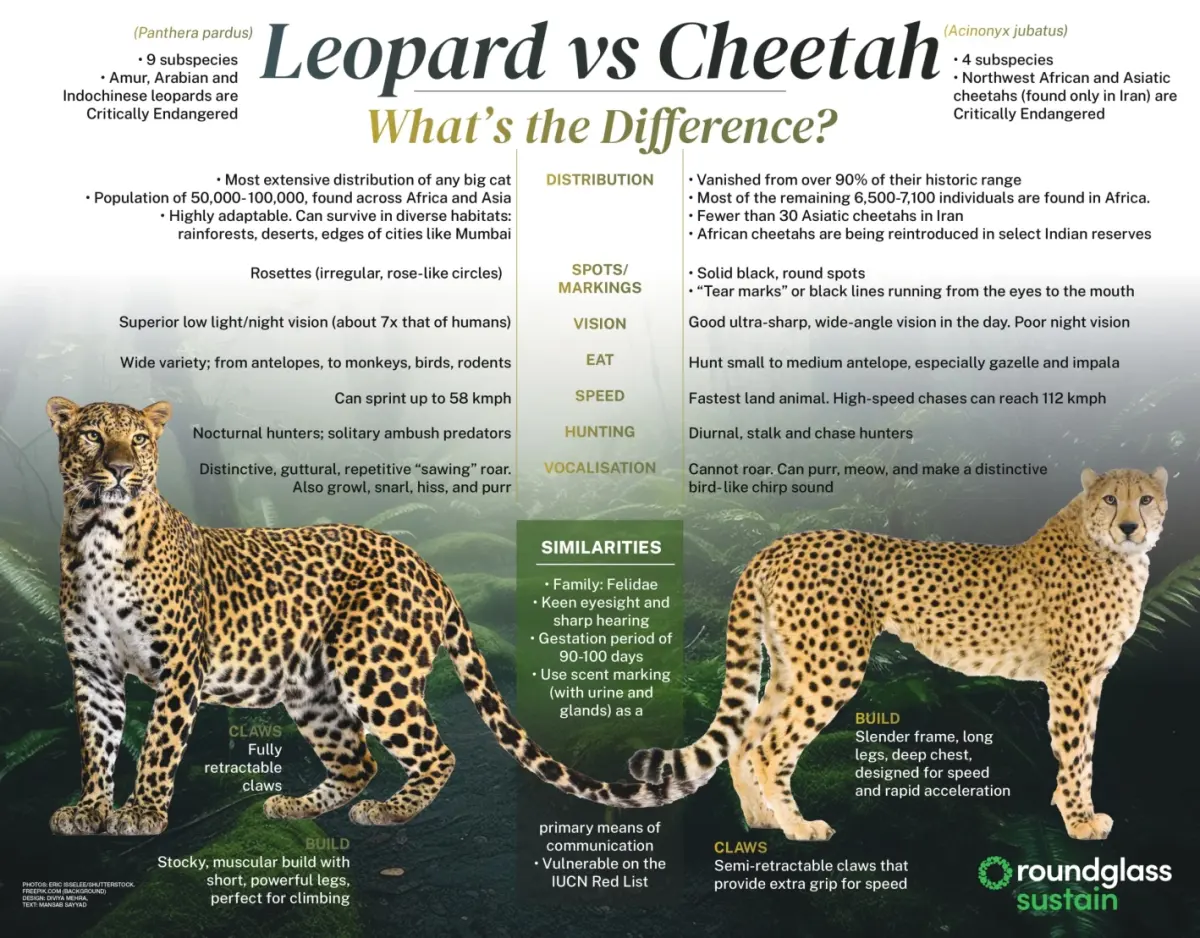
The most reliable way to distinguish between these two cats is by examining their coat patterns and facial features. Cheetahs possess solid, round black spots scattered across their tawny fur. In contrast, leopards display rosettes, which are circular, rose-like markings with a hollow center, providing them with better camouflage in dense vegetation.
Facial markings offer another definitive clue for identification in the wild. Cheetahs have distinctive black "tear marks" that run from the inner corner of each eye down to their mouth. These lines are thought to help reduce sun glare while hunting during the day. Leopards lack these markings entirely, possessing a cleaner, more uniform face that is better suited for their nocturnal lifestyle.
- Check for black tear lines running from the eyes to the mouth.
- Observe the pattern: solid spots indicate a cheetah, while rosettes indicate a leopard.
- Look at the build: a cheetah is lean and aerodynamic, while a leopard appears thick-chested and heavy.
Why cheetahs and leopards have different body types
Evolution has shaped these predators for vastly different environments and hunting methods. The cheetah is the fastest land animal, capable of reaching speeds up to 70 miles per hour in short bursts. To achieve this, they have evolved a flexible spine, semi-retractable claws that act like running spikes, and a long, muscular tail that serves as a rudder for sharp turns.
Leopards are built for power and stealth rather than raw speed. They possess a stocky, muscular frame that provides the strength necessary to drag heavy kills high into trees. This behavior protects their food from scavengers like hyenas and lions. Their retractable claws are sharp and curved, allowing them to grip bark effectively while climbing. While a cheetah’s anatomy is optimized for the open savanna, the leopard’s physique is designed for versatility in forests, mountains, and grasslands.
Where do cheetahs and leopards live
Cheetahs and leopards occupy different ecological niches, though their ranges occasionally overlap in parts of Africa and Asia. Cheetahs prefer expansive, open habitats such as grasslands, savannas, and semi-deserts. These environments provide the long sightlines and flat terrain required for their high-speed chases. They are rarely found in dense forests where their speed would be hindered by obstacles.
Leopards are among the most adaptable of all big cats, inhabiting a wider range of environments than almost any other feline. Their territory spans from the rainforests of Central Africa to the arid deserts of the Middle East and the snowy slopes of the Russian Far East. Because they are excellent climbers, they utilize vertical space that cheetahs cannot access. This adaptability allows leopards to survive in areas where prey might be scarce or where competition from larger predators is intense.
- Cheetahs: Open savannas, grasslands, and arid plains.
- Leopards: Dense forests, woodlands, mountainous regions, and rocky outcrops.
- Overlap: Both species can be found in various African national parks, though they typically avoid direct contact.
How their hunting styles differ
The hunting strategy of a cheetah is a high-stakes, high-energy pursuit. They rely on their exceptional vision to spot prey from a distance, then stalk as close as possible before initiating a rapid sprint. Because they are not built for endurance, these chases are brief. If the cheetah does not catch its prey within seconds, it must abandon the hunt to avoid overheating.
Leopards utilize a completely different approach based on patience and ambush. They are masters of stealth, using their camouflage to creep within a few feet of their target before launching a sudden, explosive attack. They do not rely on long-distance running. Instead, they use their immense strength to overpower prey quickly. Once a kill is made, they often haul the carcass into a tree to ensure they can eat in peace, a behavior never seen in cheetahs.
Common mistakes when identifying these big cats
A frequent error observers make is assuming any spotted cat in Africa is a cheetah. Many people overlook the presence of rosettes, assuming all spots are identical. If you see a cat resting in a tree, it is almost certainly a leopard. Cheetahs lack the climbing ability to navigate high branches with heavy prey, so they avoid trees entirely.
Another mistake is misinterpreting the social behavior of these animals. Cheetahs, particularly males, are sometimes seen in small groups called coalitions, which help them defend territory. Leopards are almost exclusively solitary creatures that only come together for mating. If you see two adult cats together, they are far more likely to be a cheetah coalition than a pair of leopards. Always observe the cat’s behavior and surroundings, as these clues are often more telling than a quick glance at their spots.
Key facts
- Cheetahs possess distinctive black "tear marks" running from the inner corners of their eyes to their mouths, which leopards lack.
- Leopards have rosettes—circular, rose-like markings—while cheetahs have solid, round black spots.
- Cheetahs are built for speed with semi-retractable claws that act like running spikes; leopards have fully retractable, sharp claws for climbing.
- Leopards are nocturnal, solitary ambush predators that frequently drag heavy prey into trees to protect it from scavengers.
- Cheetahs are diurnal hunters, relying on their exceptional daytime vision and speed to run down prey in open savannas.
- When identifying cats in the wild, look at the body shape: the cheetah is slender and aerodynamic, whereas the leopard is muscular and stocky.
The bottom line
While both species feature spotted coats, distinguishing them is straightforward once you observe their physical structure and behavior. Cheetahs are aerodynamic sprinters defined by their tear marks and solid spots, preferring open plains for daytime hunting. Conversely, leopards are powerful, nocturnal climbers characterized by rosettes and muscular frames. Understanding these key anatomical and behavioral differences ensures accurate identification when observing these magnificent predators in the wild.
People also ask
Can leopards run as fast as cheetahs?
No, leopards are built for strength and stealth rather than sustained speed. While a leopard can reach speeds of about 36 miles per hour in short bursts, a cheetah can accelerate to 70 miles per hour.
Do both cats live in the same environments?
They share some habitats in Africa, but they occupy different niches. Leopards are highly adaptable and thrive in forests, mountains, and savannas, while cheetahs require open grasslands for their high-speed hunting style.
Which cat is more dangerous to humans?
Leopards are significantly more aggressive and territorial toward humans than cheetahs. Cheetahs are generally timid and are considered the least dangerous of the large cat species to people.
How do their tails differ?
A cheetah’s tail is long and flat, acting as a rudder for sharp turns during high-speed chases. A leopard’s tail is rounder and serves primarily for balance while navigating tree branches.
Are cheetahs and leopards related?
Both belong to the family Felidae, but they belong to different subfamilies and genera. Cheetahs are the only members of the genus Acinonyx, while leopards belong to the genus Panthera, which includes lions and tigers.
Why do leopards climb trees with their prey?
Leopards drag prey into trees to keep it safe from other predators like hyenas and lions. Cheetahs do not climb trees well and usually abandon their kills if larger predators approach.
This answer was created with the help of AI research tools and reference sources. Spotted an error? Let us know — we correct mistakes quickly. See our editorial policy.