What is natural selection?
Short answer
Natural selection is the process where organisms better adapted to their environment tend to survive and produce more offspring. First proposed by Charles Darwin in 1859, it acts as the primary mechanism of evolution. Through this cycle, advantageous traits become more common in a population over successive generations, shaping the diversity of life.
On this page
How does natural selection work?
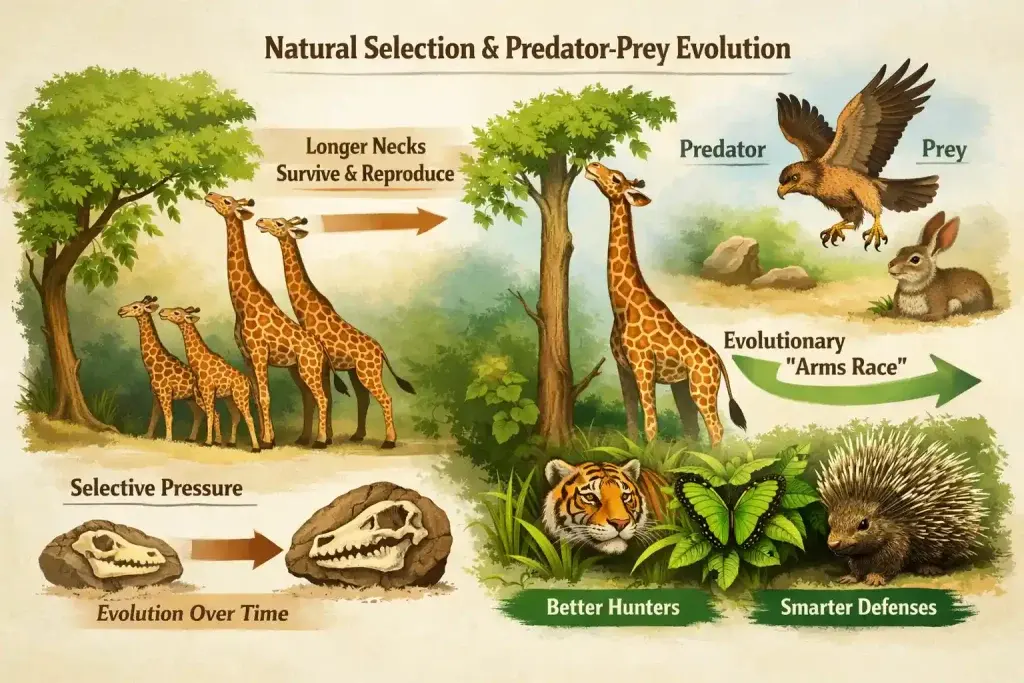
Natural selection functions through the interaction between environmental pressures and the inherent variation within a population. Every individual possesses a unique genetic makeup, leading to slight differences in physical traits, such as beak size, camouflage patterns, or metabolic efficiency. When the environment changes or resources become scarce, individuals with traits that provide a functional advantage are more likely to survive to reproductive age.
These survivors pass their beneficial genes to the next generation. Over many cycles, these advantageous traits accumulate, while less effective traits gradually diminish. This process does not happen to an individual during its lifetime; rather, it occurs across a population over vast spans of time. It is a blind, non-random process driven by the simple reality that those who reproduce successfully contribute more to the future gene pool.
- Variation exists within a population due to genetic mutations and recombination.
- Environmental pressures, such as predators or food shortages, create competition.
- Individuals with advantageous traits survive and reproduce at higher rates.
- Beneficial traits are inherited by offspring, increasing their prevalence in the population.
Why does natural selection happen?
Natural selection occurs because resources in nature are finite, creating a constant struggle for existence. No environment can support an infinite number of organisms, so individuals must compete for food, shelter, and mates. This competition acts as a sieve, filtering out those whose traits are poorly suited to the current conditions.
Furthermore, the environment is never static. Climate shifts, the arrival of new predators, or the depletion of specific food sources force populations to adapt or face extinction. Natural selection is the mechanism that allows life to track these environmental changes. By favoring traits that enhance survival, the process ensures that the population remains aligned with the demands of its habitat, maintaining the continuity of the species.
- Climate change and habitat loss.
- Introduction of new diseases or pathogens.
- Competition for limited nesting or hunting grounds.
- Changes in the availability of prey or vegetation.
How long does it take to see natural selection?
The timeframe for natural selection varies drastically depending on the generation time of the species and the strength of the selective pressure. Microorganisms, such as bacteria, can display observable changes in days or weeks because they reproduce rapidly. In these cases, researchers can witness the emergence of antibiotic resistance in a laboratory setting within a relatively short period.
For larger animals with longer lifespans, such as mammals, the process typically spans thousands or millions of years. However, rapid environmental shifts can accelerate this timeline. For example, the famous case of the peppered moth in 19th-century England showed a shift in coloration in just a few decades as industrial soot changed the environment. While major evolutionary leaps usually require geological timescales, natural selection is a continuous process that is technically occurring at all times.
Common mistakes when understanding natural selection
A frequent error is the belief that natural selection is a conscious or goal-oriented process. Organisms do not "choose" to evolve to meet a challenge; they either possess traits that allow them to survive or they do not. Evolution does not have an end goal of creating a "perfect" organism, as the environment is always changing and what is beneficial today may be useless tomorrow.
Another common misconception is that natural selection implies the survival of the strongest or most aggressive. In reality, it is the survival of the most "fit," which simply means the most effective at reproducing in a specific environment. A small, docile creature that is highly efficient at gathering food and avoiding predators is more "fit" than a large, aggressive one that cannot find enough sustenance to support its own body.
- Assuming individuals evolve during their lifetime.
- Thinking evolution always leads to increased complexity.
- Believing that natural selection is synonymous with "survival of the fittest" in a physical strength sense.
- Viewing evolution as a linear path toward humans.
Best examples of natural selection for beginners
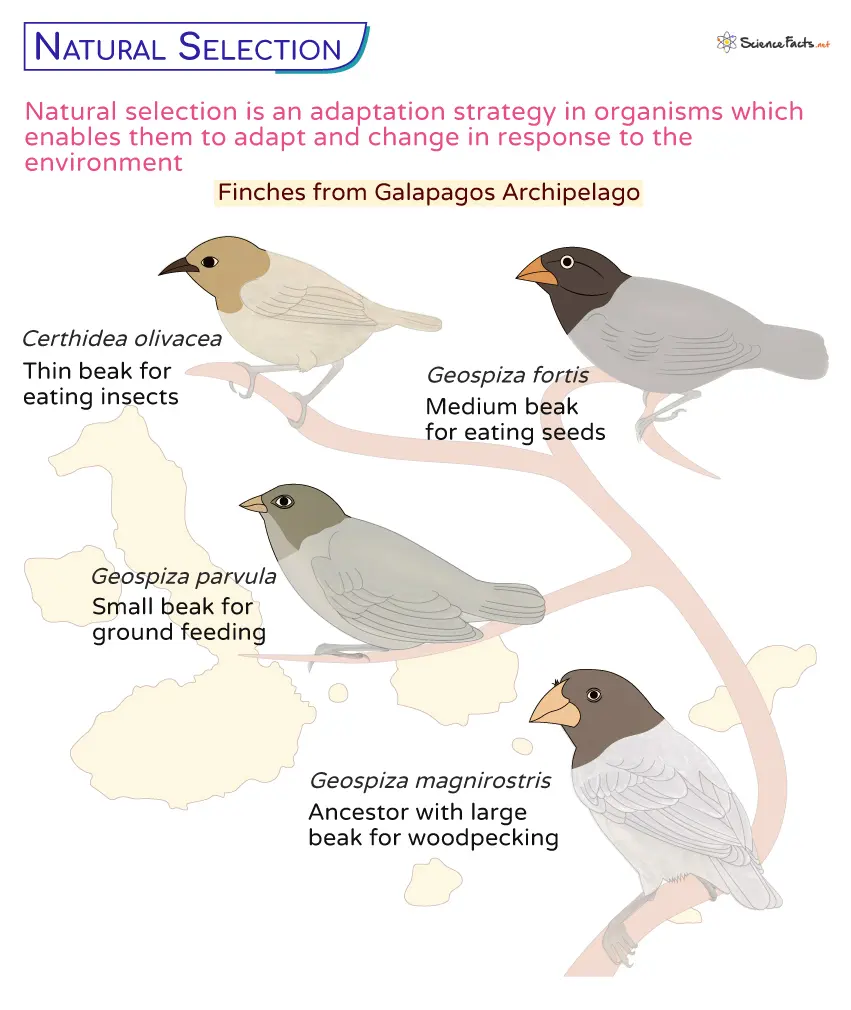
To understand this concept, look at the classic example of Darwin’s finches on the Galápagos Islands. Darwin observed that finch species had beaks perfectly adapted to the specific food sources available on their respective islands, such as hard seeds or insects. These variations arose as the birds occupied different niches, proving that environmental demands shape physical anatomy over time.
Another clear example is the development of pesticide resistance in insects. When a farmer sprays a crop, most insects die, but those with a rare genetic mutation that confers resistance survive. These survivors breed, and soon the entire population consists of resistant insects. This illustrates how quickly natural selection can act when a new, intense pressure is introduced to a population. These real-world observations confirm that the mechanisms Darwin described remain the foundation of modern biological science and our understanding of how life persists on Earth.
Key facts
- Natural selection is the process where organisms better adapted to their environment tend to survive and produce more offspring.
- Charles Darwin first detailed this mechanism in his 1859 book, On the Origin of Species.
- Genetic variation within a population is essential, as it provides the raw material for selection to act upon.
- Traits must be heritable to be passed down; acquired characteristics, like building muscle, are not passed to offspring.
- Selection does not create "perfect" organisms but rather favors traits that increase fitness in specific, changing environments.
- A common mistake is thinking individuals evolve; in reality, populations evolve over many generations as gene frequencies shift.
The bottom line
Natural selection is the fundamental engine of biological diversity, acting as a filter that preserves beneficial traits while discarding harmful ones over generations. By favoring individuals best suited to their surroundings, it shapes the complex web of life on Earth. Understanding this process reveals how species adapt to shifting climates and ecosystems, demonstrating that evolution is a continuous, logical response to the challenges of survival.
People also ask
How does natural selection differ from artificial selection?
Artificial selection occurs when humans intentionally breed plants or animals for specific traits, such as dog breeds or crop yields. Natural selection happens without human intervention, driven entirely by environmental pressures and survival needs.
Is natural selection the same thing as evolution?
No, natural selection is a mechanism that drives evolution, but it is not the only one. Evolution refers to the broader change in the inherited characteristics of a population over successive generations, which can also be influenced by genetic drift and mutation.
Can natural selection happen quickly?
Yes, it can occur rapidly if environmental pressures are intense and the generation time of the species is short. For example, antibiotic resistance in bacteria can emerge in just a few years due to the survival of resistant strains.
Does natural selection always lead to stronger or faster animals?
Not necessarily, as "fitness" in biology simply means the ability to survive and reproduce in a specific environment. Sometimes, being smaller, more camouflaged, or more efficient at conserving energy is more advantageous than being physically strong or fast.
What happens if a population has no genetic variation?
If there is no variation, natural selection cannot act because all individuals are identical in their traits. This makes the population highly vulnerable to extinction if the environment changes, as no individuals will possess the traits needed to adapt.
Is natural selection a random process?
While mutations—the source of new genetic variation—are random, natural selection itself is non-random. It is a systematic process that favors traits that provide a functional advantage for survival and reproduction in a given context.
This answer was created with the help of AI research tools and reference sources. Spotted an error? Let us know — we correct mistakes quickly. See our editorial policy.