What is Jasper Johns known for?
Short answer
Jasper Johns is an American artist renowned for bridging the gap between Abstract Expressionism and Pop art. He is best known for his iconic paintings of flags, targets, and maps. By utilizing everyday symbols, he challenged viewers to reconsider the nature of representation and the distinction between art and reality.
On this page
Why is Jasper Johns considered a bridge between art movements?
Jasper Johns emerged in the mid-1950s when the art world was dominated by the emotional, gestural style of Abstract Expressionism. While artists like Jackson Pollock focused on spontaneous, non-representational action, Johns introduced a cool, detached approach. He began painting familiar symbols that were already embedded in the public consciousness, such as the American flag. This shift redirected the focus from the artist’s internal psyche to the object itself.
By choosing subjects that were "things the mind already knows," Johns effectively dismantled the barrier between high art and mundane reality. His work forced critics to evaluate whether a painting was merely a representation of a flag or if the painting itself became the flag. This conceptual inquiry laid the essential groundwork for the Pop art movement, which would soon embrace commercial imagery. His influence remains foundational for artists interested in semiotics and the philosophical implications of visual representation.
What are the most famous works by Jasper Johns?
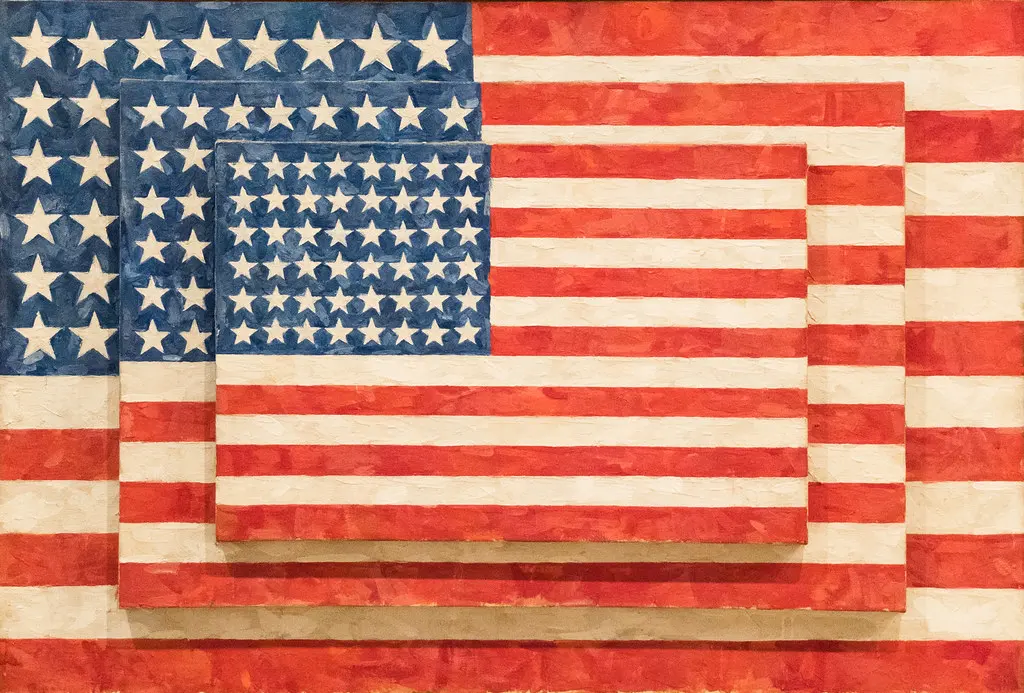
Johns gained immediate notoriety for his series of paintings depicting the American flag. His 1954 masterpiece, Flag, is perhaps his most recognizable work. Created using encaustic—a mixture of pigment and hot wax—the piece possesses a textured, tactile quality that distinguishes it from a flat graphic design. He followed this success with other iconic subjects that explore repetition and cultural iconography.
The following list highlights some of his most significant recurring motifs:
- Flags: His series of American flags, often rendered in monochromatic or traditional palettes.
- Targets: Concentric circles that emphasize the flatness of the canvas.
- Maps: Representations of the United States that blur the lines between geography and abstraction.
- Numbers and Alphabets: Stenciled characters that examine the structure of language and visual order.
- Crosshatch patterns: Complex, rhythmic marks that define his later, more abstract aesthetic.
How to analyze a Jasper Johns painting?
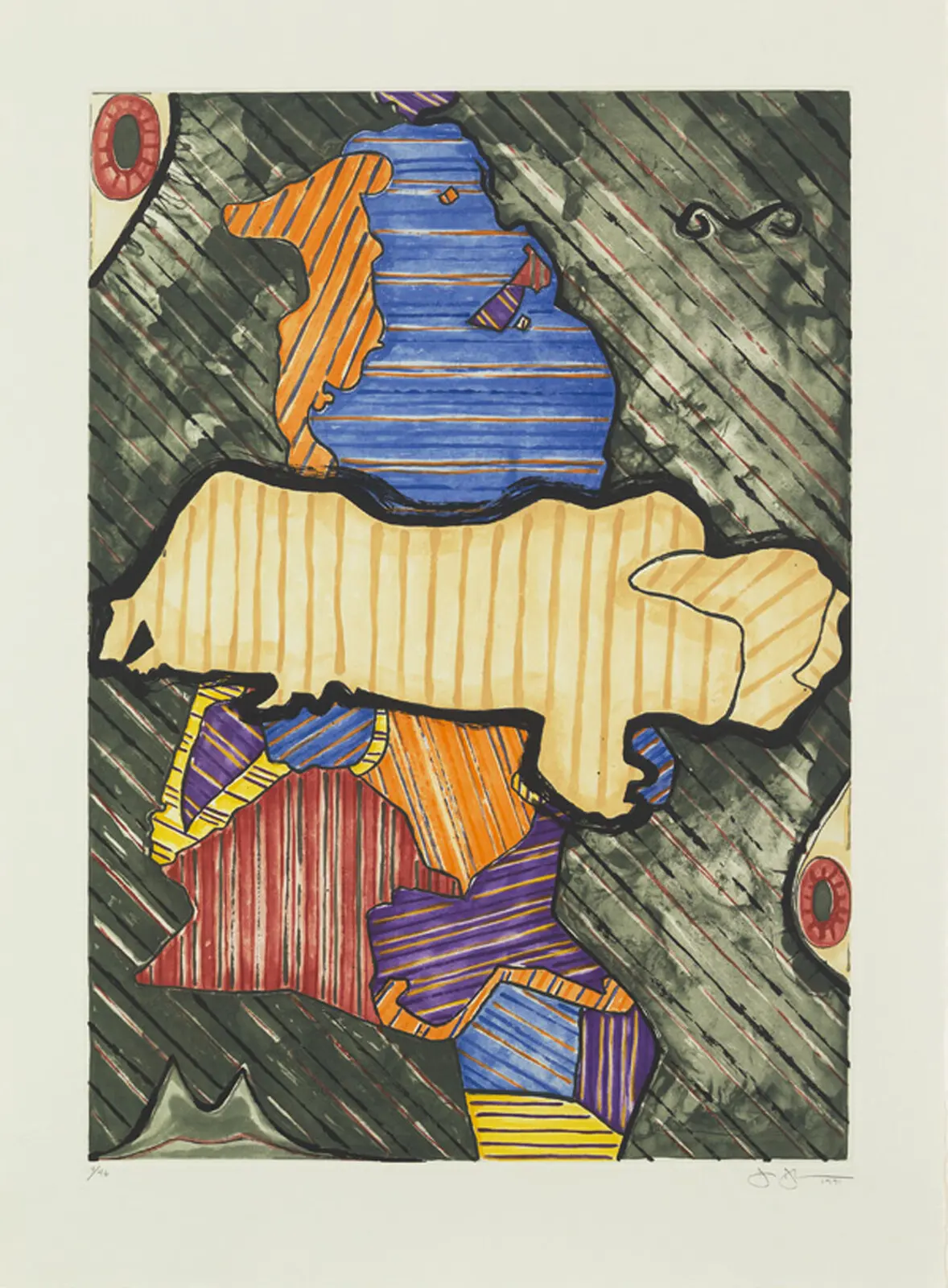
Analyzing a work by Johns requires looking past the subject matter and observing his unique technical execution. Because he often used encaustic, his surfaces are layered and physically dense, often incorporating collage elements like newspaper clippings. When viewing his work, consider how the medium interacts with the image. The texture often contradicts the simplicity of the symbol, suggesting that the painting is a physical object rather than a window into a scene.
To effectively engage with his work, follow these observational steps:
- Identify the subject: Recognize the symbol, such as a target or map, and acknowledge its familiarity.
- Examine the surface: Look for brushstrokes, drips, or embedded materials that reveal the artist's labor.
- Consider the context: Ask how the choice of a common symbol challenges traditional definitions of fine art.
- Note the color palette: Observe whether he uses primary colors or muted tones to influence your emotional response.
Common mistakes when interpreting Jasper Johns
A frequent error is assuming that Johns’s work is purely political or patriotic. While his use of the American flag is striking, he has consistently stated that his choices were driven by formal concerns rather than ideological statements. Viewers often search for hidden meanings or social critiques that the artist never intended. By projecting personal political beliefs onto the work, one misses the artist’s primary goal of exploring perception and visual language.
Another mistake is dismissing his work as merely reproductive or derivative of commercial art. Unlike Pop artists who celebrated mass-produced culture, Johns’s process is laborious and deeply personal. He does not simply copy an image; he reconstructs it through a slow, deliberate application of paint. Failing to recognize this craftsmanship leads to an incomplete understanding of his role in the history of 20th-century art. Always focus on the tension between the recognizable subject and the abstract application of material.
How to learn more about his artistic process?
The best way to understand Johns is to study his transition from painting to printmaking and sculpture. Throughout his long career, he has experimented with lithography, etching, and bronze casting. His sculptures, such as Painted Bronze (1960), which features two beer cans, further interrogate the status of everyday objects in a gallery setting. These works demonstrate his commitment to questioning how we assign value to the items that surround us daily.
To deepen your appreciation, consider these practical approaches:
- Visit major museum collections, such as the Museum of Modern Art or the Whitney Museum, to see the scale and texture of his works in person.
- Read his published interviews to understand his philosophical approach to art-making.
- Study his use of "found objects" to see how he incorporates physical items into his compositions.
- Observe his evolution from the rigid symbols of the 1950s to the more fluid, introspective crosshatch paintings of the 1970s and beyond.
By observing these shifts, you will gain a comprehensive view of how one artist continuously redefined the boundaries of modern visual expression throughout his many decades of professional production.
Key facts
- Jasper Johns gained international fame in 1958 after his first solo exhibition at the Leo Castelli Gallery in New York.
- He is best known for his series of paintings depicting the American flag, the first of which, Flag (1954), was inspired by a dream.
- His work bridges the gap between Abstract Expressionism and Pop Art by using familiar signs, targets, and numbers as subjects.
- Johns pioneered the use of encaustic, a technique involving pigment mixed with hot wax, which gives his paintings a tactile, sculptural quality.
- He was a central figure in the Neo-Dada movement, challenging the idea that art must express deep personal emotion.
- To understand his work, focus on the distinction between the object itself and the representation of the object, a core theme in his practice.
The bottom line
Jasper Johns transformed 20th-century art by shifting the focus from emotional expression to the objective nature of signs and symbols. By painting everyday icons like flags and targets with thick, tactile textures, he forced viewers to reconsider the relationship between reality and representation. His work remains a vital bridge between the raw intensity of Abstract Expressionism and the cool, detached irony of the Pop Art movement.
People also ask
Did Jasper Johns create the first Pop Art painting?
While he is often credited as a precursor to Pop Art, he is more accurately categorized as a Neo-Dadaist. His work influenced Pop artists like Andy Warhol by elevating mundane, commercial imagery to the status of fine art.
Why are his paintings of flags and targets so expensive?
Johns is considered one of the most important living artists, and his works are rare in the private market. High demand from museums and elite collectors drives prices into the tens of millions of dollars at auction.
What is the significance of the "Neo-Dada" label?
This term describes artists in the 1950s who rejected the seriousness of Abstract Expressionism. They used irony, found objects, and everyday symbols to question the traditional boundaries between art and reality.
How can I identify a Jasper Johns painting?
Look for recognizable, flat symbols like maps, numerals, or alphabets rendered with heavy, textured brushwork. He often incorporates collage elements, such as newspaper clippings or plaster casts, directly onto the canvas.
Is his work considered abstract or realistic?
It is both. Johns paints realistic, recognizable objects, but he treats them as abstract patterns of color and line, forcing the viewer to notice the physical surface of the painting rather than just the subject matter.
What is the best way to approach his art if I am a beginner?
Do not search for a hidden, emotional message. Instead, observe the materials and the way he repeats simple shapes, which allows you to appreciate the technical skill and the conceptual playfulness of his compositions.
This answer was created with the help of AI research tools and reference sources. Spotted an error? Let us know — we correct mistakes quickly. See our editorial policy.