What is inertia?
Short answer
Inertia is the inherent property of matter that causes an object to resist changes to its state of motion. An object at rest remains at rest, and an object in motion continues moving at a constant velocity unless acted upon by an external force, as defined by Isaac Newton’s first law of motion.
![9+ Polar Moment Of Inertia Formulas [2026]](/img/d0/what-is-inertia-1.webp)
On this page
What is the definition of inertia
Inertia is a fundamental concept in physics that describes the tendency of physical objects to maintain their current state of motion. Whether an object is sitting stationary on a table or traveling through space at thousands of miles per hour, it will not change its speed or direction unless a net force is applied to it. This resistance to change is not a force in itself but rather a property of mass.
The more mass an object possesses, the greater its inertia. For example, it is significantly harder to push a heavy shipping container than it is to push a small wooden box. Because the container has more matter, it requires a much larger external force to overcome its inertia and initiate movement. This relationship between mass and inertia is the cornerstone of classical mechanics, first formalized in the 17th century.
Why inertia happens in everyday life
Inertia is responsible for many common experiences, such as the sudden jerk felt when a car brakes abruptly. As the vehicle slows down, your body continues moving forward at the original speed because of its inertia. Your seatbelt provides the necessary external force to stop your momentum, preventing you from colliding with the dashboard. This illustrates how inertia governs the behavior of objects in transit.
You can observe inertia in various daily scenarios:
- A tablecloth trick relies on inertia to keep dishes in place while the fabric is pulled away rapidly.
- A passenger standing in a bus leans backward when the vehicle accelerates because their body resists the change from rest.
- A spinning figure skater keeps their arms tucked in to maintain angular momentum, demonstrating inertia in rotational motion.
- A soccer ball left on a field will stay there indefinitely until a player kicks it, overcoming its static inertia.
How to calculate inertia in physics
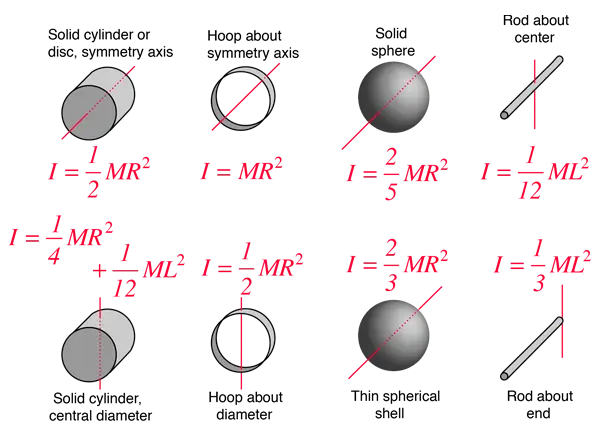
In physics, the term "moment of inertia" is used to describe how difficult it is to rotate an object around a specific axis. Unlike linear inertia, which depends solely on mass, the moment of inertia depends on how that mass is distributed relative to the rotation point. Objects with mass concentrated further from the axis of rotation are harder to spin than those with mass near the center.
To determine the moment of inertia for simple shapes, physicists use specific formulas based on the object's geometry. You can calculate it by following these steps:
- Identify the axis of rotation for the object in question.
- Determine the total mass of the object and its distance from the axis.
- Apply the appropriate geometric formula, such as I = mr² for a point mass.
- Sum the moments of all individual parts if the object has a complex shape.

Common mistakes when understanding inertia
A frequent error is confusing inertia with momentum. While inertia is a property of an object's mass, momentum is a measure of motion calculated by multiplying mass by velocity. An object can have high inertia due to its mass but zero momentum if it is not moving. Distinguishing between these two concepts is vital for understanding how forces affect objects in different states.
Another common misconception is believing that inertia is a force that pushes back against movement. In reality, inertia is passive; it is simply the absence of a change in state. When you feel "pushed" back into your seat during a car’s acceleration, you are not experiencing a force of inertia. Instead, you are experiencing the sensation of your body maintaining its state of rest while the car moves forward beneath you.
How to demonstrate inertia at home
You can easily demonstrate the principles of inertia using household items. These experiments provide a clear visual representation of how objects resist changes to their motion. By performing these tasks, you can observe the difference between static inertia, which keeps objects still, and dynamic inertia, which keeps objects moving until they encounter friction or another external force.
Follow these instructions to safely observe inertia in action:
- Place a coin on top of a stiff piece of cardboard, which is resting over an empty glass.
- Flick the cardboard away sharply with your finger.
- Observe how the coin drops straight into the glass rather than moving with the cardboard.
- Repeat the process with different objects to see how varying masses affect the outcome.
- Ensure you use a smooth surface to minimize friction, which is the primary force that eventually stops moving objects in our environment and masks the effects of inertia.
Key facts
- Inertia is the tendency of an object to resist any change in its state of motion or rest.
- Sir Isaac Newton formally defined this concept in his 1687 work, Philosophiæ Naturalis Principia Mathematica.
- Mass is the quantitative measure of inertia; the more mass an object has, the harder it is to accelerate.
- A common mistake is thinking inertia only applies to moving objects; it applies equally to stationary ones.
- To reduce the effect of inertia when moving heavy furniture, use sliders to minimize friction, which acts against your force.
- In a car, seatbelts are essential because they provide the external force needed to overcome your body's forward inertia during sudden stops.
The bottom line
Inertia is the fundamental property of matter that ensures objects keep doing what they are already doing. Whether an object is sitting still or traveling through space, it will resist changes to its velocity unless acted upon by an outside force. Understanding this concept helps explain everything from how seatbelts save lives to why heavy objects are difficult to push or stop in daily life.
People also ask
Does inertia depend on gravity?
No, inertia is an intrinsic property of matter related to mass, not weight. While weight changes depending on the gravitational field, an object's inertia remains constant regardless of its location in the universe.
Why do we feel pushed back when a car accelerates?
You are not actually being pushed backward; your body is simply trying to remain at rest due to inertia. The car is moving forward beneath you, and your body resists that change in velocity until the seat pushes you forward.
Is inertia the same thing as momentum?
They are related but distinct concepts. Inertia is the resistance to change in motion, while momentum is the product of an object's mass and its velocity.
Can an object have zero inertia?
Theoretically, only a particle with no mass, such as a photon, lacks inertia. Anything composed of matter possesses some degree of inertia, no matter how small.
Why is it harder to stop a heavy truck than a bicycle moving at the same speed?
The truck has significantly more mass, which means it has more inertia. Because it resists changes in its motion more strongly, it requires a much greater force to slow down or stop.
Does inertia exist in outer space?
Yes, inertia is a fundamental law of physics that applies everywhere. An object floating in deep space will continue moving in a straight line at a constant speed forever unless a force acts upon it.
This answer was created with the help of AI research tools and reference sources. Spotted an error? Let us know — we correct mistakes quickly. See our editorial policy.