What is cross contour drawing?
Short answer
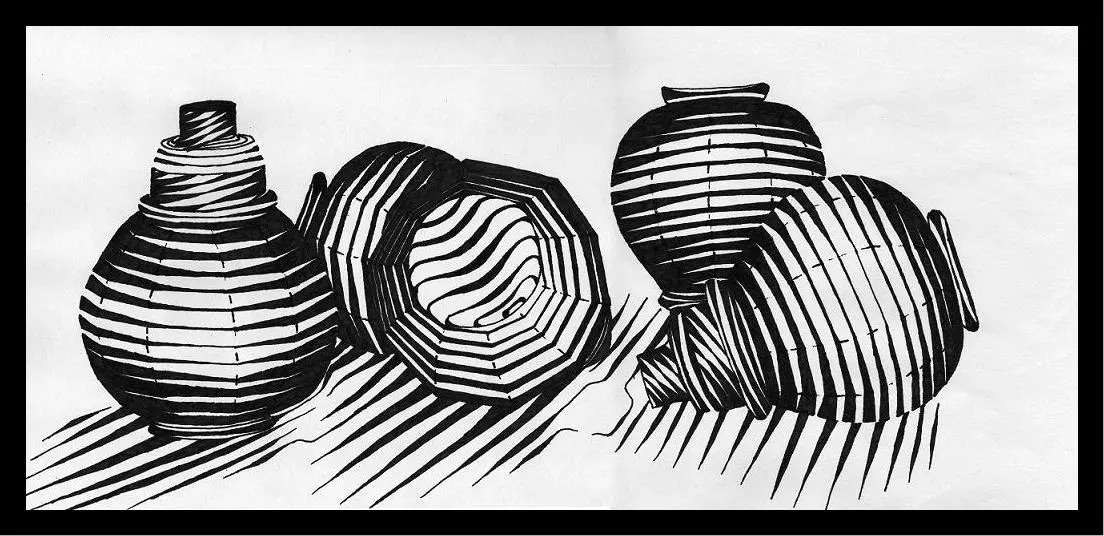
Cross contour drawing is a technique where lines are drawn across the surface of an object to describe its three-dimensional volume and topography. By following the physical curves and planes of a subject, these lines act like a topographical map, revealing how an object turns in space and defining its overall form.
On this page
What is cross contour drawing?
Cross contour drawing is a fundamental practice in representational art used to translate three-dimensional depth onto a two-dimensional surface. Unlike a standard outline, which only defines the outer edges of an object, cross contour lines travel across the interior surface. These lines act as if you are wrapping a piece of string around a form, following its every bump, dip, and curve. By visualizing the object as a series of interconnected cross-sections, the artist can effectively communicate volume, mass, and weight.
This technique is deeply rooted in the study of form and structure. It forces the artist to move beyond superficial observation and engage with the physical reality of the subject. When you draw a cross contour, you are essentially mapping the topography of the object. Whether you are drawing a simple sphere or a complex human figure, these lines provide the essential structural framework that makes an object appear solid rather than flat or hollow.
How to practice cross contour drawing
To begin practicing this technique, start with simple, geometric objects like an apple, a coffee mug, or a ball. These subjects have clear, predictable curves that make it easier to understand how lines should wrap around a form. As you progress, you can move toward more complex subjects like human anatomy or intricate fabric folds. Consistency is key to developing the spatial awareness required to master this skill.
- Select a simple object with a clear, rounded form.
- Observe the object carefully to identify the direction of its primary curves.
- Lightly draw a single line that travels from one side of the object to the other, following the surface curvature.
- Add additional lines at regular intervals to create a grid-like effect across the entire surface.
- Adjust the spacing of your lines to emphasize areas where the object curves away or toward the viewer.
Why use cross contour lines in art?
The primary advantage of cross contour drawing is its ability to create a sense of tactile reality. By describing the surface planes, the artist provides the viewer with visual cues that suggest how the object would feel to the touch. This technique is particularly useful for artists who struggle with making their drawings look "flat." Because the lines follow the physical logic of the object, they naturally guide the eye around the form, reinforcing the illusion of depth.
Beyond basic volume, cross contour lines are instrumental in understanding lighting and shading. When an artist decides where to place these lines, they often consider how light interacts with the surface. Areas where the lines are closer together may suggest a tighter turn or a shadow, while wider spacing can indicate a flatter surface or a highlight. This dual purpose makes cross contouring an essential step in the transition from simple line drawing to sophisticated, rendered artwork.
Common mistakes when drawing cross contours
One of the most frequent errors beginners make is drawing lines that are perfectly straight or parallel, regardless of the object's shape. If you draw a straight line across a curved surface, the object will immediately lose its volume and appear distorted. Another common mistake is failing to account for the perspective of the viewer. If the lines do not accurately reflect the object's orientation in space, the drawing will lack structural integrity and look disjointed or illogical to the observer.
- Ignoring the subtle changes in surface direction, such as small indentations or ridges.
- Drawing lines that are too dark or heavy, which can obscure the form rather than define it.
- Failing to maintain a consistent interval between lines, which can lead to an uneven or confusing representation of the surface.
- Forgetting to consider the "hidden" side of the object, which leads to lines that terminate abruptly instead of flowing naturally around the form.
Best tools for cross contour drawing
For those just starting, simple graphite pencils are the best tools for the job. A standard HB or 2B pencil allows for a range of pressure, which is vital for varying the weight of your contour lines. Using a soft eraser is also helpful, as it allows you to refine your lines and correct the flow of your "topographical map" without damaging the paper surface. As you become more confident, you might experiment with fine-liner pens or charcoal to achieve different textural effects.
When choosing your surface, opt for smooth, medium-weight drawing paper. Rough-textured paper can interfere with the fluid motion of your hand, making it difficult to maintain the precision required for accurate cross contouring. Keep your strokes loose and fluid rather than rigid or mechanical. By focusing on the movement of your arm and wrist, you will find that your lines naturally follow the curves of your subject, resulting in a more dynamic and convincing representation of three-dimensional space.
Key facts
- Cross contour drawing uses lines that travel across the surface of a form to define its volume and three-dimensional shape.
- Think of these lines as topographical map lines or wireframes that wrap around an object to reveal its curves and depressions.
- Unlike standard outline drawing, which only marks the outer edge, cross contour lines move through the interior of the subject.
- To practice, imagine a fly walking across the surface of an object and draw the path it would take to traverse the form.
- Varying the density of your lines helps suggest shading; closer lines indicate shadows or tighter curves, while spaced lines suggest flatter areas.
- Avoid drawing flat, straight lines across a curved surface, as this flattens the image rather than enhancing its perceived depth.
The bottom line
Cross contour drawing is a fundamental technique that transforms flat sketches into three-dimensional representations. By drawing lines that wrap around the surface of an object like a topographical map, you reveal its volume, curves, and structural depth. This practice sharpens your spatial awareness and improves your ability to render complex forms realistically. Mastering this skill allows you to communicate the physical reality of any subject effectively.
People also ask
How does cross contour differ from blind contour drawing?
Blind contour drawing focuses on carefully observing the edges of an object without looking at your paper. Cross contour drawing specifically emphasizes the interior volume and surface structure of an object through wrapping lines.
Can cross contour lines be used in digital art?
Yes, digital artists use cross contour techniques to create wireframe models or to define the surface planes of characters and objects. These lines are essential for understanding how light and shadow should wrap around a form.
Do cross contour lines need to be perfectly accurate?
While they should follow the general flow of the object, they are primarily a tool for visualization and practice. Their main purpose is to train your brain to perceive three-dimensional depth on a two-dimensional surface.
Is cross contour drawing useful for beginners?
It is an excellent exercise for beginners because it forces you to stop seeing objects as flat shapes. By mapping the surface, you develop a stronger understanding of perspective and spatial relationships.
Should I use a specific type of pen or pencil?
Any drawing tool works, but a pencil is best for beginners because it allows you to adjust the pressure. Lighter pressure helps you map the form without committing to permanent, dark lines too early.
Can I use cross contour lines on human figures?
Cross contour is highly effective for drawing anatomy, especially when mapping muscles or limbs. By drawing lines that wrap around an arm or torso, you can emphasize the roundness and muscular structure of the body.
This answer was created with the help of AI research tools and reference sources. Spotted an error? Let us know — we correct mistakes quickly. See our editorial policy.