What causes earthquakes?
Short answer
Earthquakes are caused by the sudden release of energy in the Earth's crust, which creates seismic waves. This typically occurs when massive tectonic plates move against each other, building up immense friction and stress. When the pressure exceeds the strength of the rock, it snaps or slips, causing the ground to shake.
On this page
Why do earthquakes happen?
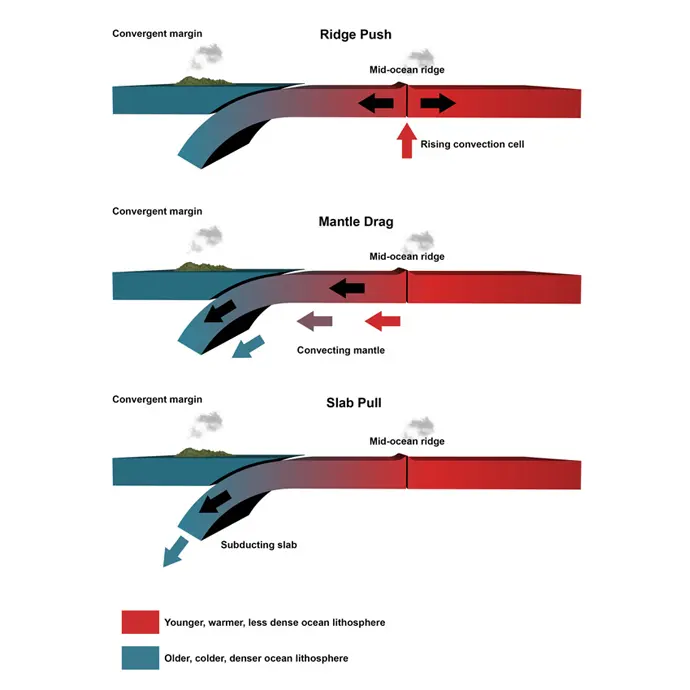
The Earth’s outer shell, known as the lithosphere, is broken into several large, rigid pieces called tectonic plates. These plates float on the semi-fluid asthenosphere beneath them, constantly moving at a pace similar to the growth of human fingernails. Most earthquakes occur at the boundaries where these plates meet, known as fault lines. As plates push, pull, or slide past one another, they often become locked due to friction.
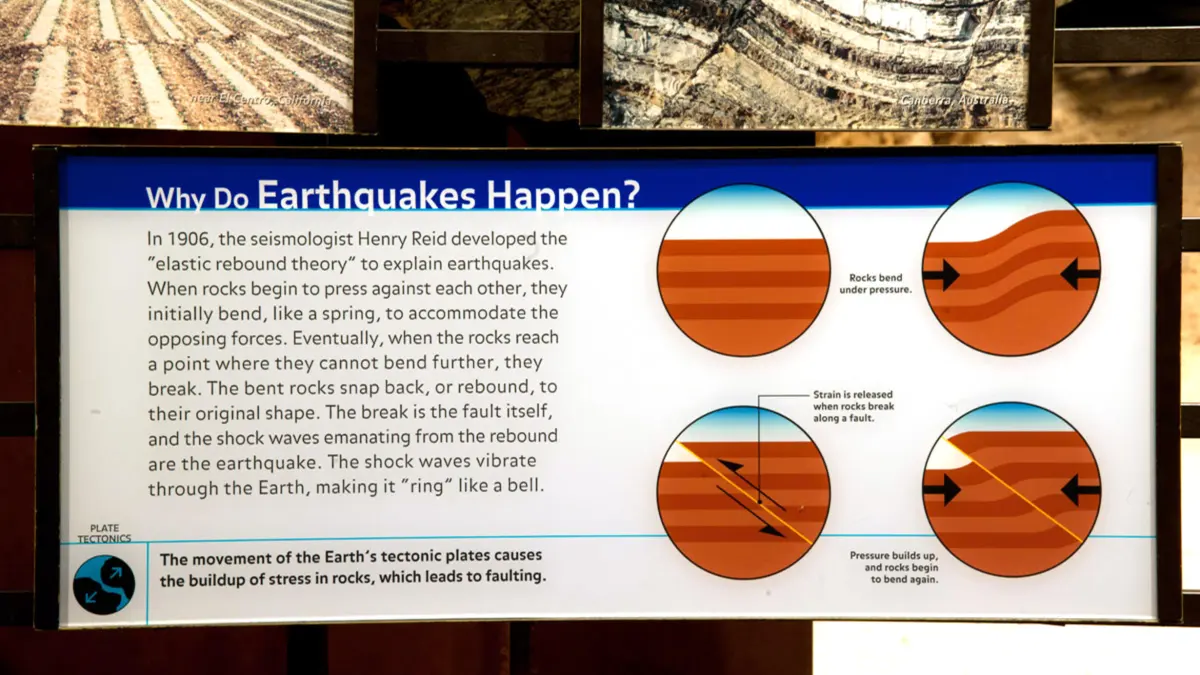
While the plates remain stuck, they continue to move, causing the rocks at the fault to deform and store elastic strain energy. Eventually, the stress becomes too great, and the rock suddenly ruptures or slips along the fault plane. This instantaneous movement releases the stored energy in the form of seismic waves that radiate outward in all directions. These waves are what we feel as the shaking of the ground during an earthquake.
How do scientists measure earthquakes?
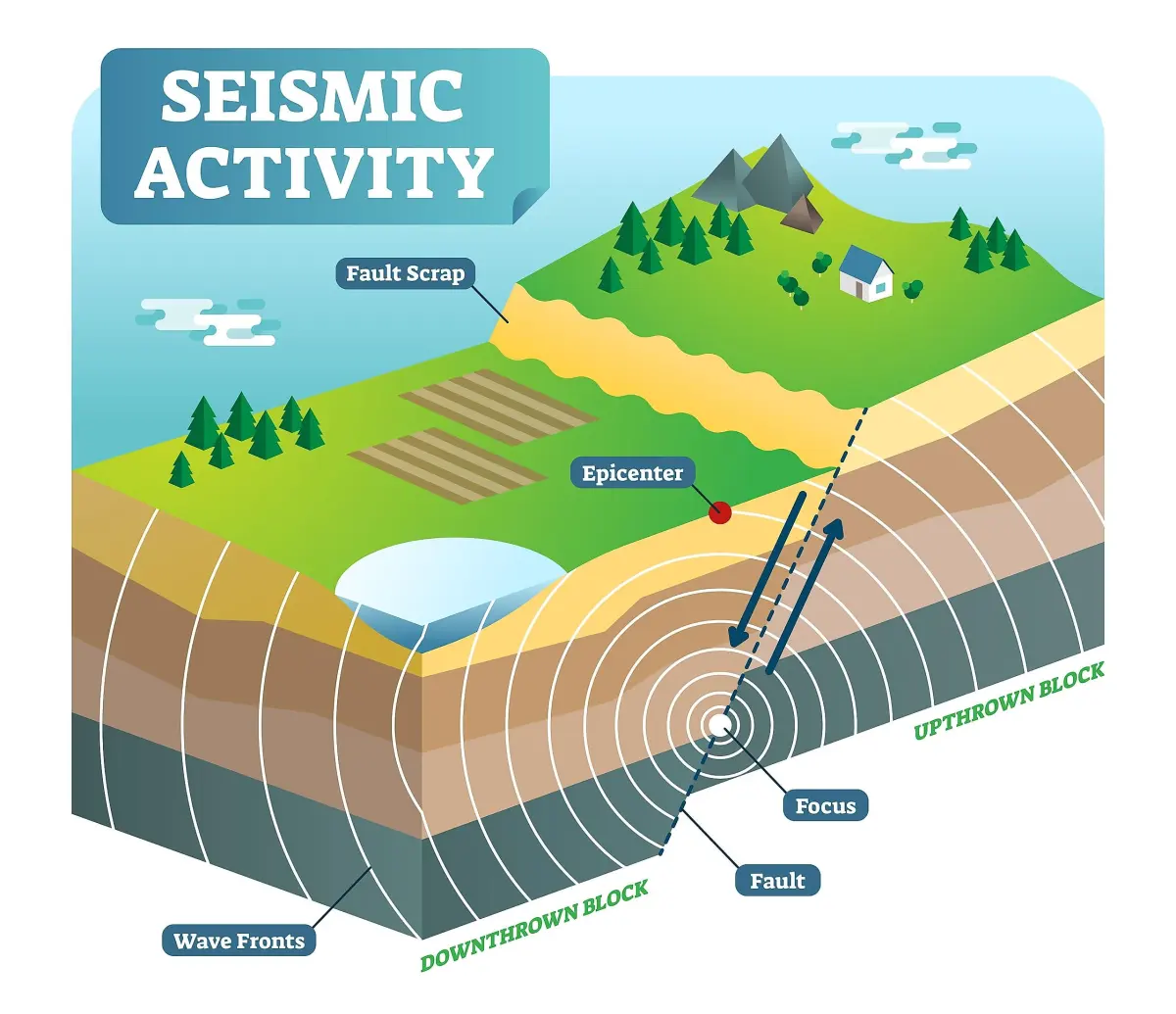
Seismologists use specialized instruments called seismometers to detect the vibrations caused by seismic waves. These devices record the intensity and duration of the shaking, allowing experts to determine the earthquake's epicenter, which is the point on the surface directly above the rupture. Data from multiple stations are triangulated to pinpoint the exact location of the event.
To quantify the size of an earthquake, scientists rely on specific scales:
- The Moment Magnitude Scale (Mw): This is the standard measure for modern seismology, calculating the total energy released based on the fault's slip distance and the area of the rupture.
- The Modified Mercalli Intensity Scale: This measures the observed effects and damage caused by an earthquake at specific locations, ranging from "not felt" to "total destruction."
- Richter Scale: While historically famous, it is now rarely used by scientists because it is less accurate for very large, distant earthquakes compared to the Moment Magnitude Scale.
Where are earthquakes most common?
Earthquakes are not distributed randomly across the globe; they are concentrated along specific zones where tectonic plates interact. The most famous of these regions is the "Ring of Fire," a horseshoe-shaped belt around the Pacific Ocean. This area contains the majority of the world’s active volcanoes and experiences roughly 90 percent of all global earthquakes due to the subduction of plates beneath one another.
Other major seismic zones include the Alpide belt, which stretches from the Mediterranean through the Middle East and into the Himalayas. These regions are characterized by the collision of continental plates, which creates massive mountain ranges and frequent seismic activity. While major events are most common in these zones, intraplate earthquakes can also occur within the interior of tectonic plates, though these are significantly less frequent and often harder to predict.
How to prepare for an earthquake?
Preparedness is the most effective way to minimize risk during a seismic event. Because earthquakes provide no warning, having a plan in place is essential for survival. Experts recommend focusing on securing your environment and maintaining a supply kit.
- Secure heavy furniture, such as bookshelves and mirrors, to wall studs to prevent them from falling during shaking.
- Identify safe spots in every room, such as under sturdy tables or against interior walls away from glass.
- Assemble an emergency kit containing at least three days of water, non-perishable food, a flashlight, a battery-powered radio, and a first-aid kit.
- Establish a communication plan with family members to ensure everyone knows how to reconnect if cellular networks fail.
Regularly practicing a "Drop, Cover, and Hold On" drill ensures that your reaction is automatic when the ground begins to shake. Knowing where to go and what to do within the first few seconds can prevent injuries caused by falling debris.
Common mistakes when earthquake safety is concerned
Many people hold misconceptions that can lead to dangerous actions during an earthquake. One of the most common mistakes is the belief that standing in a doorway is the safest place to be. In modern homes, doorways are no stronger than any other part of the house and do not provide protection from falling objects. Another dangerous error is attempting to run outside while the ground is still shaking.
- Do not stand near windows, glass partitions, or exterior walls, as these are the first elements to shatter and collapse.
- Avoid using elevators, as power outages are common and can trap you inside for hours.
- Do not attempt to re-enter a damaged building after the shaking stops, as aftershocks can cause weakened structures to collapse without warning.
- Do not rely on the "triangle of life" theory, which suggests crouching next to a sofa; instead, prioritize getting under a heavy object that can shield you from falling debris.
By avoiding these myths and following established safety protocols, you significantly increase your chances of remaining safe during and after a major earthquake event.
Key facts
- Earthquakes are caused by the sudden release of energy in the Earth's crust, creating seismic waves.
- The Earth’s outer shell is divided into massive, constantly moving pieces called tectonic plates.
- Friction causes these plates to get stuck at their edges while the rest of the plate keeps moving.
- When the built-up stress exceeds the strength of the rocks, they snap, causing the ground to shake.
- Secure heavy furniture like bookshelves and water heaters to wall studs to prevent them from falling during a tremor.
- During an earthquake, immediately drop, cover, and hold on under a sturdy table rather than running outside.
The bottom line
Earthquakes result from the dynamic movement of tectonic plates that build up and suddenly release immense energy. While these geological events are inevitable and unpredictable, you can significantly reduce personal risk by anchoring heavy furniture and practicing the drop, cover, and hold on technique. Understanding these fundamental mechanics empowers you to prepare effectively, ensuring you remain calm and protected when the ground begins to shift.
People also ask
What is the difference between the epicenter and the focus?
The focus, or hypocenter, is the exact point underground where the earthquake begins. The epicenter is the point on the surface directly above the focus where the shaking is usually most intense.
How do scientists measure the strength of an earthquake?
Scientists use the moment magnitude scale to measure the total energy released by an earthquake. This logarithmic scale means each whole number increase represents about 32 times more energy release.
Can we predict when an earthquake will happen?
Currently, there is no scientific method to predict the exact time, location, or magnitude of an earthquake. Experts can only provide long-term probabilistic forecasts based on historical data and geological stress patterns.
What are aftershocks?
Aftershocks are smaller earthquakes that occur in the same region after a larger mainshock. They are the Earth’s way of readjusting to the new stress distribution caused by the initial rupture.
Why do some earthquakes cause tsunamis?
Tsunamis occur when a large earthquake happens under the ocean and causes a vertical displacement of the seafloor. This movement pushes a massive column of water upward, creating waves that travel across the ocean.
Is it safe to stand in a doorway during an earthquake?
Modern building standards make doorways no stronger than any other part of a room. You are much safer under a sturdy table or desk, which protects you from falling debris.
This answer was created with the help of AI research tools and reference sources. Spotted an error? Let us know — we correct mistakes quickly. See our editorial policy.