How big is the universe?
Short answer
The observable universe is a sphere with a diameter of approximately 93 billion light-years. While the entire universe may be infinite, we are limited by the speed of light and the age of the cosmos, which prevents us from seeing anything beyond this specific cosmic horizon regardless of the technology used.
On this page
How big is the observable universe?
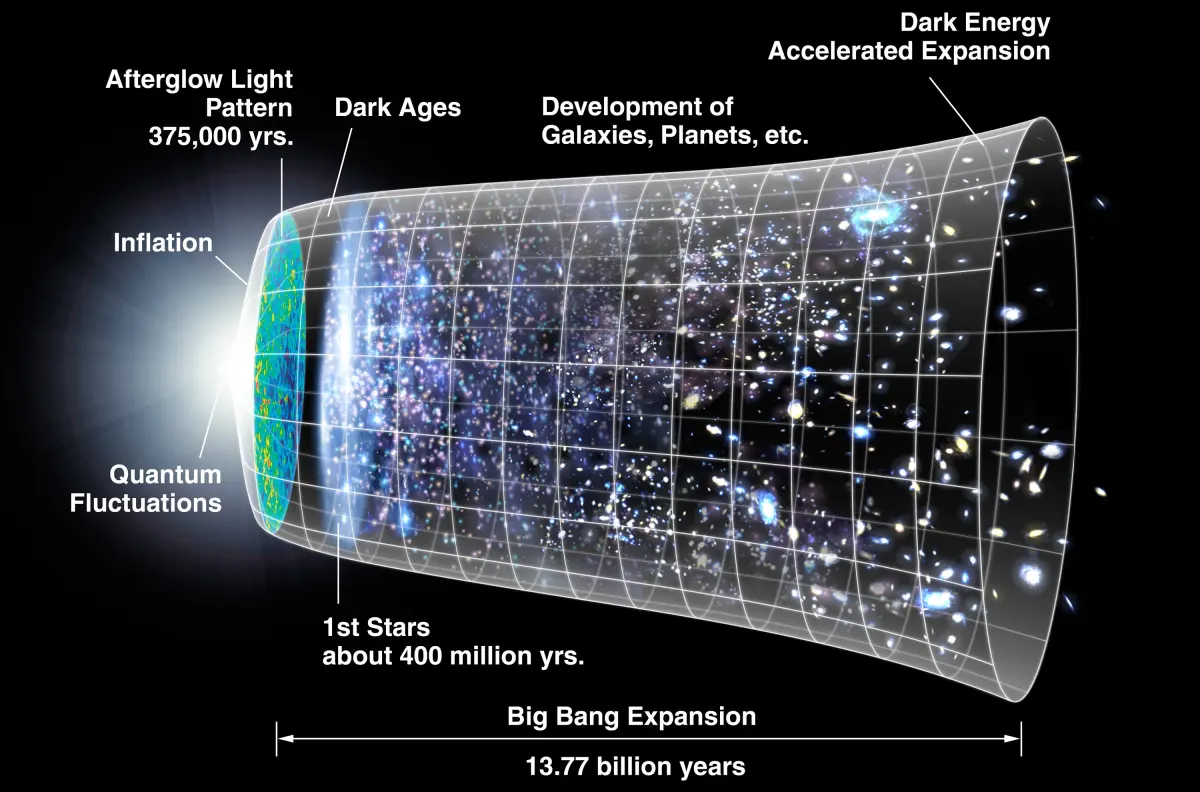
The observable universe represents the portion of space from which light has had enough time to reach Earth since the Big Bang occurred 13.8 billion years ago. Although it seems logical to assume the radius would be 13.8 billion light-years, the universe has been expanding throughout that entire duration. Space itself stretches, carrying distant galaxies further away from us even as their light travels toward our telescopes.
Because of this rapid expansion, the objects that emitted the light we see today are now much farther away than they were when the light began its journey. Current calculations place the diameter of this observable sphere at about 93 billion light-years. This boundary is often called the cosmic light horizon, acting as a physical limit to our observations. Beyond this point, light has not had enough time to reach us, rendering those regions invisible.
How do scientists measure the universe?
Measuring such vast distances requires a multi-step process known as the cosmic distance ladder. Astronomers use different "standard candles"—objects with known intrinsic brightness—to calculate distances across increasingly large scales. By comparing how bright these objects appear from Earth to their known luminosity, scientists can derive the distance to their host galaxies.
- Parallax: Measuring the slight shift in a star's position as Earth orbits the Sun.
- Cepheid Variables: Using stars that pulse at rates directly related to their true brightness.
- Type Ia Supernovae: Utilizing these massive stellar explosions as consistent beacons across billions of light-years.
- Redshift: Measuring how much the light from distant galaxies has stretched toward the red end of the spectrum due to cosmic expansion.
These methods allow researchers to map the structure of the universe with increasing precision. By combining these measurements, we can construct a three-dimensional model of the local and distant cosmos.

Why is the universe larger than its age?
A common point of confusion involves the relationship between the age of the universe and its size. Since the universe is 13.8 billion years old, one might expect the radius to be 13.8 billion light-years. However, the metric expansion of space means that the distance between any two points in the universe is constantly growing.
Imagine an ant walking on a rubber band that is being stretched while the ant moves. Even if the ant walks at a constant speed, the distance between its starting point and its destination increases while it is in transit. Similarly, light travels through space that is expanding, which effectively pushes the source of the light further away. Consequently, the light we detect today from the most distant galaxies originated from points that have since receded to distances far exceeding the age of the universe in light-years.
What is the difference between observable and total universe?
The observable universe is merely a bubble within a potentially much larger, or even infinite, whole. Cosmological models based on the flatness of space suggest that the total universe could be significantly larger than the 93 billion light-years we can see. If the universe is spatially infinite, then the observable portion is just a tiny, finite sample of an endless expanse.
- The observable universe: A finite sphere centered on Earth, limited by the speed of light.
- The global universe: The entirety of space-time, which may be infinite in extent.
- Cosmic curvature: Measurements of the cosmic microwave background radiation suggest the universe is "flat," supporting the theory of an infinite structure.
Distinguishing between these two concepts is vital. We have no way to observe the "rest" of the universe, so our understanding of its total size remains theoretical, based on the geometry of space-time and the rate of expansion.
Common mistakes when thinking about the universe
One frequent error is imagining the Big Bang as an explosion that happened at a specific point in space. Instead, the Big Bang was an expansion of space itself, occurring everywhere at once. There is no "center" of the universe, and we are not at the middle of it; every point in the cosmos sees its own unique observable horizon.
Another mistake is assuming that galaxies move through space to reach their current positions. In reality, galaxies are mostly stationary relative to their local space, while the space between them expands. To avoid these misconceptions, remember that:
- The universe does not expand "into" anything; it is the entirety of existence.
- Distant galaxies are not moving away from us because of their own kinetic energy, but because the fabric of space is growing.
- The cosmic horizon is not a physical wall, but a temporal limit defined by the finite speed of light.
By keeping these distinctions in mind, you can better grasp the true scale and nature of the cosmos without falling into common traps of human intuition.
Key facts
- The observable universe is a sphere with a radius of approximately 46.5 billion light-years.
- Light from the most distant galaxies has been traveling for 13.8 billion years to reach Earth.
- Because the universe is expanding, distant objects are now much farther away than when they emitted their light.
- The "observable" universe is limited by the distance light has had time to travel since the Big Bang.
- Space itself is expanding at an accelerating rate, carrying galaxies away from each other.
- Avoid confusing the "observable universe" with the "entire universe," as the latter may be infinite.
The bottom line
The universe is vast, with the observable portion stretching 46.5 billion light-years in every direction from Earth. While we can measure the light that has reached us since the Big Bang, the true size of the entire universe remains a profound mystery. Whether finite or infinite, the cosmos continues to expand, ensuring that the limits of what we can ever hope to observe will always remain elusive.
People also ask
Is the universe infinite?
Scientists do not know if the universe is infinite or finite. Current measurements suggest the geometry of space is flat, which is consistent with an infinite universe, but it remains a subject of ongoing research.
What is beyond the edge of the observable universe?
Beyond the edge of the observable universe lies more space, galaxies, and matter similar to what we see nearby. We cannot observe it because light from those regions has not had enough time to reach us.
How does the expansion of space affect the size of the universe?
Expansion means that the distance between galaxies is constantly increasing over time. This makes the universe grow larger, but it does not mean objects are moving through space; rather, space itself is stretching.
Can we see the Big Bang?
We cannot see the Big Bang directly, but we can detect the Cosmic Microwave Background. This is the afterglow of radiation left over from the early, hot stages of the universe, dating back about 380,000 years after the start.
Does the universe have a center?
The universe does not have a center. Because space itself is expanding everywhere simultaneously, every point in the universe appears to be moving away from every other point.
How fast is the universe expanding?
The expansion rate is described by the Hubble constant, currently measured at approximately 70 kilometers per second per megaparsec. This means that for every megaparsec of distance, galaxies recede 70 kilometers per second faster.
This answer was created with the help of AI research tools and reference sources. Spotted an error? Let us know — we correct mistakes quickly. See our editorial policy.