What is the Big Bang theory?
Short answer
The Big Bang theory is the leading scientific explanation for the origin and evolution of the universe. It proposes that the cosmos began approximately 13.8 billion years ago as an incredibly hot, dense point called a singularity, which has been expanding and cooling ever since to form the vast universe we observe today.
On this page
How did the universe begin?
The Big Bang was not an explosion in space, but rather the rapid expansion of space itself. In its earliest moments, the universe was a tiny, infinitely hot, and dense point. As this singularity began to expand, it transitioned from a state of pure energy into the fundamental particles that make up matter. Within the first few minutes, protons, neutrons, and electrons formed, eventually cooling enough to create the first simple atoms, primarily hydrogen and helium.
This process of expansion continues to this day, as galaxies move further apart from one another. Scientists describe this as the "metric expansion" of space, meaning the distance between objects increases even though the objects themselves are not physically moving through space. This theory is supported by several key pieces of evidence:
- The cosmic microwave background radiation, which is the faint afterglow of the early universe.
- The observed redshift of distant galaxies, indicating they are moving away from us.
- The relative abundance of light elements, such as hydrogen and helium, observed throughout the cosmos.
Why does the universe keep expanding?
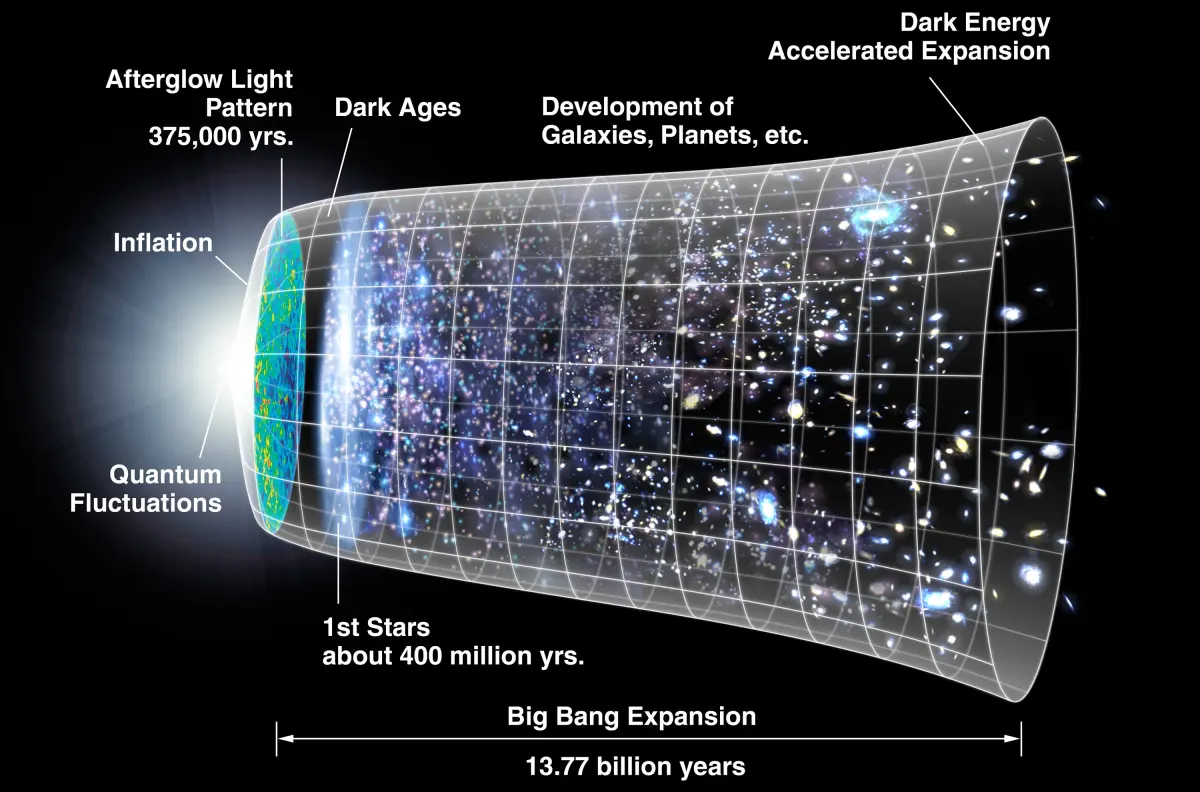
The expansion of the universe is driven by the initial momentum of the Big Bang and influenced by the mysterious force known as dark energy. While gravity acts to pull matter together, dark energy appears to act as a repulsive force, accelerating the expansion of the universe. This discovery, made in the late 1990s, surprised astronomers who previously assumed that the gravitational pull of matter would eventually slow the expansion down.
Understanding this expansion requires looking at the history of the cosmos through different stages. The universe has evolved through several distinct eras:
- The Planck Epoch: The earliest period where the laws of physics as we know them did not yet apply.
- The Inflationary Epoch: A brief period of exponential growth where the universe expanded faster than the speed of light.
- The Recombination Era: When the universe cooled enough for electrons to bind to nuclei, allowing light to travel freely for the first time.

What is the evidence for the Big Bang?
The most compelling evidence for the Big Bang is the cosmic microwave background (CMB). Discovered accidentally by Arno Penzias and Robert Wilson in 1964, the CMB is a uniform glow of microwave radiation that fills the entire sky. It represents the "first light" of the universe, emitted about 380,000 years after the Big Bang when the cosmos became transparent. This radiation provides a snapshot of the early universe's density fluctuations, which eventually grew into the large-scale structures like galaxies we see today.
Another pillar of evidence is the observation of galactic redshift. In the 1920s, Edwin Hubble observed that light from distant galaxies is shifted toward the red end of the spectrum. This phenomenon, known as the Doppler effect, confirms that these galaxies are receding from our own. By measuring the speed and distance of these galaxies, astronomers can calculate the expansion rate of the universe, known as the Hubble constant, which allows them to estimate the age of the universe at roughly 13.8 billion years.

Common mistakes when understanding the Big Bang
A frequent error is imagining the Big Bang as an explosion occurring at a specific location in space. Because the universe began as a point that contained all of space, there is no "center" to the universe. Every point in space is moving away from every other point; therefore, observers on any galaxy would see the same expansion pattern. Another misconception is that the expansion of the universe means that everything inside it, including atoms and planets, is also expanding. In reality, local gravitational forces are strong enough to hold galaxies, solar systems, and individual objects together against the expansion of space.
To correctly visualize the expansion, consider these clarifications:
- The universe does not expand "into" anything; space itself is growing.
- The Big Bang does not explain what happened "before" the event, as time itself is considered to have started with the Big Bang.
- Light from distant galaxies does not just travel through space; the space it travels through is stretching, which contributes to the observed redshift.
How to study cosmology for beginners
For those interested in exploring the Big Bang further, the best approach is to start with the fundamental principles of physics and astronomy. Begin by reading introductory texts on general relativity and the history of the universe. Many universities offer free online courses that break down these complex topics into manageable modules. Engaging with reputable science communication platforms can also provide visual aids that make the abstract concepts of spacetime and expansion much easier to grasp.
When studying, follow these steps to build a solid foundation:
- Learn the basics of the electromagnetic spectrum to understand how we detect light from the early universe.
- Research the life cycle of stars, as they are responsible for creating the heavy elements that exist today.
- Keep up with current missions, such as the James Webb Space Telescope, which is actively providing new data about the earliest galaxies.
By focusing on these core areas, you will gain a comprehensive understanding of how the universe evolved from a point of infinite density into the complex, structured cosmos we inhabit today.
Key facts
- The Big Bang theory posits that the universe began approximately 13.8 billion years ago from an extremely hot, dense point called a singularity.
- It is not an explosion in space, but rather the rapid expansion of space itself, carrying matter and energy outward.
- Evidence for the theory includes the cosmic microwave background radiation, which is the faint afterglow of the early, hot universe.
- Astronomer Edwin Hubble discovered in 1929 that galaxies are moving away from us, providing the first observational evidence of an expanding universe.
- The theory explains the abundance of light elements, such as hydrogen and helium, created during the first few minutes of existence.
- A common mistake is assuming the Big Bang happened at a specific location in space; it occurred everywhere simultaneously because space itself was expanding.
The bottom line
The Big Bang theory serves as the foundational cosmological model for understanding the origin and evolution of our universe. By describing a transition from a dense, hot singularity to an ever-expanding cosmos, it provides a coherent framework for interpreting astronomical observations. While the concept challenges human intuition, it remains the most robust explanation supported by modern physics, detailing how matter, energy, and time emerged billions of years ago.
People also ask
Was the Big Bang an explosion of matter into empty space?
No, the Big Bang was the expansion of space itself. There was no "outside" or "empty space" for the universe to expand into because space and time were created during the event.
How do scientists know the age of the universe?
Scientists calculate the age of the universe by measuring the rate of cosmic expansion and studying the oldest known stars and globular clusters. Data from the Planck space observatory provides the most precise estimate of 13.8 billion years.
What existed before the Big Bang?
According to standard physics, the concept of "before" loses meaning because time itself began with the Big Bang. There is no empirical evidence to describe conditions prior to this singularity.
Is the universe still expanding today?
Yes, the universe is not only expanding but doing so at an accelerating rate. This phenomenon is attributed to a mysterious force known as dark energy, which pushes galaxies apart.
Could the universe eventually stop expanding or collapse?
While early theories suggested a "Big Crunch," current observations of dark energy indicate that the universe will likely continue expanding indefinitely. This leads to a scenario often called the "Heat Death" of the universe.
Did the Big Bang happen at the center of the universe?
The universe has no center because space is expanding uniformly in all directions. Every point in the universe is moving away from every other point, meaning no single location can be defined as the origin.
This answer was created with the help of AI research tools and reference sources. Spotted an error? Let us know — we correct mistakes quickly. See our editorial policy.