What is the difference between an ape and a monkey?
Short answer
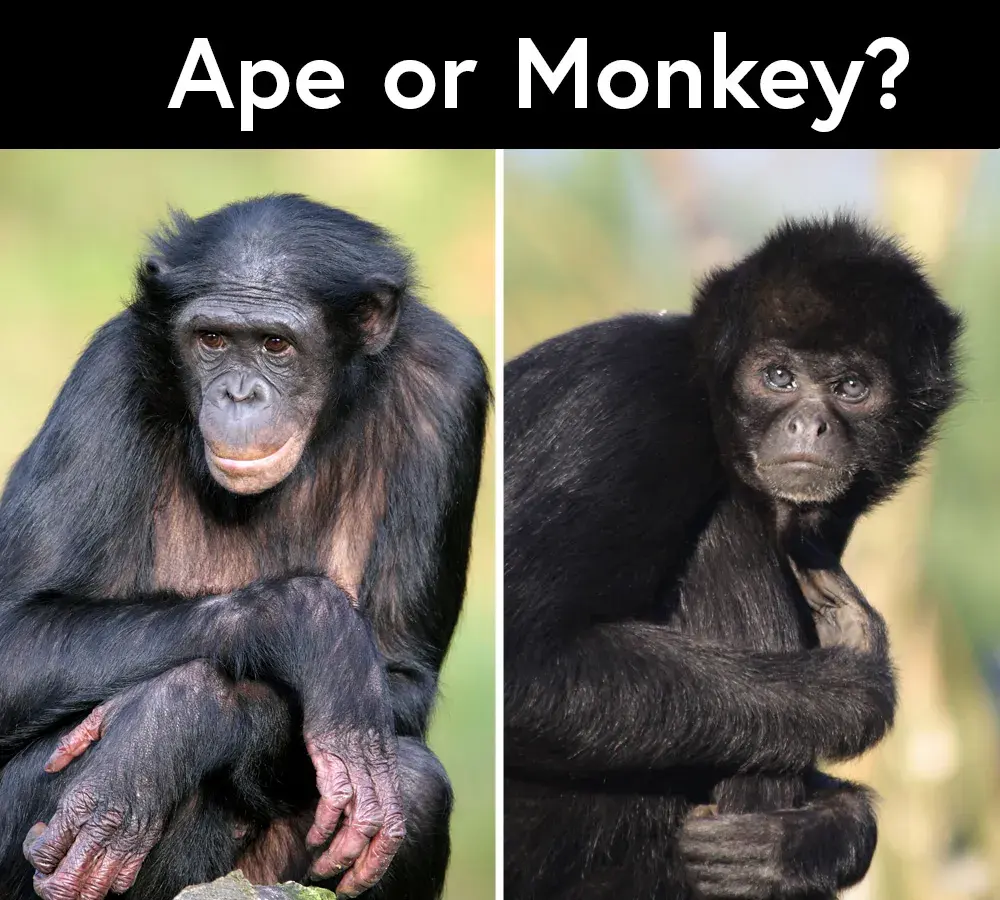
The primary difference between apes and monkeys is the presence of a tail. Apes, which include humans, gorillas, and chimpanzees, lack tails and possess larger brains relative to their body size. Monkeys typically have tails, smaller brains, and different skeletal structures, such as narrower shoulders and a different rib cage shape.
On this page
How to tell an ape from a monkey
The most reliable physical indicator for distinguishing between these two groups is the tail. Almost all monkey species possess a tail, which they use for balance, climbing, or in some New World species, as a prehensile limb to grasp branches. Conversely, no living ape species possesses a tail. If you see a primate swinging through the trees with a long, muscular tail, it is almost certainly a monkey.
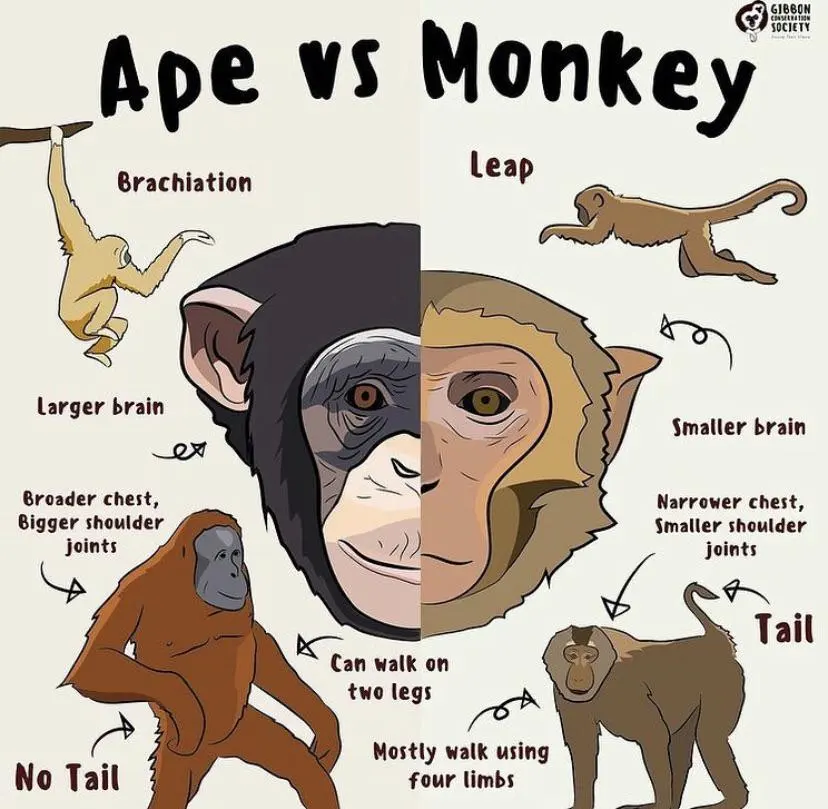
Beyond the tail, you can look at the overall body structure and movement. Apes have evolved for a more upright posture and possess flexible shoulder joints that allow them to hang and swing from branches, a behavior known as brachiation. Monkeys are generally built for running and leaping along the tops of branches, keeping their spines more parallel to the ground. When observing them in a zoo or the wild, notice these key physical traits:
- Apes have broader chests and shoulder blades positioned on their backs.
- Monkeys have narrower chests with shoulder blades positioned on the sides.
- Apes lack a tail entirely, while monkeys retain theirs for balance.
- Apes generally have larger, more complex brains compared to their body mass.
Why apes and monkeys have different skeletons
The evolutionary divergence between apes and monkeys occurred millions of years ago, leading to distinct skeletal adaptations. Apes, belonging to the superfamily Hominoidea, evolved a wider rib cage and a shorter, more rigid lower back. This configuration supports a vertical posture, which is essential for the way apes move through their environments. This skeletal shift was a crucial step in the lineage that eventually led to the development of human bipedalism.
Monkeys, divided into Old World and New World groups, possess a skeletal structure better suited for quadrupedal movement. Their spines are more flexible, allowing for the rapid, agile leaping seen in species like macaques or capuchins. Because they spend much of their time running along branches rather than swinging beneath them, their joints are structured differently. You can summarize these skeletal differences by noting the following:
- Apes possess a wider, flatter rib cage that facilitates upright movement.
- Monkeys have a deeper, narrower rib cage that supports efficient four-legged locomotion.
- Apes have a shorter lumbar region, providing a more stable base for sitting or standing.
- Monkeys have a longer lumbar region, which acts like a spring during high-speed movement.
Where apes and monkeys live in the wild
Geographic distribution is another helpful way to categorize these primates. Old World monkeys and all ape species are native to Africa and Asia. However, New World monkeys—such as spider monkeys, howler monkeys, and capuchins—are found exclusively in the tropical regions of Central and South America. If you are observing a primate in the Americas, you are looking at a monkey, as there are no wild apes in the Western Hemisphere.
Within their respective habitats, these animals occupy different niches. Apes tend to be more terrestrial or spend significant time in the canopy, but they rarely rely on tails for navigation. Monkeys are highly specialized for arboreal life, often occupying the higher, thinner branches of the canopy where a tail provides the necessary stability to prevent falls. Understanding the geography of a species is a quick way to narrow down its classification, as the ranges of these groups rarely overlap in a way that creates confusion for observers.
Common mistakes when identifying primates
A frequent error is assuming that all primates are monkeys. Many people use the term "monkey" as a catch-all for any primate, including apes like chimpanzees or orangutans. This is biologically incorrect because apes are a distinct group that shares a more recent common ancestor with humans than with monkeys. Using the terms interchangeably ignores the significant evolutionary distance between the two groups and the unique behaviors that define them.
Another common mistake is judging a primate by its size. While it is true that many apes, such as gorillas, are significantly larger than most monkeys, size is not a defining characteristic. Some monkeys, like the mandrill, can be quite large, while some apes, like the gibbon, are relatively small and agile. Always look for the presence of a tail and the structure of the shoulders rather than relying on the animal's overall mass. If you rely on size alone, you will likely misidentify smaller apes as monkeys.
How to observe primates safely and respectfully
When visiting a zoo or a sanctuary, it is important to observe these animals without causing them stress. Primates are highly intelligent and sensitive to the behavior of humans. Avoid making loud noises, tapping on glass, or using flash photography, as these actions can provoke defensive behaviors. Always maintain a respectful distance and observe their natural movements, such as how they use their hands or interact with their social group.
To improve your identification skills during your next visit, follow these simple steps:
- Scan the animal for a tail; if it is absent, you are likely looking at an ape.
- Observe the shoulder movement; if the animal can rotate its arms in a full circle to reach above its head, it is likely an ape.
- Check the environment; if you are in a zoo, read the signage to confirm the species, as some monkeys have very short, stubby tails that may be difficult to spot from a distance.
- Note the way the animal sits; apes often sit in a more upright, human-like fashion, whereas monkeys tend to crouch.
By focusing on these specific anatomical and behavioral markers, you can accurately distinguish between these fascinating creatures.
Key facts
- The most reliable way to distinguish them is by looking for a tail; monkeys almost always have tails, while apes never do.
- Apes have larger, more complex brains relative to their body size compared to monkeys.
- Monkeys generally move by running across branches on all fours, whereas apes are built for climbing and swinging through trees.
- Apes possess a broader chest and more flexible shoulder joints, which allow for a wider range of arm motion.
- There are only two main groups of apes: the lesser apes (gibbons) and the great apes (chimpanzees, gorillas, orangutans, and humans).
- Monkeys are divided into two distinct groups based on geography: Old World monkeys from Africa and Asia, and New World monkeys from the Americas.
The bottom line
The primary distinction between these primates lies in their anatomy and evolutionary history. While monkeys are diverse, smaller, and typically possess tails, apes are more complex, lack tails, and share a closer genetic lineage with humans. By observing the presence of a tail and the animal's shoulder mobility, you can easily identify whether you are looking at an ape or a monkey in the wild.
People also ask
Do all monkeys have tails?
Almost all monkey species possess a tail, which they use for balance or, in some New World species, as a prehensile limb to grip branches. A notable exception is the Barbary macaque, which is a monkey that lacks a visible tail.
Are humans considered apes?
Yes, humans are biologically classified as great apes. We share a common ancestor with chimpanzees and bonobos, and we belong to the Hominidae family alongside gorillas and orangutans.
Can you tell them apart by their size?
Size is not a definitive indicator, as some monkeys are larger than some apes. For example, a mandrill is a large monkey that can weigh more than a gibbon, which is a small ape.
Do apes and monkeys live in the same habitats?
They often share the same tropical forests, but they occupy different niches within those environments. Apes tend to spend more time in the canopy or on the ground, while monkeys are more agile in the smaller, outer branches of trees.
Why do some monkeys have colorful faces?
Many Old World monkeys, such as mandrills, exhibit bright skin coloration as a social signal. These colors are used to communicate status or reproductive readiness to other members of their troop.
Is a lemur a monkey?
No, lemurs are prosimians, which are a separate group of primates that evolved before monkeys and apes. They are primarily found on the island of Madagascar and possess different physical traits, such as a reflective layer behind their eyes.
This answer was created with the help of AI research tools and reference sources. Spotted an error? Let us know — we correct mistakes quickly. See our editorial policy.