What art style did Henri Matisse use?
Short answer
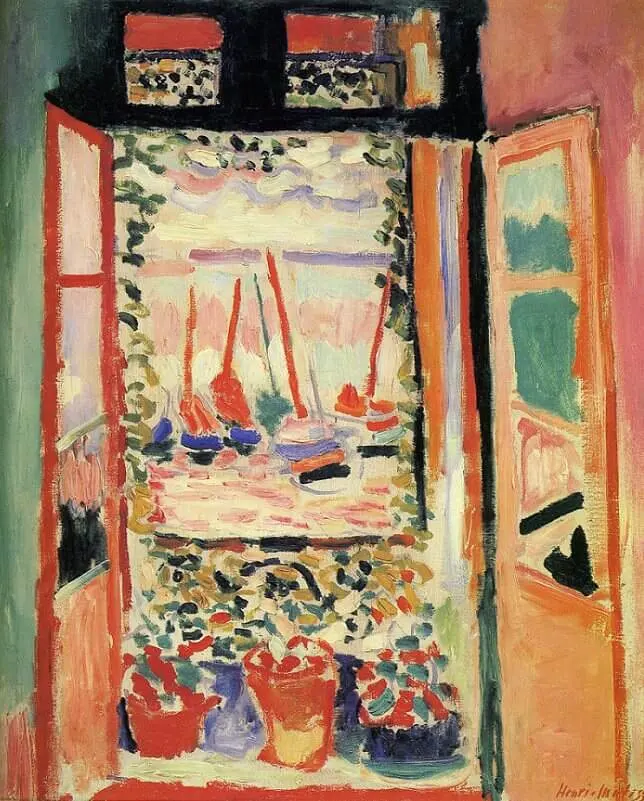
Henri Matisse is primarily defined by his role as the leader of Fauvism, a movement characterized by vivid, non-naturalistic colors and expressive brushwork. Throughout his long career, he evolved beyond this style, experimenting with Post-Impressionism, Pointillism, and eventually pioneering his own unique technique of paper cut-outs during his final years.
On this page
What is the Fauvist style?
Fauvism, meaning "the wild beasts," emerged in Paris around 1905. Matisse and his contemporaries, such as André Derain, rejected the traditional goal of reproducing realistic colors. Instead, they used bold, arbitrary hues to convey emotional intensity rather than descriptive accuracy. A sky might be painted bright yellow, or a face rendered in patches of green and red.
The movement was short-lived, officially lasting only a few years, but its impact on modern art was profound. Matisse’s masterpiece Woman with a Hat (1905) serves as the quintessential example of this period. By prioritizing color as an independent force on the canvas, Matisse liberated artists from the constraints of academic realism. This period established the core principles that would guide his aesthetic choices for the rest of his life:
- Use of saturated, unmixed colors straight from the tube.
- Simplification of forms to emphasize decorative patterns.
- Focus on the flat surface of the canvas rather than creating deep perspective.
How did Matisse develop his technique?
Matisse did not begin as a radical; he was initially influenced by the structured techniques of the Old Masters and the light-filled canvases of the Impressionists. In the late 1890s, he experimented with Pointillism, a method of applying small, distinct dots of color to form an image. Works like Luxe, Calme et Volupté (1904) show his early fascination with how the human eye perceives color when placed in proximity.
Following his Fauvist phase, Matisse moved toward a more balanced, contemplative approach. He traveled to Morocco and studied Islamic art, which introduced him to intricate ornamentation and flat, rhythmic designs. This global perspective helped him transition from the chaotic energy of his early work to the serene, rhythmic compositions of his middle period. His evolution can be summarized through these key stylistic shifts:
- Academic realism and traditional still lifes.
- The explosive, arbitrary color palette of Fauvism.
- The integration of decorative motifs and flattened space.
- The final, minimalist phase of paper cut-outs.
Why did Matisse use paper cut-outs?
In the 1940s, following a serious surgery that left him largely confined to a wheelchair or bed, Matisse could no longer stand at an easel for long periods. He turned to a new medium: the paper cut-out. He would have his assistants paint large sheets of paper with gouache, which he then cut into shapes with scissors. This process allowed him to "draw with scissors," merging color and line into a single, unified action.
This technique resulted in some of his most iconic works, such as the Jazz series and the mural-sized The Snail. By removing the need for a brush and palette, Matisse achieved a level of clarity and simplicity that had eluded him in oil painting. The cut-outs represent the culmination of his life’s work, proving that art could be both physically accessible and intellectually profound. These works are celebrated for their vibrant energy and their ability to capture the essence of a form with minimal detail.
Common mistakes when analyzing Matisse
A frequent error is assuming that Matisse’s use of bright colors was merely decorative or haphazard. While his work often appears spontaneous, it was the result of rigorous planning and constant revision. He often spent months working on a single canvas, scraping away layers of paint to achieve the perfect balance of color and composition. His simplicity was a hard-won achievement, not a lack of technical skill.
Another misconception is that his work lacks structure or depth. Critics sometimes dismiss his later cut-outs as childlike, failing to recognize the sophisticated spatial relationships he created. Matisse was deeply concerned with the "equilibrium" of a painting, ensuring that every color and shape served the overall harmony of the image. To understand his style, one must look past the immediate visual impact and consider the deliberate placement of every element. When studying his work, keep these points in mind:
- Avoid viewing his color choices as realistic representations.
- Recognize the influence of non-Western art on his decorative patterns.
- Acknowledge the physical labor required to achieve his "effortless" results.
Best ways to study Matisse’s style
To truly appreciate Matisse, start by observing his use of negative space. In many of his drawings and paintings, the background is just as important as the subject itself. He often left parts of the canvas bare or used simple, sweeping lines to define the edges of objects. This technique creates a sense of air and light that makes his figures feel alive and dynamic.
If you are interested in applying his methods, focus on simplifying your subjects. Instead of trying to capture every detail, try to identify the essential lines and the primary colors that define the mood of the scene. Practice by limiting your palette to three or four colors and focus on how they interact when placed next to each other. By stripping away the unnecessary, you can begin to see the world through the eyes of a master who spent his entire life searching for the purest form of expression.
Key facts
- Henri Matisse is best known as the leader of Fauvism, a movement characterized by vibrant, non-naturalistic colors.
- He often applied paint in bold, expressive brushstrokes rather than blending them for realistic shading.
- In his later years, Matisse pioneered the "cut-outs" technique, creating art by cutting shapes from paper painted with gouache.
- His work frequently emphasizes decorative patterns and flat, two-dimensional compositions over traditional perspective.
- A common mistake for beginners is trying to replicate his style by using muddy, muted colors; Matisse prioritized intense, pure pigments.
- To practice his style, focus on simplifying subjects into basic shapes and choosing colors for emotional impact rather than literal accuracy.
The bottom line
Henri Matisse was a revolutionary artist who shifted the focus of modern art from realistic representation to emotional expression. By championing Fauvism and later developing his iconic paper cut-outs, he transformed how color and shape interact on a canvas. His legacy remains defined by a commitment to bold, simplified forms that prioritize the artist's subjective experience, forever changing the trajectory of 20th-century visual arts.
People also ask
Was Matisse a painter or a sculptor?
Matisse was primarily a painter, but he was also a prolific sculptor, printmaker, and designer. He produced over 50 sculptures during his career, often exploring the same themes of the human form found in his paintings.
What does the term "Fauvism" mean?
The term comes from the French word "fauve," meaning "wild beast." Critics used it to describe the work of Matisse and his peers because of their shocking, aggressive use of bright colors.
Did Matisse ever paint realistically?
Yes, his early work in the 1890s followed traditional academic styles with muted tones and realistic lighting. He did not transition to his signature bold, expressive style until the early 1900s.
What inspired Matisse to start using paper cut-outs?
Matisse turned to paper cut-outs in his late 60s while confined to a wheelchair following surgery. This technique allowed him to "draw with scissors," simplifying his artistic process while maintaining his focus on color and form.
Is Matisse considered an Impressionist?
No, he was a Post-Impressionist who moved beyond the light-focused techniques of the Impressionists. While he was influenced by them, his work prioritized subjective color and emotional expression over capturing the fleeting effects of natural light.
Where can I see his most famous works today?
Major collections of his work are housed at the Museum of Modern Art in New York, the Centre Pompidou in Paris, and the Musée Matisse in Nice. These institutions hold vast archives of his paintings, drawings, and paper cut-outs.
This answer was created with the help of AI research tools and reference sources. Spotted an error? Let us know — we correct mistakes quickly. See our editorial policy.