How many heads tall is a human figure?
Short answer
An average adult human figure is traditionally measured as eight heads tall, a standard established during the Renaissance. While anatomical reality varies, most people stand between seven and seven-and-a-half heads tall. Artists utilize the eight-head canon as a baseline for idealized proportions, adjusting the scale to suit specific stylistic or realistic needs.
On this page
Why is the human figure measured in heads?
The practice of using the head as a unit of measurement, known as the "canon of proportions," simplifies the complex task of drawing the human body. By establishing the head as a constant module, artists can maintain internal consistency across a figure, ensuring that limbs and torso lengths remain proportional to one another. This method dates back to ancient civilizations, including the Egyptians, who used a grid system based on the size of a fist or a head to maintain strict aesthetic standards in their statues and wall paintings.
During the Italian Renaissance, figures like Leonardo da Vinci and Michelangelo refined these systems to achieve a more naturalistic look. They recognized that while individual anatomy varies significantly, the human eye inherently searches for balance and symmetry. Using the head as a ruler allows an artist to quickly map out the skeleton's structure before adding muscles, clothing, or skin. This foundational step prevents the common issue of drawing figures that appear too short, too long, or otherwise distorted, providing a reliable framework for both realistic portraiture and imaginative character design.
How to measure body proportions using the head
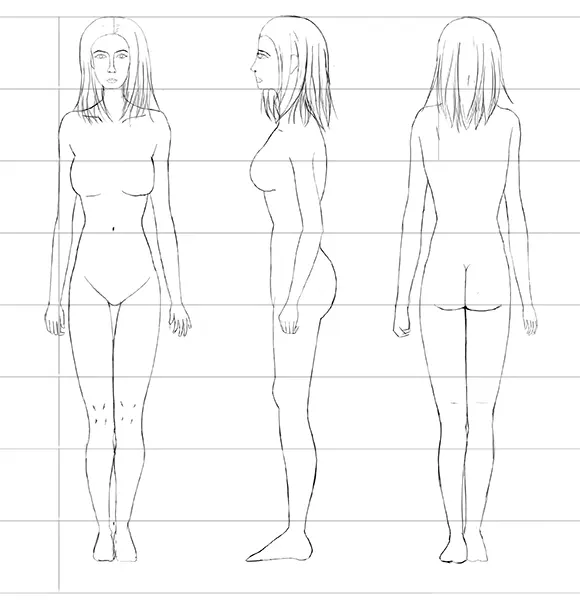
To calculate the proportions of a figure, you must first determine the height of the head from the chin to the top of the skull. Once this unit is established, you can plot the rest of the body along a vertical line. While the eight-head canon is the artistic ideal, most real-world adults fall slightly shorter, typically between seven and seven-and-a-half heads tall.
- Draw a vertical line and divide it into eight equal segments.
- Place the head in the top segment, ensuring the chin aligns with the first mark.
- Locate the nipples at the second mark and the navel at the third.
- Position the crotch at the fourth mark, which represents the midpoint of the body.
- Place the knees at the sixth mark and the feet at the bottom of the eighth segment.
Following these steps provides a balanced starting point. Always remember that these measurements are guidelines rather than rigid laws of nature. Variations in age, gender, and individual biology will naturally shift these markers, but this structure serves as an essential reference point for any figurative drawing.
![6.5-Heads Tall Adult Female [Part 1] (2013) by Meekochan on DeviantArt](/img/0d/how-many-heads-tall-is-a-human-figure-2.webp)
Common mistakes when drawing human proportions
A frequent error for beginners is failing to account for the neck, which is often mistakenly included within the first head segment. The head unit should ideally end at the chin, meaning the neck occupies the space between the first and second head marks. Another common oversight is miscalculating the placement of the elbows. In a standing position with arms at the sides, the elbows should align roughly with the waist, which is usually found near the third head mark.
Many artists also struggle with the length of the legs, often drawing them too short or too long relative to the torso. If you find your figures looking squat, check if you have placed the crotch too high. Conversely, if the figure looks spindly, ensure the torso occupies enough vertical space. Avoiding these pitfalls requires constant checking of your reference points. If your drawing feels "off," return to your vertical guide lines and verify the position of the major joints against your head-height segments to identify where the proportions have drifted away from your intended scale.
How proportions change with age
The ratio of head height to total body height changes dramatically as a human develops from infancy to adulthood. A newborn baby’s head is much larger in proportion to its body, usually representing about one-fourth of its total height. As the child grows, the body elongates at a much faster rate than the head, gradually shifting the ratio toward the adult standard.
- Infants: Approximately 4 heads tall.
- Toddlers: Approximately 5 heads tall.
- Children: Approximately 6 to 7 heads tall.
- Adults: Approximately 7.5 to 8 heads tall.
Understanding these developmental shifts is crucial for artists who draw characters of different ages. If you apply an eight-head canon to a toddler, the result will look like a miniature adult rather than a realistic child. By adjusting your head-to-body ratio based on the subject's age, you can instantly communicate maturity and realism. This awareness of growth patterns adds depth to your work, allowing for a more nuanced portrayal of human development across different stages of life.
Best practices for stylized human figures
Stylization allows artists to deviate from the standard eight-head canon to create specific visual effects or character types. For instance, fashion illustrators often use a nine-head or even ten-head canon to make figures appear taller, more elegant, and more graceful. This elongation is a deliberate aesthetic choice designed to emphasize the flow of fabric and the silhouette of the clothing rather than strict anatomical accuracy.
Conversely, cartoonists often use a smaller head-to-body ratio to create "chibi" or "super-deformed" characters. By shrinking the body to two or three heads tall while keeping the head large, the artist emphasizes cuteness and expressive facial features. When experimenting with these styles, be mindful of the "center of gravity." Even in highly stylized figures, the placement of the joints and the balance of the weight must feel plausible to the viewer. Regardless of how many heads tall you make your figure, consistency remains the most important factor. Once you establish a canon for your character, ensure that every part of the body adheres to that specific scale throughout your entire composition.
Key facts
- The standard academic canon for a well-proportioned adult human figure is 8 heads tall.
- Ancient Greek sculptors, such as Polykleitos, often used a 7-head ratio to emphasize strength and stability.
- Renaissance artists like Leonardo da Vinci frequently utilized the 8-head system to achieve an idealized, elongated aesthetic.
- A common mistake is placing the crotch too high; it should be exactly at the halfway point of the total height.
- The shoulders typically span a width of two head-lengths in a standard male figure.
- To measure proportions, hold a pencil at arm’s length to compare the height of the head against the rest of the body.
The bottom line
While the 8-head ratio serves as the gold standard for idealized human proportions in art and design, it is a stylistic convention rather than a rigid biological law. Most average adults measure closer to 7.5 heads in height. By mastering these foundational measurements, artists can create balanced, realistic figures while understanding how to adjust proportions to achieve specific aesthetic goals or exaggerated styles in their work.
People also ask
Does the head-to-body ratio change as a person ages?
Yes, the ratio changes significantly from infancy to adulthood. A newborn’s body is typically only 4 heads tall, while a child is roughly 6 heads tall.
Is the 8-head rule used for fashion illustration?
Fashion illustrators often use a 9-head or 10-head ratio to make the figure appear more elegant and elongated. This exaggerated proportion is a stylistic choice rather than a reflection of natural human anatomy.
Where should the elbows be positioned in relation to the torso?
In a standing figure, the elbows generally align with the level of the waist. This point is typically found at the 3-head mark from the top of the head.
Why do some artists use a 7.5-head ratio?
A 7.5-head ratio is often considered the most realistic measurement for the average person. It provides a slightly more grounded and natural appearance than the idealized 8-head canon.
How do you determine the length of the legs using this system?
In an 8-head figure, the legs account for half of the total height. This means the distance from the crotch to the floor should be exactly 4 heads long.
Does gender affect the standard head-to-body proportion?
While the 8-head canon is applied to both, male figures are often drawn with broader shoulders and a wider ribcage. Female figures may be drawn with narrower shoulders and a slightly higher waistline to emphasize different anatomical curves.
This answer was created with the help of AI research tools and reference sources. Spotted an error? Let us know — we correct mistakes quickly. See our editorial policy.