How do you draw a Dalmatian for beginners?
Short answer
Drawing a Dalmatian involves capturing their athletic, balanced physique and iconic spotted coat. Start by sketching basic geometric shapes to define the body, then refine the outlines to show muscle tone. Finally, apply irregular, varied spots across the white coat, focusing on natural placement rather than perfect symmetry to ensure a realistic appearance.
On this page
How to sketch a Dalmatian body shape
The Dalmatian is a medium-sized dog known for its endurance and balanced, muscular build. To begin your drawing, visualize the dog as a series of simple shapes: a circle for the head, an oval for the chest, and a smaller oval for the hindquarters. Connect these with curved lines to form the spine and belly, ensuring the back remains level. This foundational framework prevents the dog from looking distorted or disproportionate.
Once your shapes are in place, refine the outline to reflect the breed’s athletic profile. Dalmatians have a clean, sleek appearance with a deep chest and strong, straight legs. Avoid making the limbs too thick or short, as this breed is built for stamina and speed. Use light pencil strokes for these initial guidelines so you can easily adjust the proportions before finalizing the silhouette.
- Draw a circle for the head and a slightly larger oval for the chest.
- Place a smaller oval toward the rear to represent the hip area.
- Connect the shapes with smooth lines to create the neck, back, and belly.
- Add four simple rods to represent the legs, ensuring the front legs are straight and the hind legs show a slight angle at the hock.
Best drawing techniques for Dalmatian spots
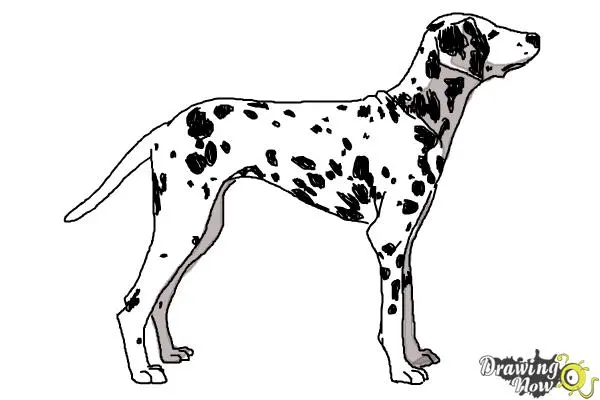
The most recognizable feature of a Dalmatian is its distinct, dark spotting. When applying these to your drawing, avoid creating a uniform pattern or making every spot the same size. In reality, spots on a Dalmatian are irregular and vary in diameter, typically ranging from the size of a dime to a half-dollar. Randomness is the key to making the coat look authentic and natural.
Focus on the density of the spots, as they are usually more concentrated on the head, ears, and tail. As you move toward the torso and legs, the spots should become slightly more spaced out. Use a soft-lead pencil or a fine-tip ink pen to vary the pressure, creating some dark, solid marks and some lighter, faint ones. This variation in tone adds depth and prevents the coat from appearing flat or like a cartoonish polka-dot pattern.
- Start by placing larger, more prominent spots on the ears and back.
- Fill in the gaps with smaller, irregular shapes to break up the white space.
- Ensure some spots overlap the edges of the body to create a three-dimensional effect.
- Leave small areas of white space between spots to keep the coat looking clean and distinct.
How to draw Dalmatian facial features
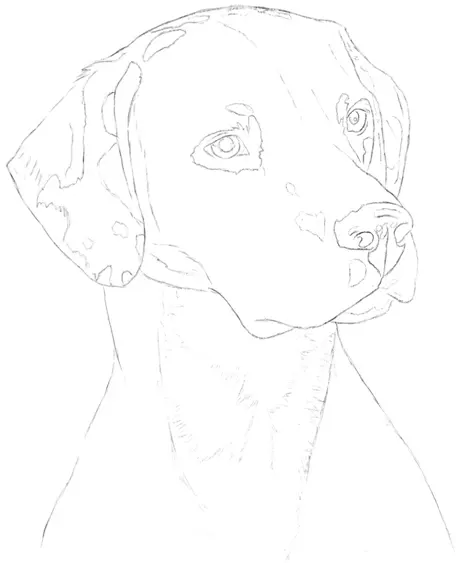
Capturing the expression of a Dalmatian requires attention to the eyes and ears. The ears should be set high on the head, hanging close to the cheeks with a soft, rounded shape. Their eyes are typically round and intelligent, often dark brown or blue, depending on the individual. When drawing the muzzle, keep it long and strong, ending in a distinct, dark nose that is usually black or liver-colored.
Pay close attention to the placement of spots on the face, as these are often asymmetrical. A common mistake is to mirror the spots on both sides of the face, which can make the dog look unnatural. Instead, treat each side of the face as a unique canvas. Keep the lines around the mouth and eyes crisp to convey the breed's alert and friendly temperament, which is a hallmark of their personality.
Common mistakes when drawing Dalmatians
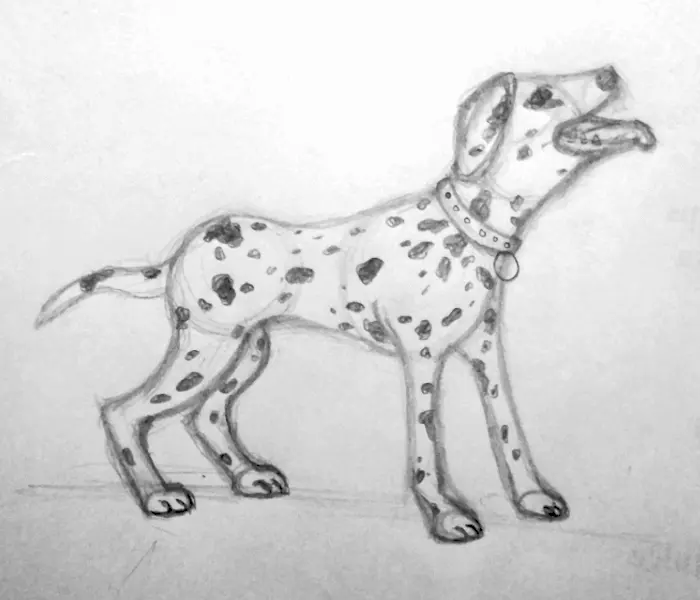
One of the most frequent errors beginners make is drawing the spots as perfect circles. In nature, spots are rarely circular; they are jagged, blob-like, and sometimes faded at the edges. If you draw perfect dots, the dog will lose its organic, lifelike quality. Always aim for irregular, slightly messy shapes that follow the contours of the dog's muscles and body structure.
Another common mistake is ignoring the breed's posture. Dalmatians are elegant, active dogs, and drawing them in a rigid, static pose can make them appear stiff. Try to introduce a slight curve to the tail or a subtle bend in one leg to suggest movement. Additionally, ensure the neck is long and graceful rather than thick or heavy, as this is essential to the breed's classic, refined silhouette.
- Avoid using a compass or stencil to create perfectly round spots.
- Do not draw spots in a grid or symmetrical pattern across the back.
- Ensure the tail is not too short; it should reach the hock and have a slight upward curve.
- Check that the chest is deep enough, as a shallow chest ruins the athletic look of the breed.
How to refine and finish your drawing
To finalize your work, look at your drawing from a distance to assess the overall balance. If the spots look too heavy in one area, use an eraser to lift some graphite or add more spots to the surrounding regions to create better visual harmony. You can also add subtle shading along the belly and the underside of the legs to suggest muscle definition and volume, which helps the dog stand out from the background.
Finally, consider the texture of the coat. While Dalmatians have short, smooth hair, adding a few faint, directional lines in the direction of the fur can enhance the realism. Keep these lines very light and sparse to avoid cluttering the drawing. Once you are satisfied with the proportions and the placement of the spots, use a darker pencil to outline the most important features, ensuring the final image is clear and professional.
Key facts
- Dalmatians are characterized by their sleek, athletic build and distinctive black or liver-colored spots.
- Start your drawing with a basic oval for the head and a larger, rounded rectangle for the chest.
- Aim for irregular, circular shapes for the spots, as uniformity makes them look unnatural.
- Focus on the ears, which should be thin, triangular, and set high on the head.
- Use a light pencil touch initially to sketch the frame before committing to dark, defined outlines.
- Add spots only after the anatomical structure is correct, ensuring they follow the contours of the body.
The bottom line
Drawing a Dalmatian requires patience and a focus on structural accuracy before applying detail. By starting with simple geometric shapes to establish the dog's athletic frame, you ensure the proportions remain realistic. Remember that the hallmark spots should be irregular and follow the body's contours rather than appearing as flat stickers. With practice, you will master the balance between form, movement, and the breed’s iconic pattern.
People also ask
Why do Dalmatians have spots?
Dalmatians are born white, and their unique spotted coat develops as they mature due to a specific genetic trait. These markings are a breed standard and serve no functional purpose other than aesthetic identification.
Should I use a reference photo when drawing a dog?
Using a reference photo is highly recommended for beginners to understand canine anatomy and proportions. It helps you accurately place joints and muscles, which are often difficult to visualize from memory alone.
How do I make the spots look realistic?
Avoid drawing perfectly symmetrical circles, as real spots vary in size and spacing across the body. Vary the density of the spots, placing them closer together on the back and ears while leaving the legs and face more sparse.
What is the most common mistake beginners make?
The most frequent error is drawing the dog's legs too short or thick. Dalmatians are elegant, high-stamina dogs, so their limbs should appear lean and proportional to their torso length.
Do I need special pencils for this drawing?
A standard HB pencil is sufficient for sketching, while a 2B or 4B pencil is better for shading the spots. Using different grades allows you to build depth and contrast without smudging your work.
How do I draw the tail correctly?
The tail should be a natural extension of the spine, tapering to a point as it curves slightly downward. Keep it thin and graceful to match the athletic silhouette of the breed.
This answer was created with the help of AI research tools and reference sources. Spotted an error? Let us know — we correct mistakes quickly. See our editorial policy.