How are mountains formed?
Short answer
Mountains are primarily formed through tectonic plate movements that force the Earth’s crust upward. When massive lithospheric plates collide, volcanic activity occurs, or crustal blocks are faulted and tilted, the surface rises significantly. These geological processes, driven by internal heat and pressure, reshape landscapes over millions of years into elevated peaks.
On this page
Why do mountains form?
Mountains are the result of the Earth’s dynamic crust, which is divided into several large, rigid tectonic plates. These plates float on the semi-fluid mantle beneath them, moving slowly due to convection currents. When these plates interact at their boundaries, they create immense pressure that forces the land to deform and rise.
There are three primary ways this interaction leads to mountain building:
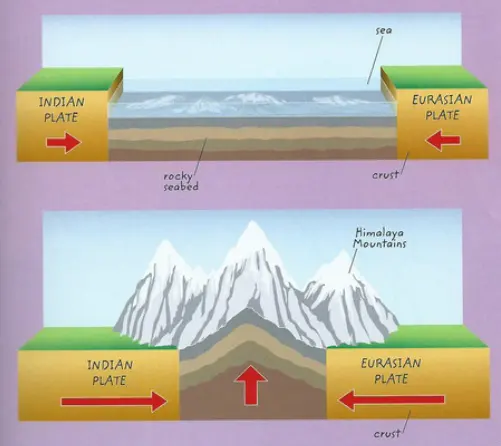
- Convergent boundaries: Two plates collide, crushing the crust and pushing it upward.
- Volcanic activity: Magma rises through the crust, cooling and accumulating to build massive peaks.
- Faulting: Tectonic forces cause large blocks of the Earth's crust to shift, tilt, or rise along fracture lines.
Without these constant movements, the Earth’s surface would eventually flatten due to the relentless process of erosion. Mountains are essentially the visible scars of the planet's internal energy finding a way to release stress.
How long does it take for mountains to form?
Mountain building, or orogeny, is an incredibly slow process that typically spans millions of years. While a major earthquake might cause a sudden shift of a few meters, the creation of a mountain range requires sustained tectonic activity over vast geological timeframes. For example, the Himalayas began forming roughly 50 million years ago and continue to rise today as the Indian plate pushes into the Eurasian plate.
The life cycle of a mountain range involves several distinct phases:
- Accumulation of sediment in a basin.
- Tectonic collision that compresses and uplifts the rock.
- Continued uplift balanced against erosion by wind, water, and ice.
- Gradual weathering that eventually reduces the range to low hills.
Because this process is so gradual, humans cannot observe the birth of a new mountain range in a single lifetime. We only see snapshots of a cycle that has been occurring for billions of years.
What are the different types of mountains?
Geologists categorize mountains based on the specific tectonic processes that created them. Understanding these types helps explain why some mountains are jagged and steep while others are rounded or isolated.
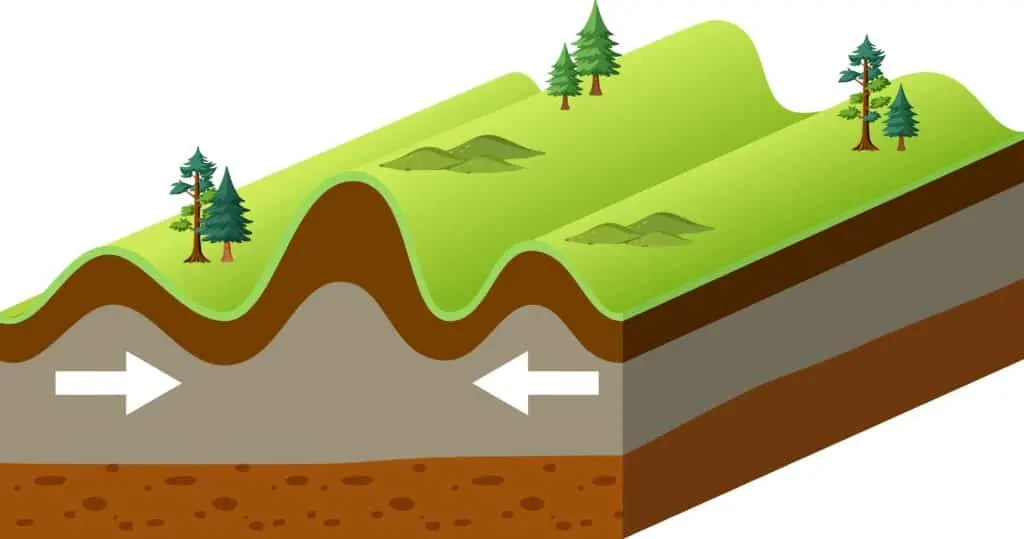
- Fold mountains: Formed when sedimentary rock layers are squeezed and crumpled into massive folds, such as the Alps or the Andes.
- Fault-block mountains: Created when large crustal blocks are pushed up or dropped down along faults, often resulting in steep, cliff-like faces like the Sierra Nevada.
- Volcanic mountains: Built by the accumulation of lava, ash, and rock fragments, such as Mount Fuji or Mount St. Helens.
- Dome mountains: Formed when molten magma pushes upward beneath the crust but fails to break through, causing the surface to bulge into a rounded shape.
Each type reflects the unique geological history of its region. By studying the rock composition and structural orientation, scientists can determine the specific forces that shaped a particular landscape.
Common mistakes when studying mountain formation
Many people assume that all mountains are formed by volcanoes, but this is a significant misconception. While volcanoes are a major category, the vast majority of the world’s largest mountain ranges, such as the Rockies or the Himalayas, are fold mountains created by plate collisions. Attributing every peak to volcanic activity ignores the complex role of tectonic compression and crustal faulting.
Another common error is believing that mountains are permanent features. In reality, mountains are in a constant state of decay. As soon as a peak is pushed upward, gravity and weather begin to tear it down. This is why younger mountains like the Himalayas are generally much taller and more jagged than older ranges like the Appalachians, which have been smoothed down by hundreds of millions of years of erosion.
How to identify mountain building evidence
If you want to observe the forces of mountain building in the field, look for specific geological clues that reveal the history of the land. You do not need to be a professional geologist to notice the signs of past tectonic violence.
- Look for tilted or folded rock layers in road cuts, which indicate that the Earth was compressed.
- Search for marine fossils at high elevations, which prove that the rock was once part of an ancient seafloor before being pushed upward.
- Identify fault lines by looking for offset rock layers or sudden changes in the type of stone on either side of a valley.
- Observe the shape of the peaks; sharp, pointed summits often suggest recent uplift and glacial carving, while rounded summits suggest long-term erosion.
By paying attention to these physical features, you can better appreciate the immense power and time required to build the mountains we see today.
Key facts
- Mountains are primarily formed through tectonic plate collisions, where the Earth's crust is pushed upward over millions of years.
- The Himalayan mountain range continues to grow by approximately 5 millimeters each year as the Indian plate pushes into the Eurasian plate.
- Fold mountains, such as the Alps and the Andes, occur when two tectonic plates collide, causing the crust to buckle and fold.
- Volcanic mountains are created when molten rock, or magma, erupts through the Earth's surface and accumulates into a cone shape.
- Fault-block mountains form when large crustal blocks are pushed upward or tilted along cracks in the Earth's surface known as faults.
- Erosion by wind, water, and ice constantly shapes mountains, often carving deep valleys and sharp peaks into the uplifted rock.
The bottom line
Mountains are dynamic features formed by the relentless movement of Earth’s tectonic plates. Whether through the slow folding of crustal layers, the explosive force of volcanic activity, or the shifting of fault blocks, these massive structures represent the surface expression of deep geological processes. While they appear permanent, mountains remain in a constant state of transformation, shaped by the opposing forces of tectonic uplift and surface erosion.
People also ask
What is the difference between a mountain range and a mountain system?
A mountain range is a series of mountains connected by high ground, such as the Sierra Nevada. A mountain system is a larger group of several mountain ranges that share a common geological origin.
Can mountains disappear over time?
Yes, mountains are subject to constant erosion from rain, frost, and glaciers. Over millions of years, these forces can wear even the tallest peaks down into low hills or flat plains.
Why are some mountains found in the middle of tectonic plates?
While most mountains form at plate boundaries, some arise from "hotspots" where plumes of magma rise from deep within the mantle. The Hawaiian Islands were created this way as the Pacific plate moved over a stationary hotspot.
How do scientists measure the height of a mountain?
Scientists use GPS technology and satellite imagery to measure elevation relative to mean sea level. Historically, surveyors used trigonometry and barometric pressure readings to estimate height.
Are all mountains made of the same type of rock?
No, mountains consist of various rock types depending on their formation. Fold mountains often contain sedimentary rock, while volcanic mountains are primarily composed of igneous rock like basalt or andesite.
Do mountains affect the local climate?
Mountains create "rain shadows" by forcing air to rise and cool, which causes precipitation on the windward side. The leeward side remains dry because the air loses its moisture before crossing the peak.
This answer was created with the help of AI research tools and reference sources. Spotted an error? Let us know — we correct mistakes quickly. See our editorial policy.