Why does the Leaning Tower of Pisa lean?
Short answer
The Leaning Tower of Pisa leans because it was constructed on unstable, soft subsoil composed of clay, fine sand, and shells. This foundation could not support the structure’s weight, causing it to sink unevenly as early as the initial stages of construction in 1173. Subsequent attempts to compensate only exacerbated the tilt.
On this page
Why the tilt happens
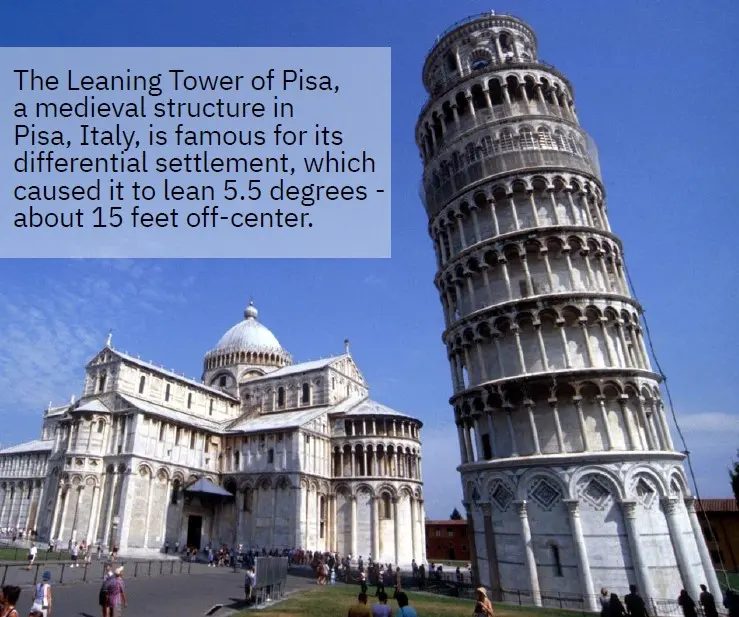
The tower’s instability stems from the geology of the Piazza dei Miracoli in Pisa. The site sits on a former river estuary where the ground consists of layers of soft alluvial soil. When construction began in 1173, the builders dug a foundation only three meters deep, which proved insufficient for the massive limestone and marble structure.
As workers reached the third story in 1178, the tower began to sink on its southern side. The weight of the masonry compressed the underlying clay, causing the structure to tilt toward the south. Because the soil was not uniform, the pressure was distributed unevenly, turning a minor settling issue into a permanent architectural defect that has defined the monument for centuries.
How the construction process failed
The construction of the tower occurred in three distinct stages spanning nearly two centuries. Work was frequently interrupted by wars and financial difficulties, which ironically allowed the soil to settle and harden under the weight of the partially completed tower. Had the structure been built rapidly, it likely would have collapsed entirely.
- First stage (1173–1178): Construction reached the third floor before the tilt became apparent.
- Second stage (1272–1278): Architect Giovanni di Simone attempted to correct the lean by building higher floors with one side taller than the other.
- Third stage (1360–1372): Tommaso di Andrea Pisano completed the belfry, adding the final weight that pushed the structure toward its critical limit.
These intermittent delays provided the necessary time for the ground to consolidate. Without these long pauses, the tower would have tipped over during the initial building phase due to the sheer lack of structural integrity in the foundation.

How engineers saved the tower
By the 1990s, the tower reached a dangerous tilt of 5.5 degrees, threatening a catastrophic collapse. An international committee was formed to stabilize the monument without destroying its iconic aesthetic. Engineers rejected the idea of straightening it completely, as the lean was considered a vital part of its historical identity.
Instead, they employed a technique called soil extraction. By removing small amounts of earth from the northern side—the side opposite the lean—the foundation was encouraged to settle back toward the vertical. This controlled process successfully reduced the tilt by approximately 17 inches. The tower is now considered stable for the next several centuries, provided that ongoing monitoring remains a priority for local preservationists.
Common mistakes when analyzing the lean
Many observers mistakenly believe that the tower was designed to lean as a deliberate architectural feature. This is a common myth; the tilt was an unintended engineering disaster that embarrassed the city for generations. Another frequent error is the assumption that the tower is made of solid stone. In reality, the tower is a hollow cylinder with two concentric walls of masonry, filled with rubble in the center.
- Assuming the tower is solid marble: It is actually a complex mix of stone, mortar, and rubble.
- Believing the lean is constant: The tilt has fluctuated significantly over the centuries due to temperature changes and groundwater shifts.
- Ignoring the role of the belfry: The final addition of the bell chamber significantly shifted the center of gravity.
Understanding these misconceptions is essential for appreciating the true engineering challenges faced by those who built and eventually saved the structure.
How to visit the tower safely
If you plan to visit the Leaning Tower of Pisa, you must book tickets well in advance, as visitor numbers are strictly capped to protect the foundation. The climb to the top involves 251 steps along a spiral staircase that feels tilted, which can be disorienting for some visitors. It is important to wear comfortable, non-slip footwear to navigate the worn and uneven marble stairs.
- Purchase tickets online at least two weeks before your visit to secure a time slot.
- Leave large bags in the mandatory storage area, as they are not permitted inside the tower.
- Walk carefully, keeping a hand on the inner railing, especially near the top where the lean is most perceptible.
Avoid visiting during peak summer heat, as the interior can become stiflingly hot and the climb is physically demanding. By following these practical steps, you can safely enjoy one of the world's most famous architectural marvels while respecting the delicate nature of its historic foundation.
Key facts
- Construction began in 1173 and took nearly 200 years to complete due to ongoing wars and debt.
- The lean resulted from a soft, unstable foundation of clay, fine sand, and shells that could not support the structure's weight.
- The tower is 183 feet tall and weighs approximately 14,500 metric tons.
- Engineers corrected the tilt in the 1990s by removing soil from beneath the higher side to stabilize the base.
- Visitors should book tickets well in advance, as daily entry is strictly limited to preserve the structure.
- When climbing the 251 steps, pace yourself, as the uneven floor and spiral incline can cause dizziness.
The bottom line
The Leaning Tower of Pisa stands as a testament to both architectural ambition and engineering error. Its iconic tilt was caused by a shallow, unstable foundation built on soft, water-saturated soil. Through centuries of patience and modern structural intervention, the tower has been secured against collapse. Today, it serves as a fascinating reminder of how geological conditions dictate the success of human construction projects.
People also ask
Will the Leaning Tower of Pisa ever fall over?
Following extensive stabilization projects completed in 2001, engineers believe the tower is stable for at least the next 200 to 300 years. Regular monitoring ensures that any further movement is detected immediately.
Can you climb to the top of the tower?
Yes, visitors are permitted to climb to the top of the tower to view the bells and the surrounding city. You must purchase a timed-entry ticket, and children under eight years old are not allowed to climb.
Why did construction take so long?
Work was frequently halted for decades at a time because of military conflicts between Pisa and neighboring states like Florence and Genoa. These pauses actually helped the tower, as the soil had time to settle and harden before more weight was added.
Is the tower perfectly straight now?
No, the tower remains tilted, though it is significantly more upright than it was before the 1990s restoration. It currently leans at an angle of about 3.99 degrees, compared to the 5.5-degree lean it reached in the 1980s.
What is the tower made of?
The structure is primarily constructed from white Carrara marble. This material is heavy and porous, which contributed to the foundation's inability to bear the weight uniformly on the soft ground.
Are there other leaning towers in Italy?
Yes, Italy is home to several other leaning structures, such as the bell towers of San Nicola and San Michele degli Scalzi in Pisa itself. These also lean due to the soft, alluvial soil characteristic of the region.
This answer was created with the help of AI research tools and reference sources. Spotted an error? Let us know — we correct mistakes quickly. See our editorial policy.