Who invented the airplane?
Short answer
Orville and Wilbur Wright are credited with inventing the airplane. On December 17, 1903, near Kitty Hawk, North Carolina, they achieved the first controlled, sustained flight of a powered, heavier-than-air aircraft. Their success resulted from years of rigorous scientific testing, wind tunnel experimentation, and the development of a sophisticated three-axis control system.
On this page
Who were the Wright brothers?
Orville and Wilbur Wright were bicycle mechanics from Dayton, Ohio, who applied their mechanical expertise to the problem of human flight. Unlike many contemporaries who focused solely on engine power, the brothers prioritized the development of aerodynamic control. They spent years observing birds and conducting experiments with kites and gliders to understand how to balance an aircraft in mid-air.
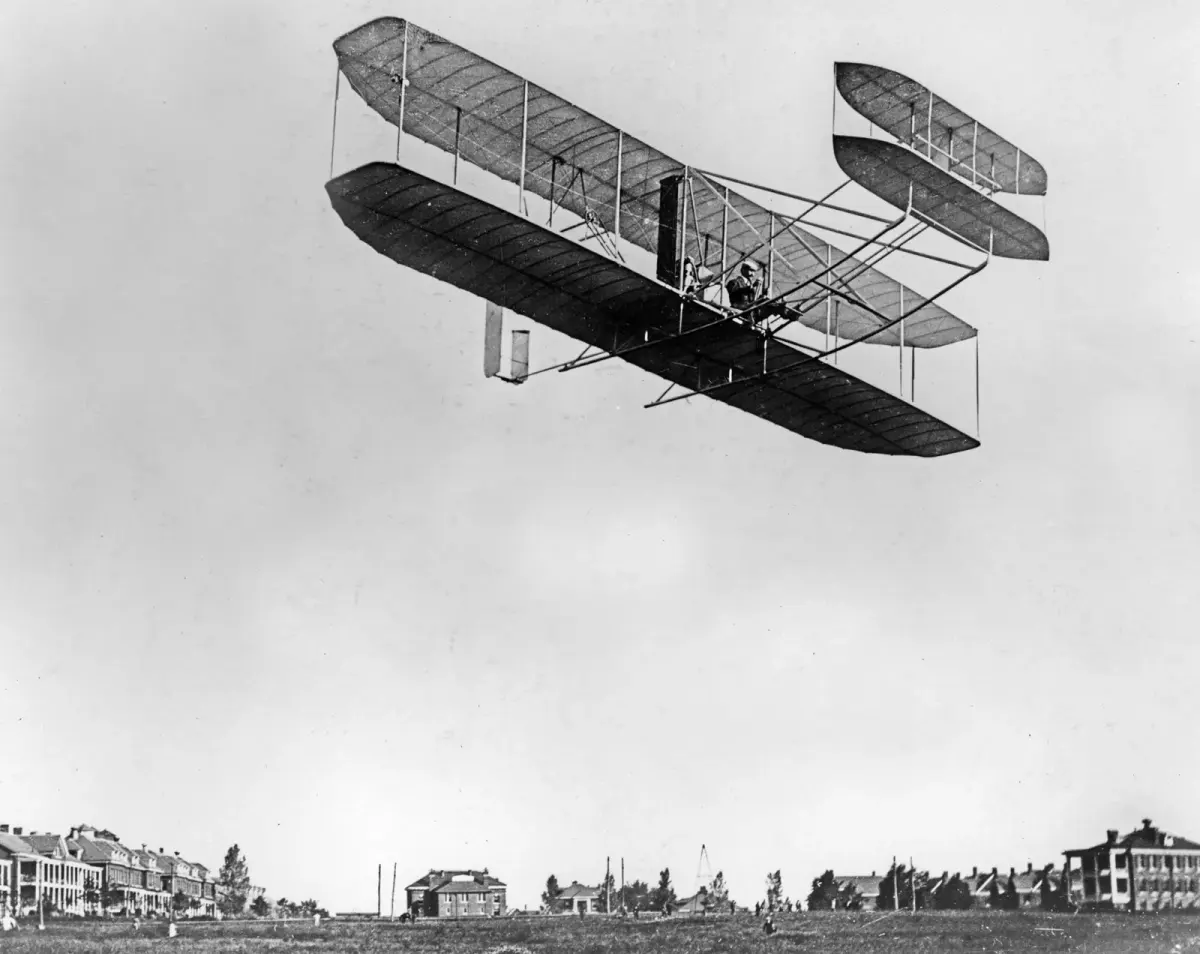
Their background in bicycle manufacturing proved essential to their success. They possessed the practical skills to build lightweight frames and the analytical mindset to solve complex engineering challenges. By the time they arrived at Kitty Hawk, they had already mastered the art of "wing warping," a technique that allowed them to twist the wings to bank the aircraft and maintain stability during turns.
How did the first flight happen?
The Wright brothers’ breakthrough occurred on the morning of December 17, 1903, at Kill Devil Hills. The aircraft, known as the Wright Flyer, was a biplane constructed of spruce wood and muslin fabric, powered by a custom-built 12-horsepower engine. Orville Wright piloted the first flight, which lasted 12 seconds and covered 120 feet.
Throughout that day, the brothers completed four successful flights. The final flight, piloted by Wilbur, lasted 59 seconds and covered 852 feet. These achievements proved that powered flight was not only possible but also controllable. Their methodical approach established the fundamental principles of flight dynamics that remain the foundation of modern aviation today.
- Prepare the launch rail on level ground.
- Ensure the engine is warmed and the propellers are clear.
- Release the restraint and accelerate into a headwind.
- Use the hip cradle to manipulate the wing-warping cables.
- Maintain a steady pitch to prevent stalling.
Why is there debate about the invention?
While the Wright brothers are widely recognized as the inventors of the airplane, some historians point to earlier pioneers. Alberto Santos-Dumont, a Brazilian inventor living in France, performed a public flight in 1906 that many Europeans considered the first true demonstration of an airplane. His aircraft, the 14-bis, took off under its own power without the need for a catapult or headwind.
However, the Wright brothers' 1903 flight predates the 14-bis by three years. The primary difference lies in the method of takeoff and control. The Wright Flyer utilized a catapult-assisted takeoff in later tests and relied on sophisticated control surfaces that allowed for sustained, banked turns. Santos-Dumont’s aircraft was impressive but lacked the advanced lateral control systems that define modern flight, making the Wrights' contribution more technologically significant.
- Gustave Whitehead: Claimed a powered flight in 1901, but lacked photographic evidence.
- Samuel Langley: Attempted a powered flight shortly before the Wrights, but his machine crashed into the Potomac River.
- George Cayley: Known as the "father of aviation" for identifying the four forces of flight in the early 19th century.
Common mistakes when studying aviation history
A frequent error is assuming that the airplane was invented in a single moment of inspiration. In reality, the Wright brothers spent years building gliders and testing wing designs in a custom-built wind tunnel. Another common mistake is ignoring the importance of the control system. Many early inventors built engines that were powerful enough for flight, but they failed because they could not steer or stabilize their machines.
Readers often overlook the role of the propeller. The Wright brothers realized that a propeller is essentially a rotating wing, and they calculated its efficiency using complex mathematics. By ignoring these technical nuances, one might mistakenly believe that flight was merely a matter of brute force and engine power, rather than the result of precise aerodynamic engineering and iterative design improvements.
How to learn more about early flight
To gain a practical understanding of how early aircraft functioned, visit aviation museums that feature replicas of the Wright Flyer. Observing the physical construction—such as the chain-drive system and the thin, curved wing profiles—provides a clearer picture of their ingenuity than reading alone. Many museums offer interactive exhibits that demonstrate how wing warping works, allowing you to see the mechanical connection between the pilot's movements and the aircraft's response.
If you are interested in the engineering side, look for historical records of the Wright brothers' wind tunnel data. They tested over 200 wing shapes to find the best lift-to-drag ratio. By studying these charts, you can appreciate the scientific rigor that turned a dream of flight into a practical mode of transportation. Understanding these foundational steps helps clarify why the Wright brothers' specific combination of control, power, and aerodynamic efficiency remains the benchmark for the invention of the airplane.
Key facts
- Orville and Wilbur Wright are credited with the first powered, controlled, and sustained flight of a heavier-than-air aircraft.
- The historic flight took place on December 17, 1903, at Kitty Hawk, North Carolina.
- Orville Wright piloted the first flight, which lasted 12 seconds and covered 120 feet.
- The Wright Flyer used a custom-built 12-horsepower engine and two wooden propellers.
- A common mistake is to ignore the importance of "three-axis control," which allowed the brothers to steer effectively.
- To understand early aviation, focus on the Wrights' systematic use of wind tunnel testing to refine wing shapes.
The bottom line
While many pioneers contributed to the dream of human flight, Orville and Wilbur Wright achieved the first successful powered, controlled, and sustained flight in 1903. Their success resulted from rigorous scientific testing, innovative wing-warping control systems, and a deep understanding of aerodynamics. By systematically refining their designs, the Wright brothers transformed aviation from a dangerous hobby into a practical technology that permanently reshaped global transportation and communication.
People also ask
Did anyone fly before the Wright brothers?
Several inventors, such as Otto Lilienthal, achieved successful flights in gliders before 1903. However, these attempts lacked the engine power and control systems necessary for sustained, powered flight.
What was the role of the Wright brothers' bicycle shop?
The brothers applied mechanical principles learned from repairing bicycles to aircraft design. Their experience with balancing and chain-drive mechanisms provided the practical foundation for their early aviation engineering.
Why is Kitty Hawk famous in aviation history?
The location was chosen for its consistent winds, soft sandy landing surfaces, and isolation. These factors provided a safe testing ground for the brothers to experiment with their prototypes.
Was the Wright Flyer the first airplane ever built?
It was the first successful powered airplane, but it was the culmination of years of building kites and gliders. The brothers built three full-size gliders between 1900 and 1902 before attempting powered flight.
How did the brothers steer their airplane?
They invented a system of "wing warping" that allowed the pilot to twist the wings to control roll. This innovation was the precursor to the modern aileron system used on all aircraft today.
Did the Wright brothers patent their invention?
Yes, they secured U.S. Patent 821,393 in 1906 for their flying machine. This legal protection was central to their efforts to establish ownership of the fundamental principles of flight control.
This answer was created with the help of AI research tools and reference sources. Spotted an error? Let us know — we correct mistakes quickly. See our editorial policy.