What is the easiest way to draw a honeycomb?
Short answer
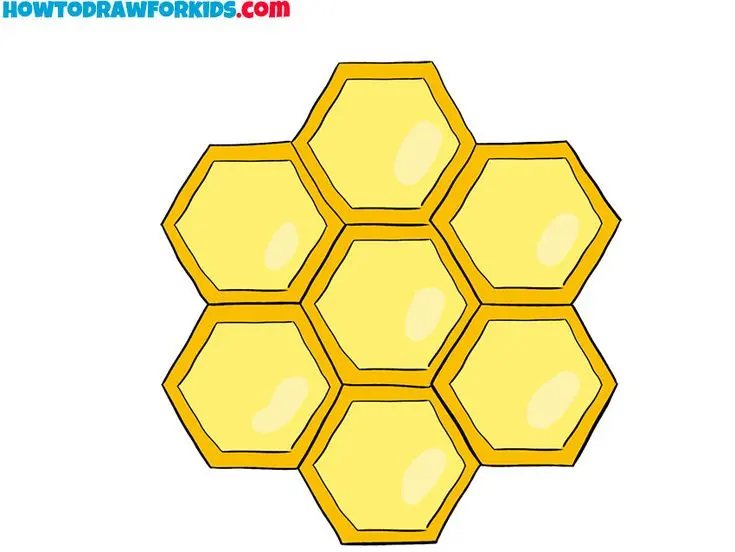
The easiest way to draw a honeycomb is to use a grid of repeating hexagons. By drawing a single hexagon and tiling it, you create a seamless tessellation. Using a ruler or a stencil ensures consistency, while connecting the sides allows the pattern to expand infinitely across your drawing surface.
On this page
How to draw a honeycomb pattern step by step
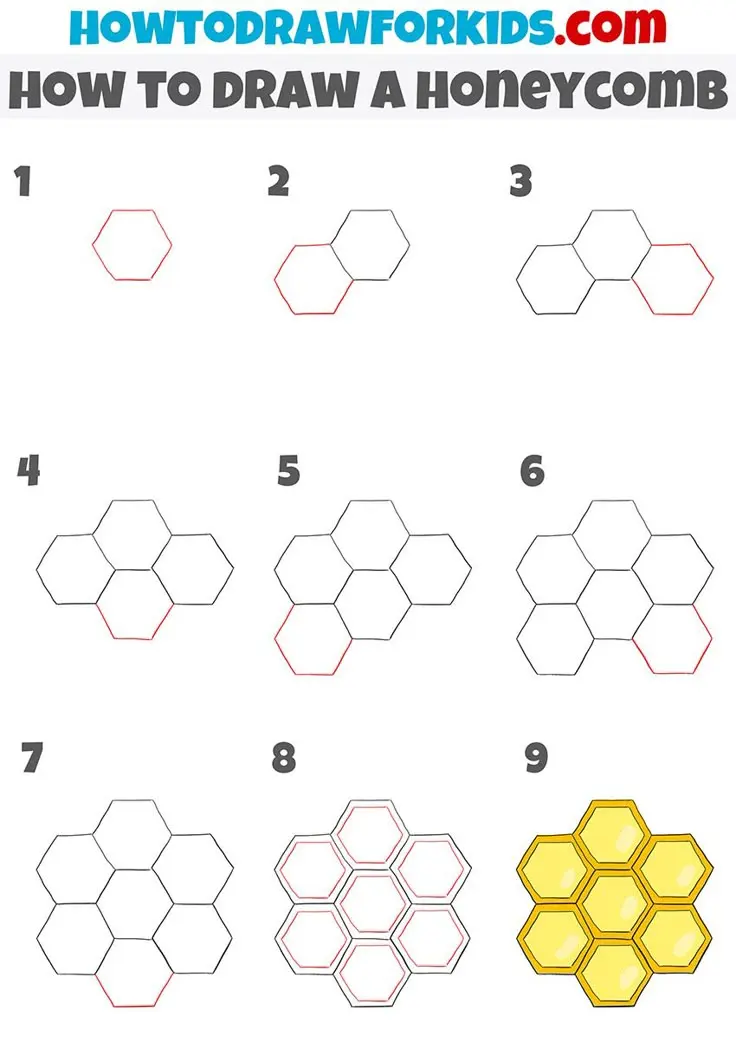
Creating a honeycomb pattern is a geometric exercise that relies on the consistent shape of the hexagon. To begin, you will need a pencil, a ruler, and a piece of paper. The most efficient method involves building the structure from a central point outward to maintain symmetry and alignment.
- Draw a single hexagon in the center of your page to serve as the anchor.
- Place a second hexagon directly against one of the flat sides of the first.
- Continue adding hexagons to every exposed side of the existing shapes.
- Ensure that each new hexagon shares a full edge with the previous ones.
- Repeat this process until your desired area is filled, keeping the lines light until you are satisfied with the layout.
By following this additive process, you avoid the common pitfall of drifting off-center. If you attempt to draw each hexagon individually without connecting them, you will likely encounter gaps or misaligned edges that break the illusion of a continuous structure.
Best tools for drawing hexagons for beginners
While you can draw a honeycomb freehand, using specific tools significantly improves accuracy and speed. A hexagonal stencil is the most effective tool for beginners because it provides a pre-measured template. These stencils are widely available at art supply stores and allow you to trace perfect shapes repeatedly without needing to measure angles.
If you prefer not to buy a stencil, a ruler and a protractor are essential. A hexagon is essentially six equilateral triangles joined at a center point, with each interior angle measuring 120 degrees. By marking these angles precisely, you can construct a perfect hexagon from scratch.
- Use a mechanical pencil for sharp, thin lines that are easy to erase.
- Utilize a grid-lined notebook to serve as a natural guide for your spacing.
- Keep a soft eraser nearby to clean up intersecting lines once the pattern is established.
- Use a fine-liner pen to trace over your final pencil lines for a professional, polished finish.
Why hexagons are used in honeycombs
The hexagonal shape found in nature is not arbitrary; it is the most efficient way for bees to store honey and raise larvae. In geometry, this is known as the honeycomb conjecture, which proves that a regular hexagonal grid is the best way to divide a surface into regions of equal area with the least total perimeter.
From a drawing perspective, this efficiency translates into a pattern that is easy to replicate. Because every side of a hexagon is shared with an adjacent cell, you only need to draw one line to create a side for two different cells. This mathematical property makes the honeycomb one of the most satisfying patterns to draw, as it creates a complex, organic look through very simple, repetitive actions.
Common mistakes when drawing a honeycomb
The most frequent error when drawing a honeycomb is failing to maintain consistent side lengths. Even a small discrepancy in the length of one side will cause the entire grid to warp as you move outward. This is often caused by rushing the initial construction or neglecting to use a ruler for the first few rows of the pattern.
Another common mistake is drawing the hexagons with rounded corners. While this might look more "organic," it prevents the shapes from fitting together perfectly. To maintain the structural integrity of the drawing, ensure that every corner is a sharp, distinct point where three lines meet. If you find your lines are becoming messy, stop and re-evaluate your spacing before continuing. It is always easier to fix a mistake in the first row than it is to correct a skewed pattern that has already covered half of your page.
How to add depth to your honeycomb drawing
Once you have mastered the basic flat grid, you can add depth to make the honeycomb appear three-dimensional. This technique involves drawing small, angled lines from the interior corners of each hexagon toward a central point. By shading these inner triangles, you create the illusion that the cells have actual depth and walls.
- Draw your standard flat honeycomb pattern using thin, light pencil lines.
- Inside each hexagon, draw three lines connecting every other corner to the center of the hexagon.
- Use a darker pencil or ink to shade the three resulting triangles that face the same direction.
- Apply a lighter touch or a different color to the remaining sections to create a highlight effect.
- Add a subtle drop shadow to one side of each cell to further enhance the three-dimensional appearance.
By applying these shading techniques, you transform a simple geometric pattern into a realistic representation of a hive. This method requires patience, but the visual result is significantly more engaging than a standard two-dimensional grid. Always work in small sections to ensure that your shading remains consistent across the entire honeycomb structure.
Key facts
- A honeycomb is composed of tessellating regular hexagons, which are six-sided polygons with equal angles and side lengths.
- The most efficient way to draw a grid is to start with a single hexagon and build outward by sharing edges.
- Using a ruler or a stencil ensures that the side lengths remain consistent, which is necessary for the pattern to lock together correctly.
- Hexagons are mathematically optimal because they provide the largest surface area for storage while using the minimum amount of wax.
- To create a honeycomb effect, draw a series of vertical zig-zag lines and then connect them with horizontal or angled segments.
- A common mistake is drawing the hexagons with rounded corners, which prevents the shapes from fitting together in a true tessellation.
The bottom line
Drawing a honeycomb is best achieved by mastering the tessellating hexagon. By focusing on consistent side lengths and shared edges, you can build a precise, repeating structure that mimics nature’s efficiency. Whether you choose to draft your grid manually with a ruler or utilize digital tools, the key is maintaining geometric uniformity. With a bit of practice, you will create a perfect, professional-looking honeycomb pattern every time.
People also ask
Why are honeycombs always hexagonal?
Bees build hexagonal cells because this shape minimizes the amount of wax required to build the structure while maximizing the storage volume for honey and larvae. It is the most efficient geometric shape for filling a 2D plane without leaving any gaps.
Can I draw a honeycomb without a ruler?
Yes, you can create a honeycomb pattern freehand by drawing a grid of staggered dots and connecting them to form hexagons. However, using a straight edge is recommended for beginners to ensure the lines remain parallel and the angles stay uniform.
What is the best pen or pencil for this drawing?
A mechanical pencil is ideal for drafting the initial grid because it produces thin, precise lines that are easy to erase. Once the structure is set, you can use a fine-liner or ink pen to darken the edges for a clean, professional look.
How do I make the honeycomb look three-dimensional?
You can add depth by drawing a small rhombus inside the top or side of each hexagon to represent the base of the cell. Shading the interior of each cell with a darker color on one side also creates the illusion of depth.
Are all the hexagons in a honeycomb the same size?
In a natural beehive, worker bee cells are typically uniform, while drone cells are slightly larger. When drawing a decorative pattern, keeping all hexagons the same size creates a more balanced and visually pleasing aesthetic.
Is there a digital shortcut for drawing honeycombs?
Most graphic design software includes a "polygon tool" that allows you to set the number of sides to six. You can then copy and paste the shape or use a pattern-fill feature to create a perfect, repeating honeycomb grid instantly.
This answer was created with the help of AI research tools and reference sources. Spotted an error? Let us know — we correct mistakes quickly. See our editorial policy.