What is Takashi Murakami known for?
Short answer
Takashi Murakami is a globally renowned Japanese contemporary artist known for founding the "Superflat" movement. He blurs the boundaries between high art and commercial pop culture, creating vibrant, anime-inspired works. His signature motifs, including colorful smiling flowers and the character Mr. DOB, have appeared in galleries, luxury fashion collaborations, and music videos.
On this page
What is the Superflat art movement?
Superflat is an aesthetic and theoretical framework developed by Murakami in the early 2000s. It critiques the lack of depth in Japanese consumer culture while simultaneously celebrating the two-dimensional nature of traditional Japanese art, such as Edo-period woodblock prints, and modern manga. By flattening the hierarchy between high-brow painting and low-brow commercial merchandise, Murakami challenges how society consumes visual imagery.
The movement emphasizes bright colors, bold outlines, and a distinct lack of perspective, mimicking the digital precision of animation. Murakami argues that post-war Japanese society is "superflat," meaning the distinction between high art and mass-produced goods has vanished. This philosophy allows his work to exist comfortably in both the prestigious halls of the Palace of Versailles and on limited-edition handbags sold in retail malls.
Why are Murakami flowers so famous?
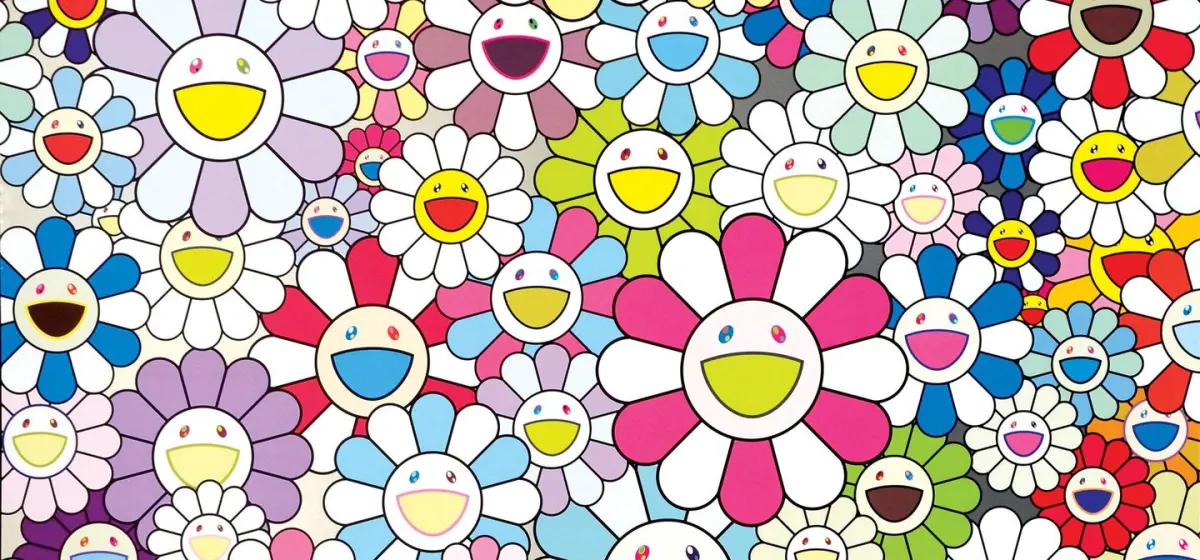
The smiling flower is Murakami’s most recognizable icon, serving as a symbol of his optimistic yet complex artistic vision. These flowers typically feature vibrant, multicolored petals surrounding a cheerful, wide-eyed face. While they appear whimsical and childlike, Murakami often intends for them to represent the duality of human emotion, reflecting both joy and the underlying anxiety of the modern world.
These motifs have become staples of contemporary visual culture, appearing on everything from fine art prints to plush toys. Their popularity stems from their accessibility and the emotional response they elicit from viewers of all ages. To understand their cultural impact, consider these key characteristics:
- Repetitive, geometric patterns that evoke a sense of mass production.
- A high-saturation color palette that captures the energy of Japanese youth culture.
- A blend of "kawaii" (cute) aesthetics with a slightly unsettling, manic intensity.
How to identify a Murakami collaboration?
Murakami is famous for his prolific partnerships with global luxury brands and pop culture icons. He treats commercial collaborations as an extension of his artistic practice rather than a distraction. A typical Murakami collaboration involves the integration of his signature characters, such as the colorful flowers or his alter-ego Mr. DOB, into the branding or physical design of a product.
If you are looking to identify his work in a commercial context, watch for these common markers:
- The presence of his signature smiling flower motifs integrated into fabric or packaging.
- The use of vibrant, neon, or high-contrast color schemes.
- Official branding that explicitly credits the artist, often found on limited-edition labels.
- A sense of playfulness that contrasts with the traditional seriousness of luxury goods.
What are the most important works by Takashi Murakami?
Murakami’s career is defined by several monumental pieces that shifted the trajectory of contemporary art. His early works, such as "My Lonesome Cowboy" (1998), gained international notoriety for their provocative nature. These sculptures pushed the boundaries of eroticism and otaku culture, sparking intense debates about the role of sexualized imagery in fine art.
Beyond sculpture, his large-scale paintings are central to his legacy. His work often features massive canvases filled with thousands of intricate, hand-painted details. These pieces require teams of assistants to complete, reflecting his belief that the artist should function more like a film director or a CEO of a studio. Key works include:
- "The 500 Arhats" (2012): A massive, 100-meter-long painting created in response to the 2011 Tohoku earthquake.
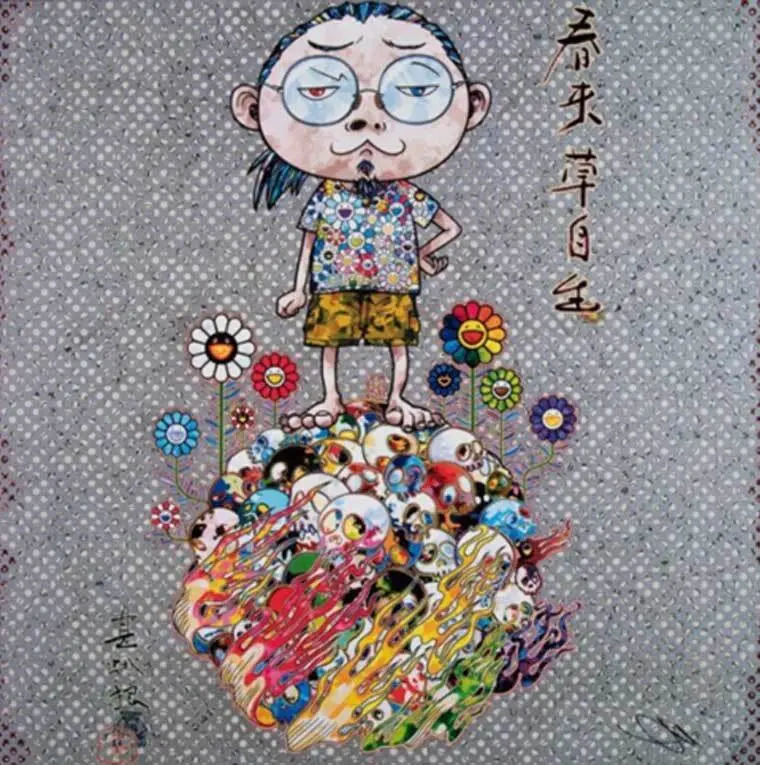
- "Mr. DOB": A recurring character that evolves through various iterations, representing the artist's own identity.
- "Flower Ball": A spherical composition featuring his iconic floral motifs that has become a collector's favorite.
Common mistakes when collecting Murakami art?
Entering the market for Murakami’s work requires caution due to the prevalence of unauthorized merchandise and high-end fakes. A common mistake for beginners is assuming that every item featuring a smiling flower is an authentic piece of fine art. Many mass-produced goods, such as keychains or stickers, are licensed products, not limited-edition artworks, and they do not hold the same investment value as his prints or sculptures.
When attempting to collect his work, avoid these pitfalls:
- Purchasing items without a verified certificate of authenticity from a reputable gallery or auction house.
- Confusing mass-produced "merch" with limited-edition prints signed by the artist.
- Ignoring the condition of the piece, as his vibrant colors are prone to fading if exposed to direct sunlight or poor climate control.
- Failing to research the specific provenance of a piece, which is essential for confirming that the work was produced under the artist's direct supervision within his Kaikai Kiki studio.
Key facts
- Takashi Murakami is the founder of "Superflat," an art movement that blends traditional Japanese aesthetics with modern pop culture.
- He is famous for his signature motif, the smiling "Mr. DOB" character, which often serves as a self-portrait.
- Murakami holds a Ph.D. in Nihonga, a style of traditional Japanese painting, from the Tokyo University of the Arts.
- He famously collaborated with luxury fashion house Louis Vuitton in 2003 to create a line of handbags featuring colorful monograms.
- His large-scale sculpture "My Lonesome Cowboy" sold for $15.2 million at a Sotheby’s auction in 2008.
- To identify authentic Murakami prints, always check for the official Kaikai Kiki studio stamp or embossed signature on the back.
The bottom line
Takashi Murakami is a pivotal figure in contemporary art, celebrated for bridging the divide between commercial products and fine art. By synthesizing traditional Japanese techniques with the vibrant imagery of anime and manga, he created the globally recognized Superflat style. His influence extends beyond galleries, shaping fashion, music, and pop culture, ultimately redefining how audiences interact with art in a mass-market, digital-first world today.
People also ask
What is the Superflat movement?
Superflat is a postmodern art style that flattens the distinction between "high" art, such as fine painting, and "low" culture, like anime and manga. It emphasizes bright colors, bold outlines, and a two-dimensional aesthetic.
Did Takashi Murakami work with Kanye West?
Yes, Murakami designed the iconic album cover for Kanye West’s 2007 studio album, "Graduation." This collaboration helped bridge the gap between contemporary fine art and mainstream hip-hop culture.
What are Kaikai and Kiki?
Kaikai and Kiki are two recurring characters in Murakami’s work, often depicted as small, playful creatures. They also serve as the name of his art production and management company, Kaikai Kiki Co., Ltd.
Is Takashi Murakami still alive?
Yes, Takashi Murakami is alive and continues to produce art, fashion, and film from his studios in Tokyo and New York. He remains one of the most commercially successful living artists today.
What materials does Murakami use for his sculptures?
Murakami utilizes a variety of materials, including fiberglass, steel, and acrylic paint. He often employs a team of skilled assistants to execute his complex designs, similar to the traditional workshop model.
Where can I see Murakami's work in person?
His works are held in the permanent collections of major institutions like the Museum of Modern Art in New York and the Tate Modern in London. Many of his pieces are also frequently featured in international traveling exhibitions.
This answer was created with the help of AI research tools and reference sources. Spotted an error? Let us know — we correct mistakes quickly. See our editorial policy.