What is Surrealism?
Short answer
Surrealism was a 20th-century avant-garde movement that sought to release the creative potential of the unconscious mind. By juxtaposing irrational imagery and dreamlike states, artists challenged traditional logic and societal norms. Emerging in Paris during the 1920s, it profoundly influenced literature, painting, film, and photography with its focus on the marvelous.
On this page
What is the history of Surrealism?
Surrealism officially began in 1924 when French poet André Breton published the Surrealist Manifesto. The movement grew out of Dadaism, an earlier anti-art movement that reacted against the horrors of World War I by embracing chaos and absurdity. While Dada sought to destroy traditional aesthetics, Surrealism aimed to build a new reality by merging the dream world with everyday life. This philosophy was heavily influenced by the psychoanalytic theories of Sigmund Freud, particularly his work on the unconscious and the interpretation of dreams.
The movement attracted a wide range of international talent, including painters, writers, and filmmakers. Key figures such as Salvador Dalí, Max Ernst, Joan Miró, and René Magritte pushed the boundaries of visual expression. The group remained active throughout the 1930s, eventually spreading across Europe and the Americas as artists fled the political turmoil of World War II. By the time the movement officially dissolved in the late 1960s, it had fundamentally altered modern artistic expression and cultural criticism.
How do you identify Surrealist art?
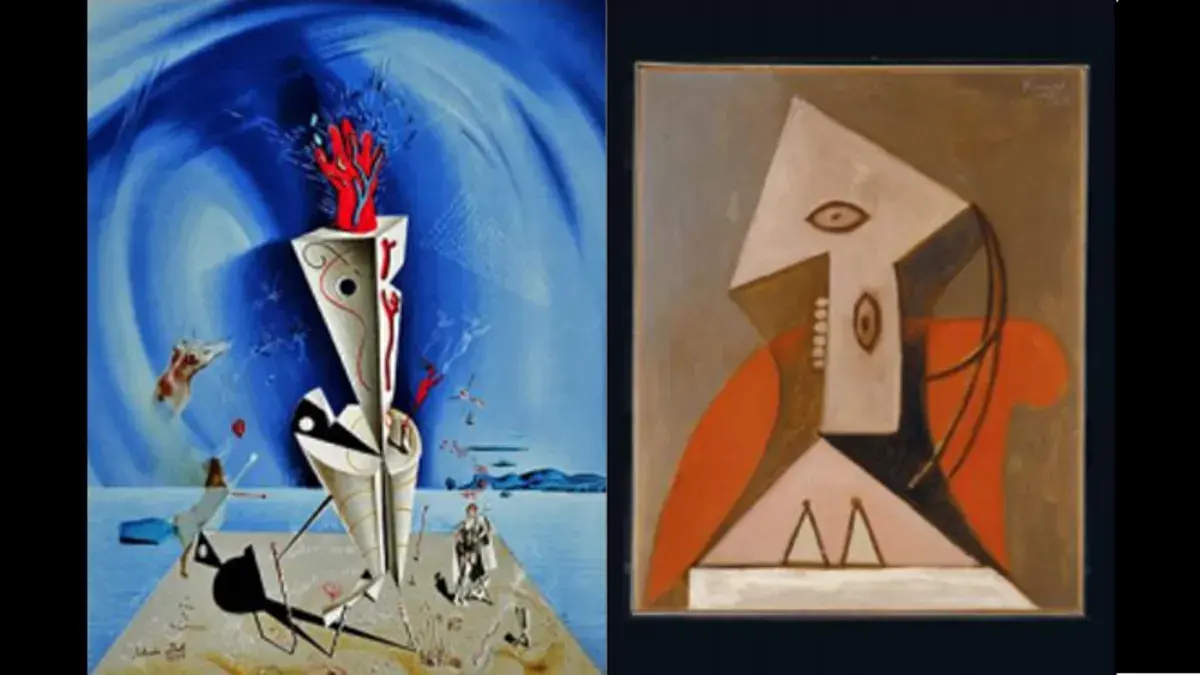
Surrealist art is defined by its refusal to follow the rules of rational thought. You can identify these works by looking for specific techniques and themes that prioritize the subconscious over conscious logic. Artists often employed "automatism," a method of creating art without conscious thought or planning, to bypass the ego and reveal hidden desires. The resulting imagery is frequently unsettling, bizarre, or physically impossible.
Common visual markers of Surrealist art include:
- Distorted or melting objects placed in realistic settings.
- Unexpected juxtapositions, such as a lobster on a telephone or a train emerging from a fireplace.
- Dreamlike, vast, or desolate landscapes that lack a clear sense of scale.
- Symbolic representations of fear, desire, or repressed memories.
- The use of hyper-realistic detail to depict impossible or nightmarish scenarios.
By placing familiar objects in unfamiliar contexts, Surrealists forced viewers to question their own perception of reality and the stability of the world around them.
What are the best Surrealist works for beginners?
If you are new to the movement, starting with the most iconic pieces will provide a solid foundation for understanding the aesthetic. These works are famous because they perfectly encapsulate the movement's goal of making the irrational seem tangible. Many of these pieces are housed in major museums, making them accessible to the public both in person and through high-quality digital archives.
Consider starting your study with these foundational works:
- The Persistence of Memory (1931) by Salvador Dalí: Famous for its iconic melting clocks, this painting challenges our perception of time.
- The Treachery of Images (1929) by René Magritte: This work features a pipe with the text "This is not a pipe," forcing the viewer to distinguish between an object and its representation.
- The Elephant Celebes (1921) by Max Ernst: A prime example of early Surrealist collage and mechanical, dreamlike imagery.
- The Hunter (Catalan Landscape) (1924) by Joan Miró: This piece showcases the use of biomorphic shapes and symbolic automatism.
Why does Surrealism still matter today?
Surrealism remains relevant because it encourages the viewer to look beyond the surface of reality. In a world increasingly dominated by data and literalism, the movement provides a necessary outlet for the imagination and the irrational. It taught subsequent generations that art does not need to be representational or logical to be profound or emotionally resonant. Its influence is visible today in modern advertising, music videos, and experimental cinema, where dream logic is frequently used to capture attention.
Furthermore, Surrealism challenged the status quo by questioning the political and social structures of its time. By emphasizing the importance of individual desire and the liberation of the mind, it laid the groundwork for later countercultural movements. The movement proved that art could be a tool for psychological investigation and social critique, ensuring that its legacy persists in how we interpret media, symbols, and human behavior in the modern age.
Common mistakes when analyzing Surrealist art
A frequent error when approaching Surrealism is the attempt to find a single, "correct" meaning for every symbol. Because the movement is rooted in the individual's unconscious, there is rarely a universal key to unlock a painting's message. Trying to force a logical, linear narrative onto a work that was intentionally created to be irrational will only lead to frustration. Instead of asking what the artist "meant," focus on how the image makes you feel and what personal associations it triggers.
To better engage with these works, avoid these pitfalls:
- Assuming that every symbol has a Freudian definition; sometimes an object is chosen simply for its aesthetic shock value.
- Ignoring the title of the work, which often provides a crucial, ironic, or poetic clue to the artist's intent.
- Overlooking the technical skill involved; Surrealists were often highly trained academic painters who used their mastery of technique to make the impossible look real.
- Viewing works in isolation rather than considering the broader cultural context of the era.
Key facts
- Surrealism was officially founded in Paris in 1924 by the poet André Breton with the publication of his "Surrealist Manifesto."
- The movement sought to bridge the gap between dreams and reality to create an "absolute reality," or surreality.
- Artists utilized "automatism," a technique of writing or drawing without conscious thought, to bypass the rational mind.
- Key figures in the movement include Salvador Dalí, René Magritte, Max Ernst, Joan Miró, and Frida Kahlo.
- To practice surrealist writing, set a timer for ten minutes and write continuously without editing, censoring, or pausing to think.
- A common mistake is assuming surrealism is just "random" or "weird"; it is actually a calculated attempt to express the unconscious mind.
The bottom line
Surrealism is an artistic and intellectual movement that prioritizes the unconscious mind over logic and reason. By embracing dreams, chance, and the juxtaposition of ordinary objects in impossible ways, surrealists aim to unlock a deeper, more authentic human experience. Whether through painting or writing, the practice encourages individuals to bypass their internal censors, allowing raw, imaginative expression to surface and challenge our perception of reality.
People also ask
How does Surrealism differ from Dadaism?
Dadaism was an anti-art movement born from the trauma of World War I that focused on chaos and destruction. Surrealism evolved from Dadaism but shifted the focus toward psychological exploration and the power of the subconscious.
Can anyone create surrealist art?
Yes, surrealism relies on personal intuition rather than technical perfection. By focusing on juxtaposition—placing two unrelated objects together—anyone can create a surrealist image or poem.
Why are clocks melting in Salvador Dalí’s paintings?
In his famous work "The Persistence of Memory," the melting clocks represent the fluidity of time in the dream state. Dalí used these images to challenge the rigid, mechanical perception of reality held by the waking world.
What is the "exquisite corpse" game?
This is a collaborative drawing or writing game where each participant adds to a composition without seeing what the previous person created. It is designed to produce unexpected, collective imagery that no single person could have planned.
Is Surrealism still relevant today?
Surrealism remains a major influence on modern advertising, film, and fashion. Its emphasis on breaking logic and exploring the irrational continues to shape how creators approach visual storytelling and brand identity.
What are the main themes of Surrealist literature?
Surrealist writers often explored forbidden desires, the uncanny, and the intersection of madness and creativity. They frequently used dream journals and stream-of-consciousness techniques to capture the unfiltered voice of the inner self.
This answer was created with the help of AI research tools and reference sources. Spotted an error? Let us know — we correct mistakes quickly. See our editorial policy.