What is still life drawing?
Short answer
Still life drawing is the artistic practice of capturing inanimate objects arranged in a deliberate composition. Artists use these subjects to study light, shadow, texture, and form. By focusing on stationary items like fruit, vessels, or household goods, creators develop fundamental technical skills essential for mastering perspective, proportion, and tonal value.
On this page
What is the history of still life drawing?
Still life as an independent genre emerged prominently in the late 16th century, particularly within the Dutch Golden Age. Artists like Pieter Claesz and Willem Claeszoon Heda specialized in "ontbijtjes," or breakfast pieces, which showcased domestic luxury and moral allegories. These works often utilized vanitas symbolism, incorporating skulls, wilting flowers, or extinguished candles to remind viewers of the fleeting nature of life and material wealth.
By the 18th and 19th centuries, the focus shifted toward formal experimentation. Paul Cézanne revolutionized the genre by breaking objects into geometric planes, moving away from strict realism toward a more structural interpretation of space. This shift influenced modern movements, including Cubism, where artists like Pablo Picasso and Georges Braque deconstructed objects into fragmented, overlapping perspectives. Today, the practice remains a cornerstone of academic art education, serving as a primary method for teaching students how to translate three-dimensional reality onto a two-dimensional surface.
How to set up a still life drawing?
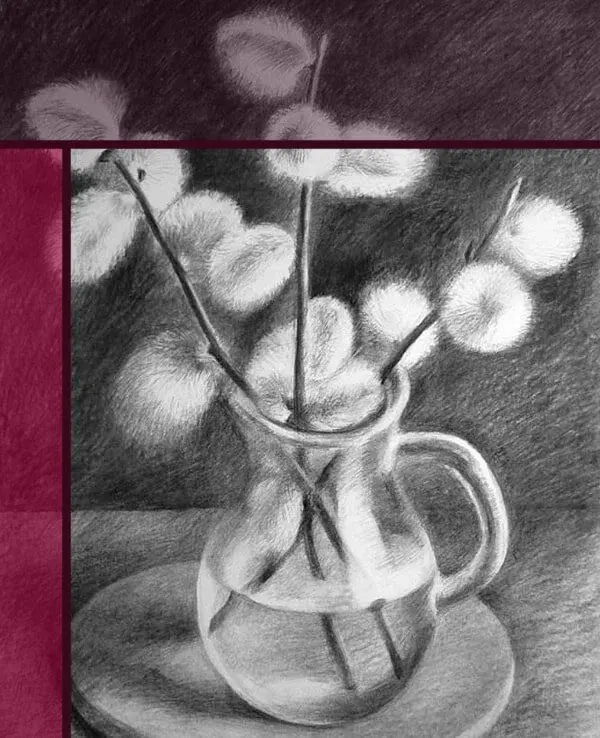
Creating a compelling still life requires careful planning of the physical environment. The arrangement of objects dictates the narrative and the visual flow of the final piece. Start by selecting items that vary in size, shape, and surface quality, such as a smooth glass vase paired with a textured piece of fruit or fabric.
- Select a stable, flat surface like a table or pedestal.
- Position a single, strong light source to one side to create dramatic highlights and deep shadows.
- Arrange your objects in an asymmetrical grouping to create visual interest.
- Use a neutral background, such as a plain cloth or wall, to prevent visual clutter.
- Sit at a consistent height to ensure your perspective remains stable throughout the drawing process.
Avoid placing all objects in a straight line, as this creates a static and uninteresting composition. Instead, overlap items to create depth and lead the viewer's eye across the page.
Best materials for still life drawing?
Beginners should start with versatile, forgiving media that allow for easy correction. Graphite pencils ranging from 2H for light initial sketches to 6B for deep, dark shadows are the industry standard. Charcoal is another excellent option, as it allows for rapid tonal blocking and expressive, smudged textures that help define the volume of rounded objects.
- Graphite pencils: Ideal for precision and fine detail.
- Compressed charcoal: Best for bold, high-contrast drawings.
- Kneaded erasers: Essential for lifting highlights and correcting mistakes without damaging the paper.
- Blending stumps: Useful for smoothing transitions between light and shadow.
- Heavyweight cartridge paper: Provides a durable surface that withstands repeated erasing.
When choosing paper, opt for a medium-tooth texture. A surface that is too smooth will not hold charcoal well, while overly textured paper can make fine pencil lines appear broken and inconsistent. Always keep a sharpener or a utility knife nearby to maintain a crisp point on your drawing tools.
Why lighting is important in drawing?
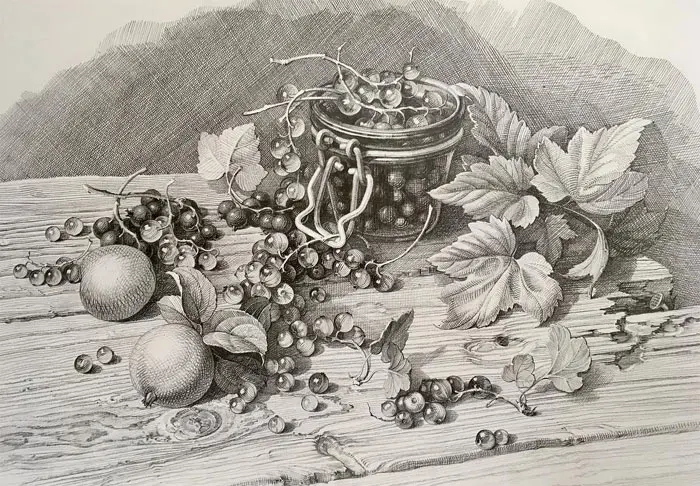
Lighting is the most critical element in still life drawing because it defines the form and volume of the objects. Without a clear light source, a sphere looks like a flat circle. You must identify the "highlight," the "mid-tone," the "core shadow," and the "reflected light" to create a convincing illusion of three-dimensional space.
The "cast shadow"—the dark shape projected onto the surface by the object—is equally important. It anchors the object to the table and provides context for the light's direction. Observe how shadows change as they move further from the object; they often become softer and lighter due to ambient light. By mastering these tonal values, you can make a simple piece of fruit appear heavy, round, and tactile. Practice squinting at your subject to blur the details; this helps you see the primary shapes of light and dark rather than getting distracted by surface patterns or colors.
Common mistakes when drawing still life?
One frequent error is drawing what you think you see rather than what is actually there. For example, artists often draw a circular rim of a cup as a perfect circle, even when viewed from an angle where it should appear as an ellipse. Relying on mental symbols instead of visual evidence leads to distorted proportions and a lack of realism.
- Neglecting the negative space between objects, which helps define their edges.
- Using a light source that is too diffuse, resulting in weak, muddy shadows.
- Failing to establish the "ground plane," causing objects to look like they are floating.
- Over-detailing one object while ignoring the relationship between all items in the group.
- Using a hard outline for every object, which flattens the image.
To improve, periodically step back from your drawing to view it from a distance. This helps you spot errors in proportion and overall balance that are invisible when you are working close to the paper. Consistency in your observation is the key to success.
Key facts
- Still life drawing is the artistic depiction of inanimate objects, typically arranged on a tabletop or flat surface.
- The genre became a distinct category in Western art during the late 16th century, flourishing during the Dutch Golden Age.
- Essential tools include a graphite pencil set (HB to 6B), a kneaded eraser, and a sketchbook with high-quality drawing paper.
- Successful compositions rely on a single, strong light source to create clear highlights, mid-tones, and deep shadows.
- Artists often use a viewfinder—a small cardboard frame—to help crop and scale the subject matter before beginning the sketch.
- To avoid "floating" objects, ensure every item is grounded by a visible cast shadow that connects it to the surface plane.
The bottom line
Still life drawing is a foundational practice that sharpens your ability to translate three-dimensional reality onto a two-dimensional surface. By focusing on the interplay of light, shadow, and proportion, you develop the technical skills necessary for all forms of representational art. Whether you are a beginner or an advanced student, the consistent study of inanimate objects remains the most effective way to improve your observational accuracy.
People also ask
What is the best way to arrange a still life setup?
Choose objects with varying heights, textures, and shapes to create visual interest. Place the items on a plain cloth to simplify the background and use a desk lamp to establish dramatic lighting.
How do I start a still life drawing?
Begin by sketching light, loose geometric shapes to map out the proportions of each object. Once the placement is correct, refine the outlines and begin layering your shading from darkest to lightest.
What are the most common mistakes beginners make?
Many beginners draw objects too small for their paper or fail to observe the actual proportions, relying instead on what they think an object looks like. Another error is neglecting the "negative space" between objects, which is crucial for accurate spacing.
Do I need expensive materials to practice?
No, you can learn the fundamentals with a single HB pencil and standard printer paper. Mastery comes from observing light and shadow rather than the quality of your tools.
How long should a still life drawing take?
A quick gesture study might take 10 minutes, while a highly detailed rendering can take several hours over multiple sessions. Focus on accuracy and tonal range rather than speed during your initial learning phase.
Why is still life considered a foundational skill?
It teaches artists how to see light, volume, and perspective in a controlled environment. Because the subjects do not move, it allows for deep study of how light interacts with different materials like glass, metal, or fabric.
This answer was created with the help of AI research tools and reference sources. Spotted an error? Let us know — we correct mistakes quickly. See our editorial policy.