What is Pierre-Auguste Renoir known for?
Short answer
Pierre-Auguste Renoir was a leading French Impressionist painter celebrated for his vibrant depictions of light, leisure, and the human form. Renowned for his mastery of color and soft brushwork, he captured the joyful spirit of Parisian life. His extensive body of work includes iconic scenes of social gatherings, portraits, and landscapes.
On this page
What defined Renoir’s artistic style?
Renoir’s work is characterized by a focus on light and atmosphere, hallmarks of the Impressionist movement. Unlike his contemporaries who often focused on landscapes, Renoir was primarily a painter of people. He utilized a technique of short, broken brushstrokes that allowed colors to blend optically in the viewer’s eye rather than on the palette. This approach created a sense of movement and warmth that made his subjects appear alive and radiant.
His color palette evolved significantly throughout his career. In his early years, he favored bright, saturated hues to capture the effects of sunlight filtering through trees or reflecting off water. Later, he moved toward a more classical style, emphasizing sharper lines and more structured forms. Despite these shifts, his core interest remained the celebration of beauty, youth, and the pleasures of modern life. His ability to render skin tones with a luminous, pearlescent quality remains one of his most distinctive technical achievements.
How to identify a Renoir painting
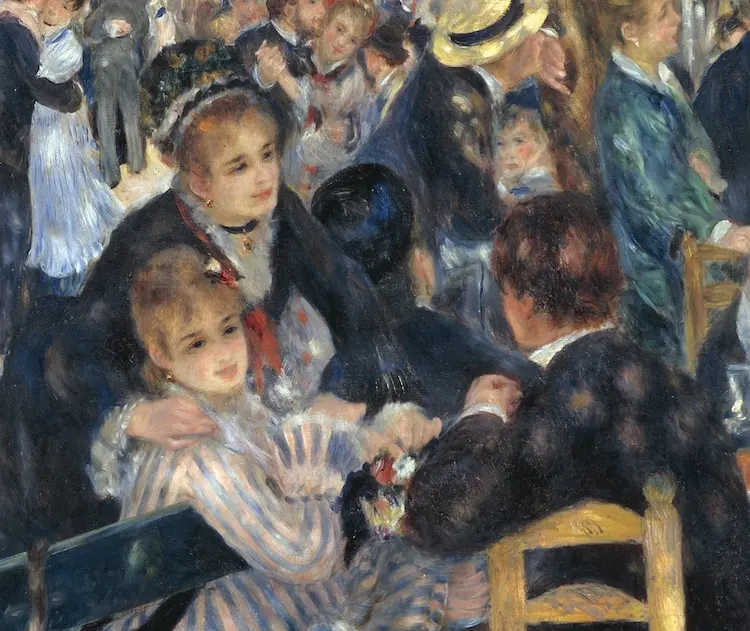
Identifying a Renoir requires looking for specific thematic and technical markers. Most of his famous paintings feature social settings, such as dance halls, cafes, or garden parties. He often depicted his friends and family, imbuing these portraits with a sense of intimacy and casual grace. If a painting features a crowded scene with dappled light and a joyful, relaxed atmosphere, it is likely a product of his Impressionist period.
When examining a potential work, look for these key visual indicators:
- Soft, blurred edges that avoid harsh outlines.
- A focus on the interplay of light and shadow, particularly "dappled" sunlight.
- Subjects captured in moments of spontaneous movement or genuine interaction.
- A warm, inviting color palette that avoids deep, somber blacks.
- Fluid, rhythmic brushwork that suggests a sense of ease and spontaneity.
Why Renoir’s subject matter changed over time
Renoir’s career was marked by a significant transition from the experimental nature of early Impressionism to a more disciplined, traditional approach. In the 1880s, he traveled to Italy and became deeply influenced by the works of Raphael and other Renaissance masters. He felt that Impressionism had led him into a "dead end" where he had lost the ability to draw or paint with structural integrity. Consequently, he began to emphasize form, contour, and a more permanent, sculptural quality in his figures.
This period, often called his "Ingres period," saw him move away from the fleeting, transient effects of light. He began to paint more formal portraits and mythological subjects, such as his famous series of bathers. While these works were initially criticized by some of his peers for being too rigid, they demonstrated his technical versatility. He successfully bridged the gap between the radical innovations of the 19th-century avant-garde and the timeless traditions of European art history.
Common mistakes when analyzing Impressionism
Many observers mistakenly assume that all Impressionist art is abstract or lacks technical skill. In reality, painters like Renoir were highly trained in traditional academic techniques before they chose to break the rules. A common error is evaluating his work based on photographic realism rather than the artist's intent to capture a sensory experience. Impressionism was never about documenting every detail; it was about capturing the "impression" of a moment as it was perceived by the human eye.
To gain a better appreciation of his work, try these steps:
- View the painting from a distance to allow the colors to blend naturally.
- Observe how the light hits the subjects rather than focusing on the background details.
- Consider the social context of the era, such as the rise of the Parisian middle class.
- Compare an early Impressionist piece to a later, more structured portrait to see his technical evolution.
- Avoid looking for perfect anatomical precision, as the emotional mood of the scene is the priority.
Where to see Renoir’s masterpieces today
Renoir was incredibly prolific, producing several thousand paintings during his lifetime. Because of this massive output, his works are held in major museums across the globe. The Musée d'Orsay in Paris holds the largest collection, including his monumental masterpiece, Bal du moulin de la Galette. This painting is widely considered the quintessential example of his ability to capture the vibrant, shifting light of a bustling Parisian dance hall.
Other significant collections include the Art Institute of Chicago, the Metropolitan Museum of Art in New York, and the National Gallery in London. Many of these institutions offer digital archives that allow viewers to zoom in on his brushwork, which is essential for understanding his technique. When visiting these galleries, look for the contrast between his early, light-filled scenes and his later, more statuesque compositions. By tracing his development through these major holdings, you can better understand why he remains one of the most beloved figures in the history of Western art.
Key facts
- Pierre-Auguste Renoir (1841–1919) was a leading French painter and a founding member of the Impressionist movement.
- He is best known for his vibrant celebration of beauty, feminine sensuality, and leisure activities in Parisian life.
- His masterpiece, Bal du moulin de la Galette (1876), exemplifies his signature style of capturing dappled sunlight through trees.
- In the 1880s, Renoir shifted away from pure Impressionism toward a more linear, classical style after visiting Italy and studying Raphael.
- He produced an estimated 4,000 paintings during his lifetime, despite suffering from severe rheumatoid arthritis in his later years.
- To study his work, look for his mastery of "broken brushstrokes" and his refusal to use black paint, preferring to mix complementary colors for shadows.
The bottom line
Pierre-Auguste Renoir remains one of the most beloved figures in art history for his ability to capture the joy of human connection and the warmth of natural light. While his technique evolved from spontaneous, colorful Impressionism to a more disciplined classical approach, his work consistently prioritized beauty and optimism. Exploring his vast catalog reveals a lifelong dedication to documenting the fleeting, vibrant pleasures of life.
People also ask
Why did Renoir stop painting in the Impressionist style?
After a trip to Italy in 1881, Renoir felt he had exhausted the possibilities of Impressionism. He became dissatisfied with its lack of structure and began focusing on more defined forms and classical compositions.
Did Renoir paint portraits of famous people?
Yes, he painted prominent figures such as actress Jeanne Samary, composer Richard Wagner, and fellow artist Claude Monet. These portraits were instrumental in establishing his reputation among the Parisian elite.
How did Renoir manage to paint while suffering from arthritis?
In his final years, his joints became severely deformed, making it difficult to hold a brush. He reportedly had brushes strapped to his hands and continued to paint with the help of assistants.
What is the "Renoir style" of lighting?
Renoir is famous for his "dappled light" effect, where sunlight filters through leaves to create flickering spots of color on skin and clothing. He achieved this by using small, rapid strokes of contrasting, unblended colors.
Are Renoir’s paintings considered expensive today?
Renoir is one of the most commercially successful artists in history. Several of his works have sold for tens of millions of dollars at auction, reflecting his enduring popularity with global collectors.
Where can I see Renoir’s most famous paintings in person?
Major collections are housed at the Musée d'Orsay in Paris, the Art Institute of Chicago, and the Metropolitan Museum of Art in New York. These museums hold the largest inventories of his Impressionist-era canvases.
This answer was created with the help of AI research tools and reference sources. Spotted an error? Let us know — we correct mistakes quickly. See our editorial policy.