What is Grant Wood known for?
Short answer
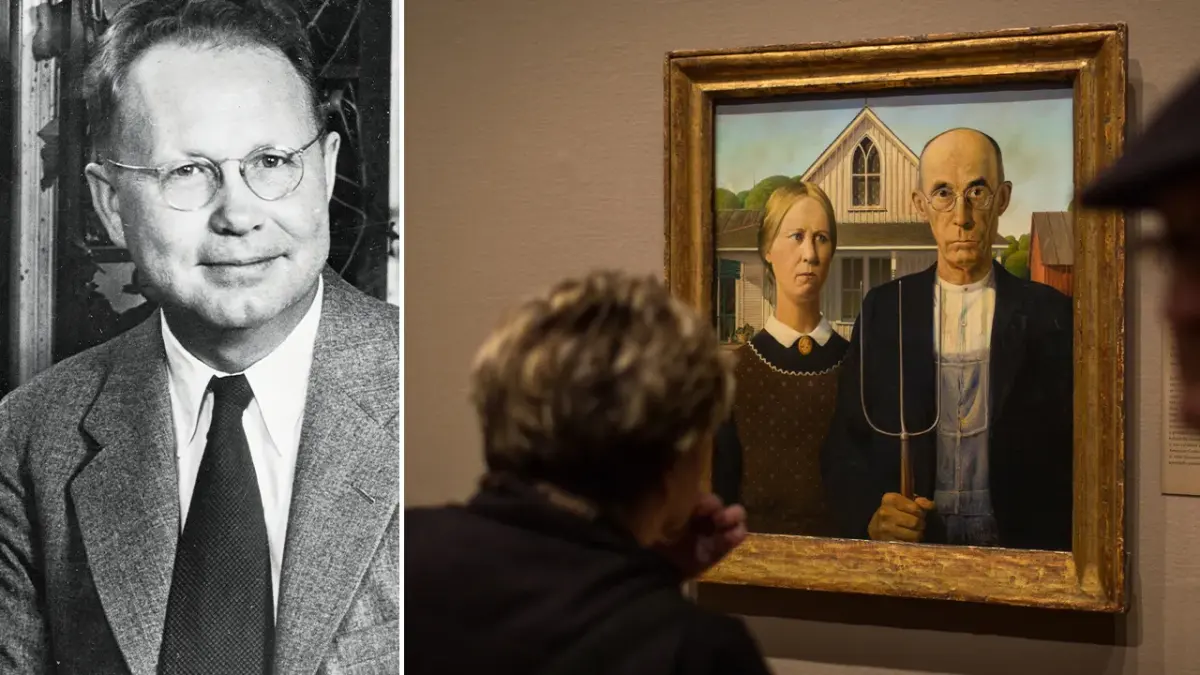
Grant Wood is best known as a leading figure of the American Regionalist movement, celebrated for his iconic 1930 painting American Gothic. His work captures the stoic, rural spirit of the American Midwest during the Great Depression. Wood’s distinctive style emphasizes clean lines, stylized forms, and a deep reverence for agrarian life.
On this page
Why is American Gothic so famous?
American Gothic is widely considered one of the most recognizable images in 20th-century American art. Painted in 1930, the work depicts an elderly farmer and his daughter standing before a white house with a distinctive Gothic-style window. The painting debuted at the Art Institute of Chicago, where it won a bronze medal and immediately sparked national debate regarding its meaning.
Many viewers initially interpreted the painting as a satirical critique of the narrow-mindedness of rural Midwesterners. Wood, however, insisted that he intended the work to be a positive tribute to the steadfast, hardworking nature of the American pioneer spirit. The painting’s enduring fame stems from this ambiguity, as it remains a Rorschach test for how Americans view their own cultural identity. Its composition remains a frequent subject of parody and homage in modern pop culture, solidifying its status as a permanent fixture in the American visual lexicon.
What defines the Regionalist art style?
Regionalism emerged in the 1930s as a rejection of European abstract modernism, which many American artists felt was disconnected from the realities of the Great Depression. Wood, along with contemporaries like Thomas Hart Benton and John Steuart Curry, sought to create a uniquely American aesthetic. They focused on local subject matter, rural landscapes, and the dignity of manual labor.
Wood’s approach to this style was characterized by several specific technical choices that set his work apart from his peers:
- Precise, hard-edged outlines that give figures a sculptural, almost carved appearance.
- A deliberate simplification of forms, often bordering on the geometric or stylized.
- Muted, earthy color palettes that emphasize the seasonal cycles of the Midwestern landscape.
- A focus on narrative storytelling, often incorporating historical or folkloric elements of Iowa life.
By stripping away unnecessary detail, Wood created images that felt both timeless and deeply rooted in the specific geography of his home state.
How to identify a Grant Wood painting?
Identifying a work by Grant Wood requires looking for his signature blend of realism and stylization. While he was a realist, he did not aim for photographic accuracy. Instead, he sought to capture the "essence" of his subjects through careful arrangement and smooth, polished brushwork. His landscapes are particularly easy to spot, as they often feature rolling, rhythmic hills and highly organized, almost patterned fields.
If you are examining a potential Wood work, look for these common characteristics:
- Check for the "doll-like" quality of human subjects, who often feature rigid postures and fixed expressions.
- Observe the background, which frequently includes stylized trees or clouds that look like they were carved from wood or stone.
- Note the lighting, which is usually clear and even, lacking dramatic shadows or atmospheric haze.
- Verify the subject matter, as Wood rarely ventured outside of Iowa scenes, portraits of local figures, or historical allegories.
Common mistakes when interpreting his work
A common error when studying Wood is assuming that he was a simple, unrefined artist who lacked formal training. In reality, Wood was a sophisticated painter who studied extensively in Europe and was well-versed in the techniques of the Flemish Renaissance masters. He intentionally adopted a "primitive" or folk-art aesthetic to convey a sense of honesty and simplicity, but this was a calculated artistic choice rather than a lack of skill.
Another frequent mistake is viewing his work as purely nostalgic or sentimental. While his paintings often depict a bygone era, they are frequently tinged with a subtle, dry humor or a sense of psychological tension. Wood was a complex individual who often felt alienated from the very culture he painted. By ignoring the irony embedded in his compositions, viewers often miss the deeper, more cynical commentary he was making about the rigidity of small-town social structures during the early 20th century.
Where to see his work today?
The most significant collection of Grant Wood’s work is held by the Cedar Rapids Museum of Art in Iowa, which houses the largest assembly of his paintings, drawings, and decorative arts. This museum is located near the house that served as the backdrop for American Gothic, which is preserved as a historic site. Visiting these locations provides the best context for understanding the environment that shaped his creative vision.
For those unable to travel to Iowa, major institutions across the United States hold key pieces of his portfolio:
- The Art Institute of Chicago, which maintains American Gothic as a centerpiece of its American collection.
- The Whitney Museum of American Art in New York, which features several of his major oil paintings.
- The Smithsonian American Art Museum in Washington, D.C., which holds various sketches and lithographs.
- The Figge Art Museum in Davenport, Iowa, which hosts a significant collection of his murals and experimental works.
By exploring these collections, one can gain a comprehensive view of Wood’s evolution from a decorative artist into a defining voice of American regionalism.
Key facts
- Grant Wood (1891–1942) was a prominent American painter best known for his depictions of the rural American Midwest.
- His most famous work, American Gothic (1930), features a farmer and his daughter standing before a white house with a Gothic window.
- Wood was a leading figure in the Regionalist movement, which rejected European abstraction in favor of realistic scenes of American life.
- He spent much of his career in Iowa and often utilized his family members and neighbors as models for his paintings.
- His style is characterized by smooth, polished brushwork, sharp outlines, and stylized, geometric forms that give his subjects a sculptural quality.
- To appreciate his work, look for the subtle satire and social commentary hidden within his seemingly straightforward, nostalgic portrayals of agricultural life.
The bottom line
Grant Wood remains a defining figure of 20th-century American art, celebrated for his unique ability to blend technical precision with the cultural essence of the Midwest. By elevating rural life to the status of high art, he challenged the dominance of European modernism. His legacy endures through his iconic imagery, which continues to shape how the public perceives the identity and history of the American heartland.
People also ask
Is the couple in American Gothic husband and wife?
No, the figures in the painting are actually Wood’s sister, Nan Wood Graham, and his dentist, Dr. Byron McKeeby. Wood intended them to represent a father and daughter rather than a married couple.
What is Regionalism in American art?
Regionalism was a movement during the 1930s that focused on realistic depictions of rural and small-town American scenes. Artists like Wood sought to celebrate local identity during the Great Depression.
Where can I see Grant Wood’s original paintings?
The Art Institute of Chicago houses American Gothic, while the Cedar Rapids Museum of Art in Iowa holds the world's largest collection of his works. Many other pieces are held in major public galleries across the United States.
Did Grant Wood study art in Europe?
Yes, Wood traveled to Europe several times in the 1920s, where he was influenced by Northern Renaissance painters like Jan van Eyck. This influence is visible in his meticulous detail and precise, hard-edged technique.
Why did critics sometimes dislike Wood's work?
Some contemporary critics viewed his paintings as overly simplistic or even mocking of rural people. Wood maintained that he felt a deep affection for the Midwest, despite the satirical undertones in his art.
How did Wood influence later American culture?
His work became an iconic symbol of American identity, frequently parodied in films, advertisements, and political cartoons. His vision of the American heartland remains a foundational image in the country's visual history.
This answer was created with the help of AI research tools and reference sources. Spotted an error? Let us know — we correct mistakes quickly. See our editorial policy.