What is divergent thinking?
Short answer
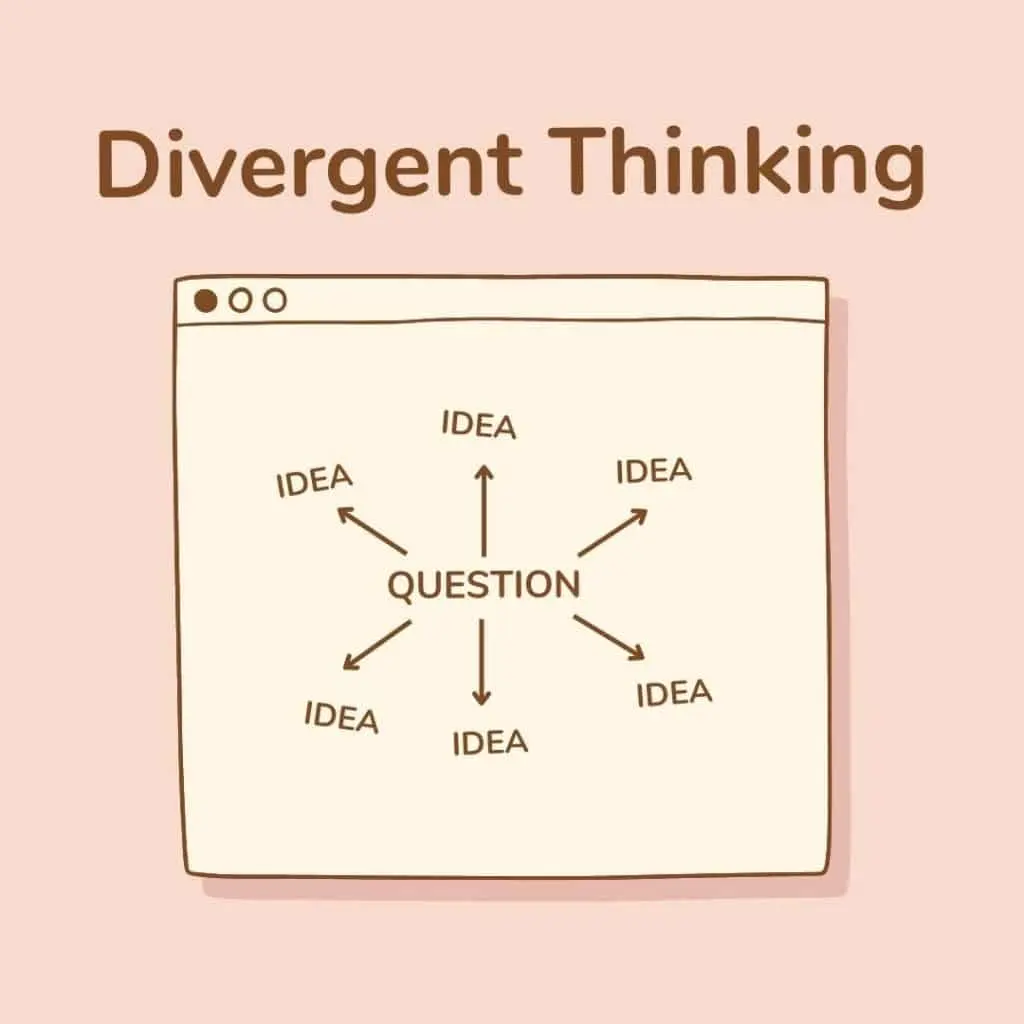
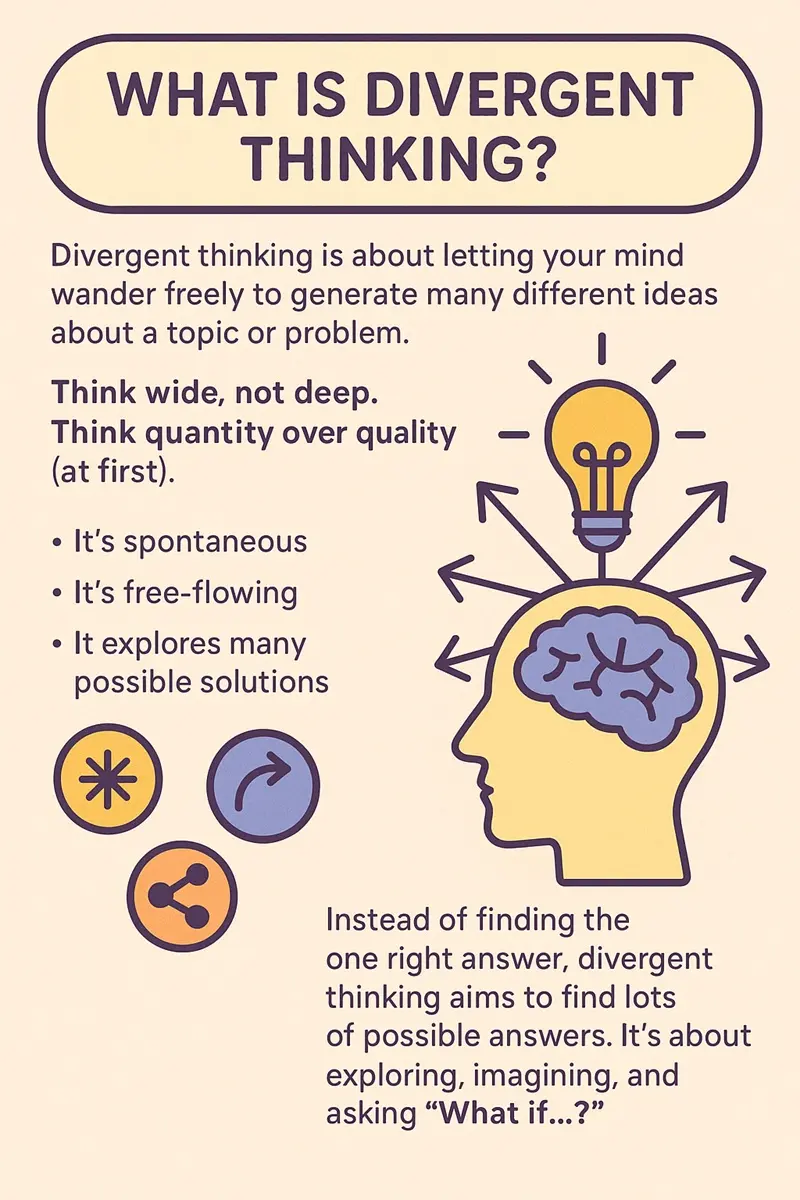
Divergent thinking is a cognitive process used to generate creative ideas by exploring many possible solutions. Unlike convergent thinking, which focuses on finding one correct answer, divergent thinking encourages spontaneity, free-flowing association, and non-linear reasoning. It is the fundamental mechanism behind brainstorming, innovation, and problem-solving in diverse professional and personal fields.
On this page
What is divergent thinking and how does it work?
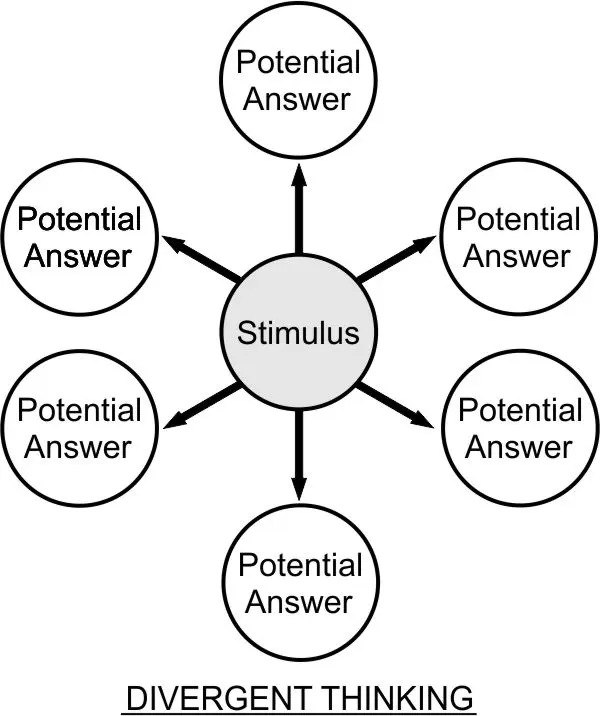
Divergent thinking is a mental process that allows individuals to generate multiple unique ideas from a single starting point. Coined by psychologist J.P. Guilford in the 1950s, the concept describes a way of thinking that breaks away from traditional, logical patterns to embrace ambiguity. While convergent thinking relies on speed, accuracy, and logic to reach a single conclusion, divergent thinking prioritizes breadth and variety. It is often associated with "out-of-the-box" thinking, where the primary goal is not to judge the quality of an idea immediately, but to expand the field of possibilities.
This cognitive style functions by activating different neural pathways that link seemingly unrelated concepts. When engaged in this process, the brain moves away from habitual responses and explores unconventional connections. It is a critical component of creativity, as it allows for the discovery of novel solutions that might otherwise be overlooked by more rigid, analytical approaches. By suspending self-criticism, individuals can produce a high volume of ideas, which serves as the raw material for later refinement.
How to practice divergent thinking techniques
To improve your ability to think divergently, you must create an environment that minimizes judgment and encourages exploration. Techniques like brainstorming or mind mapping are designed to facilitate this shift in perspective. By externalizing thoughts, you can visualize connections that are not immediately apparent in your internal monologue. The key is to focus on quantity over quality during the initial phase of idea generation, as this prevents the premature rejection of potentially viable concepts.
- Define the core problem or challenge clearly but broadly.
- Set a timer for 10 to 15 minutes to prevent overthinking.
- Write down every idea that comes to mind, regardless of how illogical it seems.
- Use "what if" scenarios to push past your standard assumptions.
- Combine two disparate ideas to see if they create a new, functional solution.
- Review your list only after the timer has finished to select the most promising options.
Why divergent thinking is important for innovation
Innovation rarely occurs in a vacuum; it requires a wide pool of ideas from which to draw. Divergent thinking provides the necessary volume of raw input that organizations and individuals need to solve complex problems. By exploring various avenues, you can identify hidden risks and opportunities that a singular, linear approach would likely miss. This process is essential in fields such as engineering, art, and business, where adapting to changing circumstances is a competitive necessity.
Research suggests that high levels of divergent thinking correlate with increased adaptability and emotional intelligence. When you practice this style of thought, you become more comfortable with uncertainty and better equipped to handle unexpected challenges. It fosters a growth mindset, as it emphasizes that there is rarely only one way to achieve a desired outcome. By valuing the process of discovery, you build a mental library of strategies that can be applied to future obstacles, ensuring that you remain flexible and resilient in your professional and personal life.
Common mistakes when using divergent thinking
One of the most frequent errors is the tendency to self-edit while generating ideas. Many people instinctively evaluate the feasibility or cost of an idea the moment it arises, which effectively shuts down the creative flow. This premature criticism creates a mental bottleneck that restricts the scope of exploration. To maintain the integrity of the process, you must strictly separate the generation phase from the evaluation phase. If you analyze ideas too early, you lose the chance to build upon wilder concepts that could lead to breakthroughs.
Another common mistake is failing to document the process effectively. When ideas are not written down or mapped, they are often lost to the limitations of working memory. Additionally, many people fall into the trap of "functional fixedness," where they only see objects or concepts in their traditional roles. Overcoming this requires a conscious effort to detach from conventional definitions. Avoiding these pitfalls requires discipline, as the brain naturally prefers the comfort of established patterns over the effort required to forge new, unfamiliar neural connections.
How to balance divergent and convergent thinking
The most effective problem-solvers do not rely exclusively on one mode of thought; they master the transition between divergent and convergent thinking. Divergent thinking is the engine of creativity, but convergent thinking is the engine of execution. Once you have generated a wide array of options, you must switch gears to analyze, filter, and implement the best ideas. This cycle of expansion followed by contraction is the hallmark of high-level creative performance. Understanding when to switch between these two modes is a skill that can be developed with practice.
- Use divergent thinking when you are in the early stages of a project or facing a creative block.
- Switch to convergent thinking when you have a clear list of options and need to make a final decision.
- Recognize the signs of mental fatigue, as divergent thinking is cognitively demanding and often requires periods of rest.
- Seek feedback from others to help bridge the gap between your creative ideas and practical reality.
- Maintain a balance by ensuring that your creative exploration always leads to a concrete, actionable plan for implementation.
Key facts
- Divergent thinking is a cognitive process used to generate creative ideas by exploring many possible solutions.
- Psychologist J.P. Guilford coined the term in 1956 to distinguish it from convergent thinking, which focuses on finding one single correct answer.
- Fluency, flexibility, originality, and elaboration are the four primary metrics used to measure divergent thinking capacity.
- Brainstorming sessions are most effective when participants suspend judgment to allow unconventional ideas to surface.
- Mind mapping is a practical technique that visually organizes thoughts to encourage non-linear associations between concepts.
- To improve divergent thinking, practice "forced association" by connecting two completely unrelated objects to create a new product or concept.
The bottom line
Divergent thinking is the engine of innovation, allowing you to break free from linear logic to uncover unexpected solutions. By prioritizing quantity over quality during the initial stages of problem-solving, you can bypass mental blocks and explore a wider range of possibilities. Cultivating this skill requires suspending self-criticism and embracing curiosity, ultimately transforming how you approach challenges in both your professional and personal life.
People also ask
How does divergent thinking differ from convergent thinking?
Divergent thinking is expansive and seeks multiple possibilities, while convergent thinking is analytical and seeks a single, logical solution. Most complex problems require a balance of both, using divergent thinking to brainstorm and convergent thinking to select the best path.
Can divergent thinking be improved with practice?
Yes, cognitive flexibility can be strengthened through regular exercises like lateral thinking puzzles or creative writing prompts. By consistently challenging your brain to find multiple uses for common objects, you build neural pathways that facilitate faster idea generation.
What is the role of the "incubation period" in creative thinking?
Incubation involves stepping away from a problem to allow the unconscious mind to process information. This period often leads to "aha!" moments because it prevents the fixation on a single, ineffective approach.
Are there common mistakes to avoid during brainstorming?
A frequent error is premature evaluation, where participants criticize ideas before they are fully formed. This kills momentum and discourages others from sharing risky or unconventional thoughts.
How does stress affect the ability to think divergently?
High stress levels trigger the brain’s "fight or flight" response, which prioritizes survival over creative exploration. A relaxed, playful environment is essential for the cognitive openness required to generate diverse ideas.
Is divergent thinking the same as intelligence?
While divergent thinking is a component of creative intelligence, it is distinct from general IQ. A person might have a high IQ but struggle with open-ended problems, or vice versa, illustrating that creativity is a specific cognitive skill set.
This answer was created with the help of AI research tools and reference sources. Spotted an error? Let us know — we correct mistakes quickly. See our editorial policy.