What is a molecule?
Short answer
A molecule is the smallest unit of a chemical compound that retains its unique properties. It consists of two or more atoms held together by chemical bonds. These atoms can be identical, as in oxygen gas, or different, as in water, forming the fundamental building blocks of all matter in the universe.
On this page
What defines a molecule?
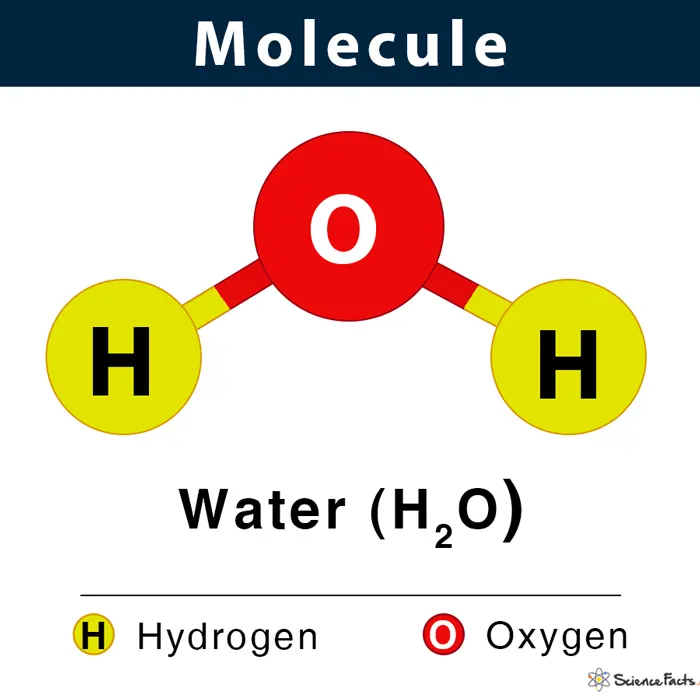
A molecule forms when atoms share electrons through covalent bonds. These bonds act like invisible glue, locking atoms into a specific geometric arrangement. The number and type of atoms involved determine the molecule's identity, mass, and behavior. For instance, a single molecule of water, denoted as H2O, contains two hydrogen atoms bonded to one oxygen atom.
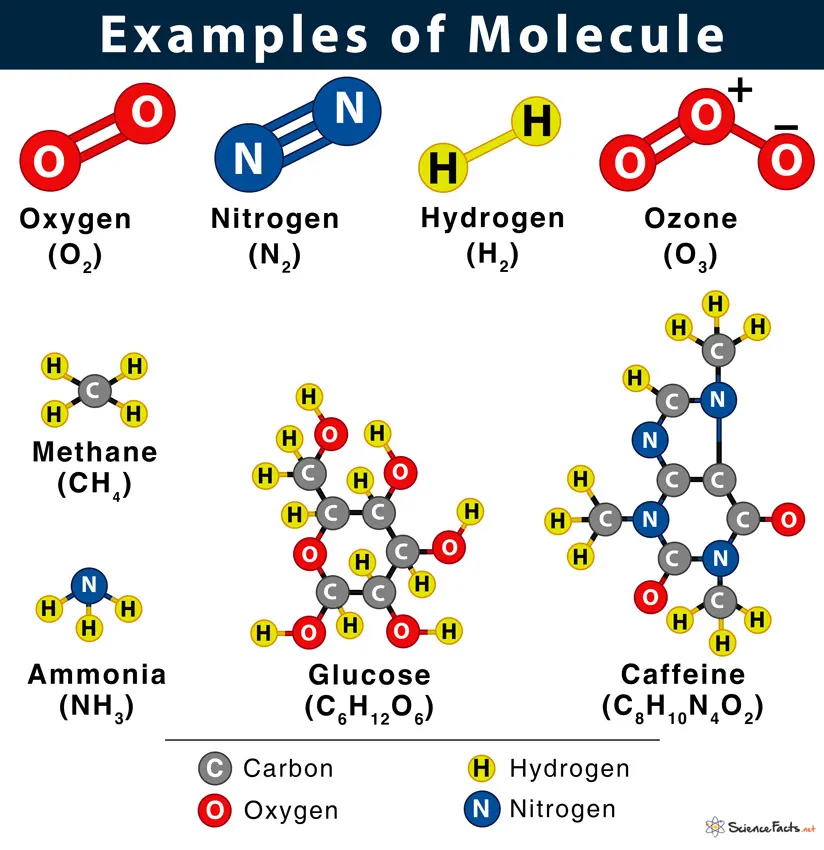
The size of molecules varies drastically. Some are simple, like diatomic nitrogen, which makes up most of the air we breathe. Others are massive macromolecules, such as DNA or proteins found in living cells, which contain thousands of atoms arranged in complex, folded chains. Regardless of size, all molecules remain electrically neutral because the total number of protons in the nuclei equals the total number of electrons in the surrounding clouds.
How are molecules different from atoms?
An atom is the basic particle of a chemical element, such as gold or carbon. A molecule, by contrast, is a combination of these atoms. While atoms represent the smallest unit of an element that retains its chemical properties, molecules represent the smallest unit of a compound. If you split a molecule into its individual atoms, it loses the chemical identity of the original substance.
To better understand the distinction, consider these key differences:
- Atoms are the individual bricks, while molecules are the structures built from them.
- A molecule can consist of a single element, like O2, or a compound, like CO2.
- Atoms are defined by their proton count, whereas molecules are defined by their structural formula.
- Chemical reactions involve the breaking and forming of bonds between atoms, which creates entirely new molecules.
Why do molecules form bonds?
Atoms generally seek stability by filling their outer electron shells. By sharing electrons with neighboring atoms, they achieve a lower energy state, which is more stable than existing as isolated, reactive atoms. This process, known as chemical bonding, is the driving force behind all matter. The specific way atoms bond dictates the physical state of the substance at room temperature.
The nature of these bonds can be categorized by how electrons are distributed:
- Covalent bonds: Atoms share electron pairs to achieve stability.
- Polar covalent bonds: Electrons are shared unequally, creating partial charges.
- Nonpolar covalent bonds: Electrons are shared equally between identical or similar atoms.
- Hydrogen bonds: Weak attractions between molecules that influence properties like boiling points.
These interactions explain why water is a liquid at room temperature while carbon dioxide is a gas. The strength and geometry of these bonds determine whether a substance is a solid, liquid, or gas under specific conditions.
Common mistakes when identifying molecules
A frequent error is confusing molecules with ionic compounds. While both involve atoms, ionic compounds—such as table salt, or sodium chloride—do not form discrete molecules. Instead, they form infinite, repeating crystal lattices held together by electrostatic attraction rather than shared electrons. If you cannot identify a distinct, bounded group of atoms, you are likely looking at an ionic lattice rather than a molecule.
Another mistake is assuming that all substances containing multiple atoms are molecules. For example, metals exist as a "sea of electrons" where atoms are not bonded into specific, small units. When studying chemistry, keep these points in mind to avoid confusion:
- Do not mistake metallic structures for molecules.
- Remember that noble gases, like helium, exist as single atoms and are not considered molecules.
- Distinguish between a mixture of molecules and a single chemical compound.
- Always check the chemical formula to see if the atoms are covalently linked.
Where can you see molecules in everyday life?
Molecules are everywhere, from the air in your lungs to the screen you are reading right now. Every scent you smell is the result of volatile molecules reaching your olfactory receptors. Every taste you experience is the result of specific molecules binding to receptors on your tongue. Understanding molecular structure allows scientists to create new medicines, durable plastics, and efficient fuel sources.
By studying how molecules interact, researchers can predict how substances will behave under heat, pressure, or in biological systems. This knowledge is the foundation of modern pharmacology and materials science. Whether it is the caffeine molecule providing a morning boost or the glucose molecule fueling your muscles, your entire existence is governed by the constant, precise dance of these tiny particles. As you observe the world, remember that the complex beauty of nature is simply the result of atoms bonding together to form the diverse array of molecules that constitute our reality.
Key facts
- A molecule is the smallest unit of a chemical compound that retains the chemical properties of that substance.
- Molecules are formed when two or more atoms bond together through sharing or transferring electrons.
- The chemical formula for water, H2O, indicates that one molecule contains two hydrogen atoms and one oxygen atom.
- Molecules can range from simple structures like oxygen gas (O2) to massive, complex chains like DNA.
- Chemical bonds, such as covalent or ionic bonds, act as the "glue" that holds the atoms within a molecule together.
- To distinguish a molecule from an element, remember that molecules can consist of different types of atoms, while elements consist of only one type.
The bottom line
Molecules represent the fundamental building blocks of the chemical world, formed when atoms connect through stable bonds. By understanding how these structures assemble, scientists can predict the behavior of everything from the water we drink to the complex proteins in our bodies. Recognizing that these tiny units dictate the physical and chemical properties of all matter is essential for grasping the core principles of modern chemistry.
People also ask
How do molecules differ from atoms?
An atom is the basic building block of matter, consisting of a nucleus surrounded by electrons. A molecule is a group of two or more atoms held together by chemical bonds.
Are all substances made of molecules?
Not all substances are molecular; for example, metals and ionic salts like table salt form crystal lattices rather than discrete molecules. These substances are instead described by their empirical formulas.
Can you see a molecule with a regular microscope?
Molecules are far too small to be seen with a standard light microscope, as they are often only a few angstroms in size. Scientists use advanced tools like scanning tunneling microscopes or electron microscopes to image them.
What is the difference between a molecule and a compound?
A molecule is any group of atoms bonded together, whereas a compound specifically requires at least two different types of elements. Therefore, all compounds are molecules, but not all molecules are compounds.
Why do atoms bond to form molecules?
Atoms generally bond to achieve a more stable electron configuration, often by filling their outer electron shells. This process releases energy and results in a more stable, lower-energy state for the system.
How do scientists represent molecules?
Chemists use structural formulas, ball-and-stick models, and space-filling models to visualize molecular geometry. These representations help researchers understand how the shape of a molecule influences its reactivity and function.
This answer was created with the help of AI research tools and reference sources. Spotted an error? Let us know — we correct mistakes quickly. See our editorial policy.