What does the sun symbolize in art?
Short answer
The sun symbolizes life, divinity, power, and enlightenment across human history. In art, it serves as a universal emblem of vitality, cosmic order, and the transition between cycles of time. Whether depicted as a radiant deity or a celestial light source, it consistently represents clarity, truth, and the sustaining energy of existence.
On this page
Why the sun symbolizes divinity and power
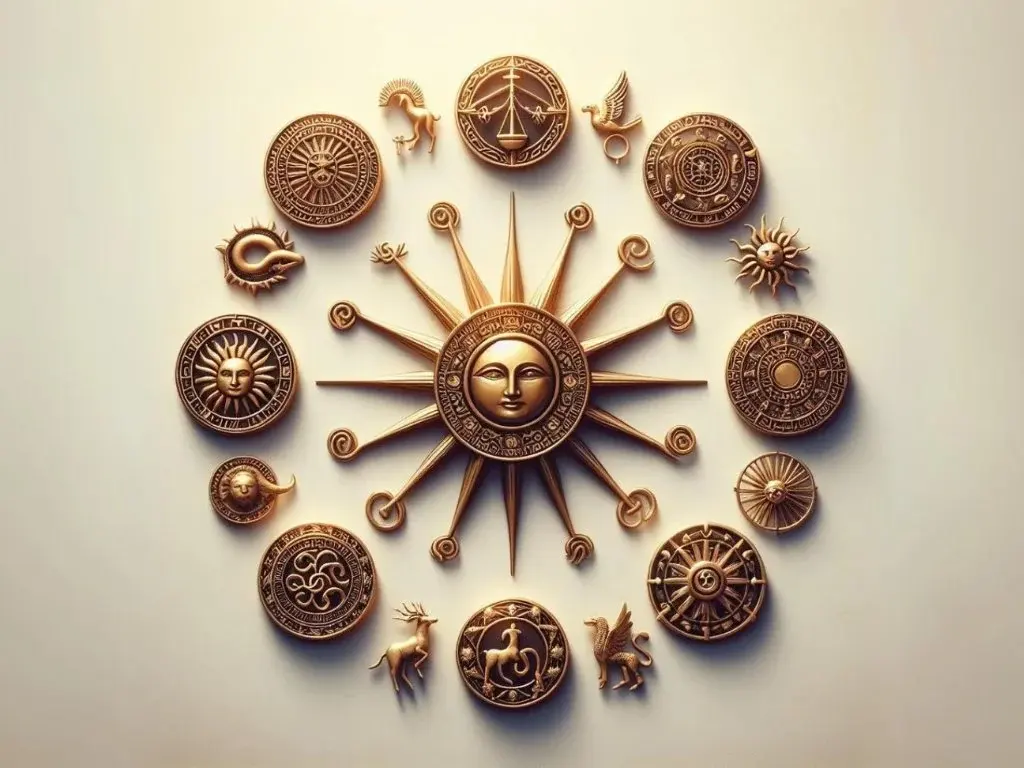
Ancient civilizations frequently elevated the sun to the status of a supreme deity, making it a central motif in religious iconography. In Ancient Egypt, the god Ra was depicted as a solar disk, symbolizing the eternal cycle of birth and rebirth. Similarly, in the Inca Empire, the sun god Inti was the state's primary deity, with gold—the metal of the sun—used extensively in art to reflect divine authority and earthly wealth.
Artists often used the sun to signify the absolute power of rulers who claimed to be earthly representatives of the divine. King Louis XIV of France, known as the "Sun King," famously adopted the sun as his personal emblem. By associating himself with the celestial body that governs the heavens, he reinforced his absolute authority. This symbolic link between solar imagery and political legitimacy remains a recurring theme in portraiture and monumental architecture throughout history.
How the sun represents enlightenment and truth
During the Renaissance and the Enlightenment, the sun evolved into a powerful metaphor for human reason, knowledge, and intellectual clarity. Artists began to move away from purely mythological interpretations, instead using the sun to symbolize the "light" of truth dispelling the "darkness" of ignorance. This shift mirrored the era's focus on scientific discovery and the belief that human intellect could illuminate the mysteries of the natural world.
In landscape painting, the sun often serves as a focal point that directs the viewer's eye toward a scene of harmony or revelation. The use of "chiaroscuro," or the contrast between light and shadow, relies on the sun as a source of truth. When an artist places a bright sun at the center of a composition, they are often making a statement about:
- The triumph of logic over superstition.
- The clarity of a moral or philosophical vision.
- The presence of hope within a complex narrative.
What the sun means in modern and contemporary art
In the 20th and 21st centuries, the sun's symbolism became more subjective and varied, often reflecting the artist's internal emotional state rather than universal religious truths. Impressionist painters like Claude Monet used the sun to study the fleeting nature of light and atmosphere, turning the celestial body into a tool for capturing the passage of time. For these artists, the sun was not just a symbol but a sensory experience that defined the color and mood of a landscape.
Contemporary artists often subvert traditional solar symbolism to address modern anxieties. While the sun traditionally signifies life, some contemporary works use it to represent environmental concerns or the intensity of modern existence. By manipulating the sun's appearance, artists can evoke feelings of warmth and comfort or, conversely, the harshness of a changing climate. This duality highlights how the sun remains a versatile symbol that adapts to the shifting priorities of each generation.

Common mistakes when interpreting solar symbolism
A frequent error when analyzing solar imagery is assuming that the sun always carries a positive, life-affirming meaning. While it is true that the sun is often associated with warmth and growth, it can also represent destructive heat, judgment, or the blinding nature of absolute truth. Failing to look at the surrounding context of the artwork can lead to a misunderstanding of the artist's intent. Always consider the color palette and the surrounding figures before deciding on the sun's specific symbolic role.
Another common mistake is ignoring the cultural background of the artist. Solar motifs do not hold identical meanings in every culture. To properly interpret the sun in a piece of art, follow these steps:
- Identify the historical period and the cultural origin of the work.
- Analyze the placement of the sun within the composition relative to other figures.
- Determine if the sun is depicted as a natural light source or a stylized, symbolic emblem.
- Note the emotional tone of the work to see if the sun provides comfort or intensity.
How to use solar imagery in your own artwork
If you are looking to incorporate the sun into your creative projects, it is helpful to decide early on whether you want the sun to be a literal light source or a symbolic element. Using the sun as a literal light source allows you to practice realistic shading and atmospheric perspective, which creates a sense of depth and realism. If you choose to use it as a symbol, you can experiment with abstraction, bold colors, and geometric shapes to convey a specific message or feeling.
To effectively communicate a theme through the sun, consider the following techniques:
- Use warm, saturated colors like golds and oranges to evoke feelings of divinity or joy.
- Use cool, muted tones to suggest a sun that is distant, indifferent, or fading.
- Place the sun at the horizon line to signify a transition, such as a beginning or an end.
- Use the sun as a frame for other subjects to emphasize their importance or spiritual significance.
By carefully choosing your approach, you can ensure that the sun enhances your narrative and resonates with your audience.
Key facts
- In ancient Egyptian art, the sun god Ra was depicted as a solar disk, symbolizing the supreme power of creation and life.
- The halo in Christian art, dating back to the 4th century, uses the sun as a metaphor for divine light and holiness.
- During the Baroque period, King Louis XIV of France adopted the sun as his personal emblem, representing absolute monarchy and order.
- In Japanese art, the sun is a core national symbol, often represented as a red circle to signify the country's identity as the "Land of the Rising Sun."
- When painting the sun, avoid using pure white for the center; instead, use a pale yellow or cream to maintain a sense of warmth and depth.
- To convey energy in a composition, place the sun at the top of the frame, as human eyes naturally associate the zenith with peak power.
The bottom line
The sun serves as a versatile artistic motif, evolving from a literal deity in ancient civilizations to a nuanced metaphor for power, divinity, and human emotion. By understanding these historical associations, you can better interpret the intent behind solar imagery. Whether used to signify life-giving warmth or the cold finality of a sunset, the sun remains a primary tool for establishing mood and thematic weight in art.
People also ask
Why is the sun often depicted with a human face in historical art?
Artists added faces to the sun to anthropomorphize nature, making the celestial body appear more approachable and emotionally expressive. This practice was common in medieval manuscripts and Renaissance engravings to represent cosmic intelligence.
How does the color of the sun change its symbolic meaning?
A golden sun typically represents prosperity, divinity, and masculine energy. Conversely, a red or setting sun often symbolizes mortality, the end of a cycle, or the transition into the afterlife.
What does a black sun represent in art?
A black sun is a complex symbol often associated with alchemy, representing the "nigredo" or the initial stage of transformation. It can also signify melancholy, hidden knowledge, or the occult.
Is the sun always a positive symbol?
No, the sun can represent destructive power, such as drought or the scorching heat of a desert. In some modernist works, an oppressive, blinding sun is used to evoke feelings of alienation or existential dread.
How can I use the sun to show perspective in a landscape painting?
Use the sun to dictate your light source and cast long, directional shadows. If the sun is low on the horizon, shadows should be elongated, which helps create a sense of depth and time of day.
What is the difference between a sunburst and a solar disk?
A solar disk is a solid, geometric shape representing unity and wholeness. A sunburst, characterized by radiating lines, emphasizes movement, expansion, and the active spread of influence or truth.
This answer was created with the help of AI research tools and reference sources. Spotted an error? Let us know — we correct mistakes quickly. See our editorial policy.