How do you write an artist statement?
Short answer
An artist statement is a brief, written introduction to your creative work that explains your motivations, themes, and techniques. It bridges the gap between your visual output and the viewer's understanding. To write one effectively, focus on clarity, authenticity, and the specific intent behind your practice rather than overly complex jargon.
On this page
How to structure an artist statement
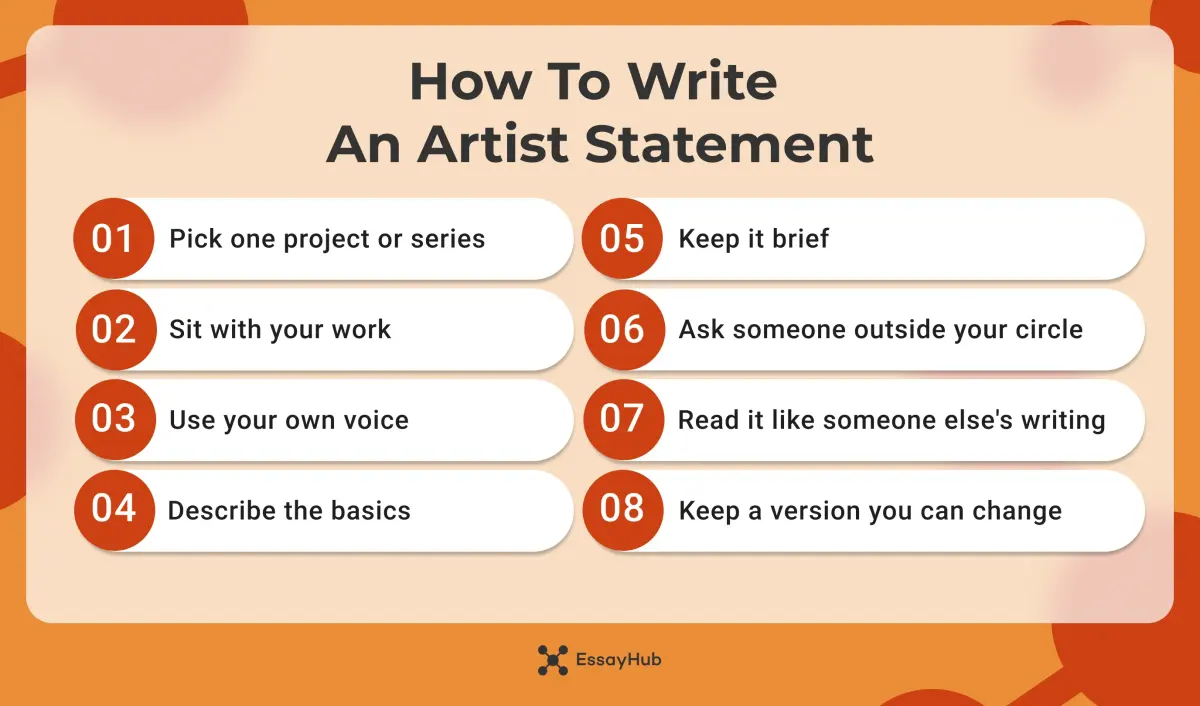
An effective artist statement typically follows a logical flow that guides the reader from your general philosophy to your specific process. Start with a strong opening sentence that defines the core subject matter of your work. This should be followed by a paragraph explaining why you choose these subjects and what you hope to communicate to the audience. Finally, conclude by describing your technical approach, such as your choice of medium or the physical process you employ.
To keep your writing organized, follow these steps:
- Define your "why": State the primary motivation or question that drives your creative practice.
- Connect to the "what": Explain how your chosen materials and techniques serve the themes you identified.
- Contextualize the work: Briefly mention how your background or influences shape your current artistic direction.
- Refine and edit: Remove unnecessary adjectives and ensure the tone remains professional yet personal.
How long should an artist statement be
Most professional galleries, grant committees, and residency programs prefer artist statements between 100 and 300 words. A single page is often the absolute maximum, though two or three concise paragraphs are usually sufficient to convey your intent. Because curators and jurors often review hundreds of applications, brevity is a sign of respect for their time and demonstrates your ability to communicate clearly.
If you find yourself exceeding 300 words, you are likely providing too much biographical detail or over-analyzing individual pieces. Save your life history for your biography and reserve the artist statement for the conceptual framework of your current body of work. Aim for a length that allows you to summarize your practice in under two minutes of reading time. If your statement feels too short, focus on deepening the connection between your themes and your process rather than simply adding more words.
Best practices for writing an artist statement
The most successful statements use plain, accessible language that invites the reader into the work rather than alienating them with academic theory. Use the first person ("I") to maintain a personal connection, as this establishes a direct voice between the creator and the viewer. Focus on the "what" and the "why" of your work, ensuring that your descriptions are grounded in the actual objects or images you produce.
Consider these tips for clarity:
- Use active verbs to describe your process instead of passive, flowery descriptions.
- Avoid "art speak," which refers to unnecessarily complex jargon that obscures meaning.
- Test your draft by reading it aloud; if you stumble over a sentence, it is likely too convoluted.
- Update your statement regularly to reflect shifts in your artistic focus or medium.
Why artists struggle with writing statements
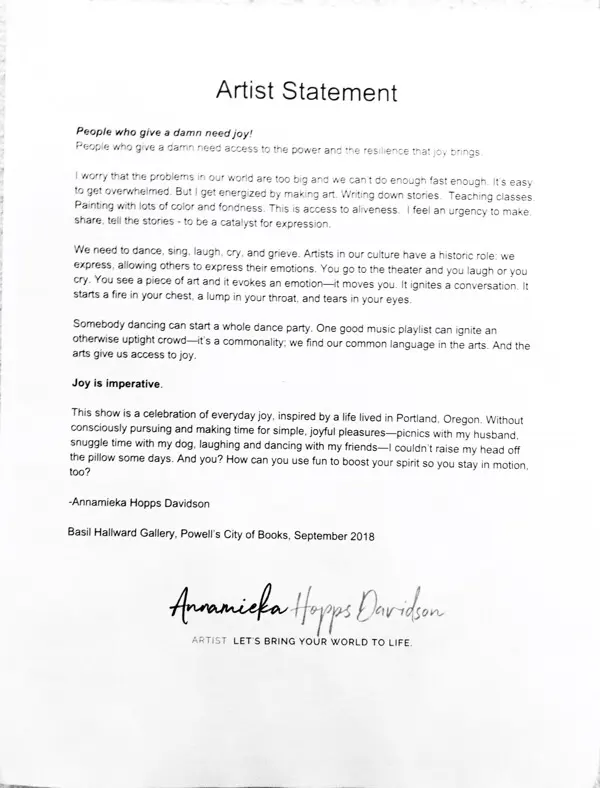
Many artists find writing difficult because it requires translating visual or non-verbal concepts into a linear, linguistic format. This process can feel restrictive, as art often functions on an emotional or intuitive level that words cannot fully capture. Furthermore, artists often fear that defining their work in writing will limit how viewers interpret their pieces, leading to a tendency to be overly vague or intentionally mysterious.
However, a statement is not meant to be the final word on your art; it is meant to provide a gateway. When you provide context, you give the viewer a lens through which to view your work, which often increases their engagement. If you feel stuck, try describing your work to a friend or colleague and recording the conversation. Often, the way you explain your art in casual conversation is the most authentic and effective way to write it down.
Common mistakes when writing an artist statement
One of the most frequent errors is writing a manifesto rather than a statement. A manifesto is a declaration of beliefs or political goals, whereas an artist statement should focus on the specific work currently on display. Another common mistake is writing in the third person, which can create an unnecessary distance between you and your audience. Stick to the first person to maintain an honest, approachable tone throughout the document.
Avoid these pitfalls to ensure your statement remains professional:
- Do not use flowery, pretentious language to sound more intellectual or sophisticated.
- Avoid making grand, unverifiable claims about the impact of your work on society.
- Do not list every exhibition or award you have ever received; that belongs in your CV.
- Avoid typos and grammatical errors, as these can undermine your professional credibility.
- Do not write a separate statement for every single piece unless specifically requested by a gallery.
By avoiding these traps, you ensure that your writing serves as a helpful tool for your career rather than a distraction from your art. A well-crafted statement should feel like a natural extension of your creative voice, providing the necessary context that allows your work to resonate deeply with your audience. Keep your focus on the work itself, and your statement will remain a vital asset for years to come.
Key facts
- Keep your statement between 100 and 300 words to ensure it remains accessible for busy curators and viewers.
- Use the first person ("I") to create a direct, personal connection between your creative intent and the audience.
- Focus on the "why" and "how" of your work rather than simply describing what is visually obvious.
- Avoid overly academic jargon or complex art-speak that obscures the meaning of your practice.
- Update your statement regularly to reflect shifts in your themes, materials, or conceptual focus.
- Proofread meticulously, as grammatical errors can detract from your professional credibility.
The bottom line
An effective artist statement serves as a bridge between your creative output and the viewer’s understanding. By using clear, concise language to explain your motivations and process, you invite the audience into your world. Focus on authenticity and clarity, avoiding unnecessary complexity. When you articulate your vision with confidence and brevity, you provide the context necessary for others to engage deeply with your artistic practice.
People also ask
Should I write a different statement for every exhibition?
You should tailor your statement slightly for specific opportunities, but the core message should remain consistent. Adjust the focus to highlight works or themes most relevant to the specific gallery or audience.
Is it okay to mention my artistic influences?
You may mention influences if they are essential to understanding your conceptual framework. However, focus primarily on your own contributions rather than listing names of famous artists you admire.
How do I describe my technique without sounding technical?
Explain your process by focusing on the relationship between your materials and your intended meaning. Describe the physical act of creation only if it serves to clarify the emotional or intellectual purpose of the piece.
What if my work changes drastically over time?
Your artist statement should be a living document that evolves alongside your practice. If your work shifts into a new medium or subject, rewrite the statement to reflect your current artistic trajectory.
Can I use quotes from other people in my statement?
It is generally better to speak in your own voice to maintain authority over your work. Use quotes only if they provide a vital, unique perspective that you cannot articulate yourself.
Should I include my biography in the artist statement?
Keep your biography and artist statement separate. The statement focuses on your current conceptual goals, while the biography provides a chronological summary of your education, exhibitions, and professional history.
This answer was created with the help of AI research tools and reference sources. Spotted an error? Let us know — we correct mistakes quickly. See our editorial policy.