How do you weave on a loom?
Short answer
Weaving on a loom involves interlacing two sets of threads at right angles: the vertical warp and the horizontal weft. You secure the warp threads under tension, create an opening called a shed, pass the weft thread through, and beat it into place to build a stable, woven fabric structure.
On this page
How to prepare a loom for weaving
The first phase of weaving is "warping," which involves measuring and securing the vertical threads that provide the foundation for your cloth. You must calculate the length and width of your project, adding extra length for loom waste and fringe. Once measured, these threads are wound onto the back beam of the loom under consistent, firm tension.
After the warp is wound, you must thread each individual strand through the heddles, which are wire or string eyes on the shafts. Following this, you thread the warp through the reed, a comb-like frame that keeps the threads evenly spaced. Proper tension is critical here; if some threads are looser than others, the final fabric will have uneven puckers or distorted patterns.
- Measure your warp length according to your pattern requirements.
- Wind the warp onto the back beam while maintaining even tension.
- Thread each warp end through the heddles according to your design draft.
- Sley the reed by pulling each thread through the slots to set your width.
- Tie the warp onto the front apron rod to begin weaving.
Best looms for beginners
For those new to the craft, a rigid heddle loom is the most accessible entry point. These looms are compact, affordable, and combine the heddle and reed into a single piece of equipment. They are excellent for learning the fundamentals of warp tension and shed formation without the complexity of a multi-shaft floor loom.
If you intend to weave intricate patterns or complex structures like twills, a four-shaft table loom is a superior choice. These looms allow you to lift different combinations of warp threads, enabling a vast library of weave structures. While they require more space and setup time, they provide the mechanical versatility needed to grow your skills beyond basic plain weave.
- Rigid Heddle Looms: Ideal for scarves, table runners, and simple wall hangings.
- Table Looms: Best for learning pattern drafting and multi-shaft weaving techniques.
- Floor Looms: Recommended for experienced weavers producing large-scale projects like rugs or blankets.
How to weave the weft
Once the loom is dressed, you begin the actual weaving process by creating a shed, which is the opening between the warp threads. You insert your shuttle—a tool holding the weft yarn—through this opening from one side to the other. After passing the shuttle, you use the beater bar to push the new weft row firmly against the previous one.
The rhythm of weaving relies on the sequence of lifting shafts and passing the shuttle. After each pass, you change the shed by lifting a different set of shafts, then repeat the process. Consistency in your "beat" is essential; if you press too hard on one row and too lightly on the next, the density of your fabric will fluctuate, leading to visible horizontal bands.
- Always leave a small diagonal angle when laying the weft thread before beating.
- Maintain a consistent rhythm to ensure the fabric density remains uniform throughout the piece.
- Check your edges, or "selvedges," to ensure they remain straight and do not pull inward.
Common mistakes when weaving
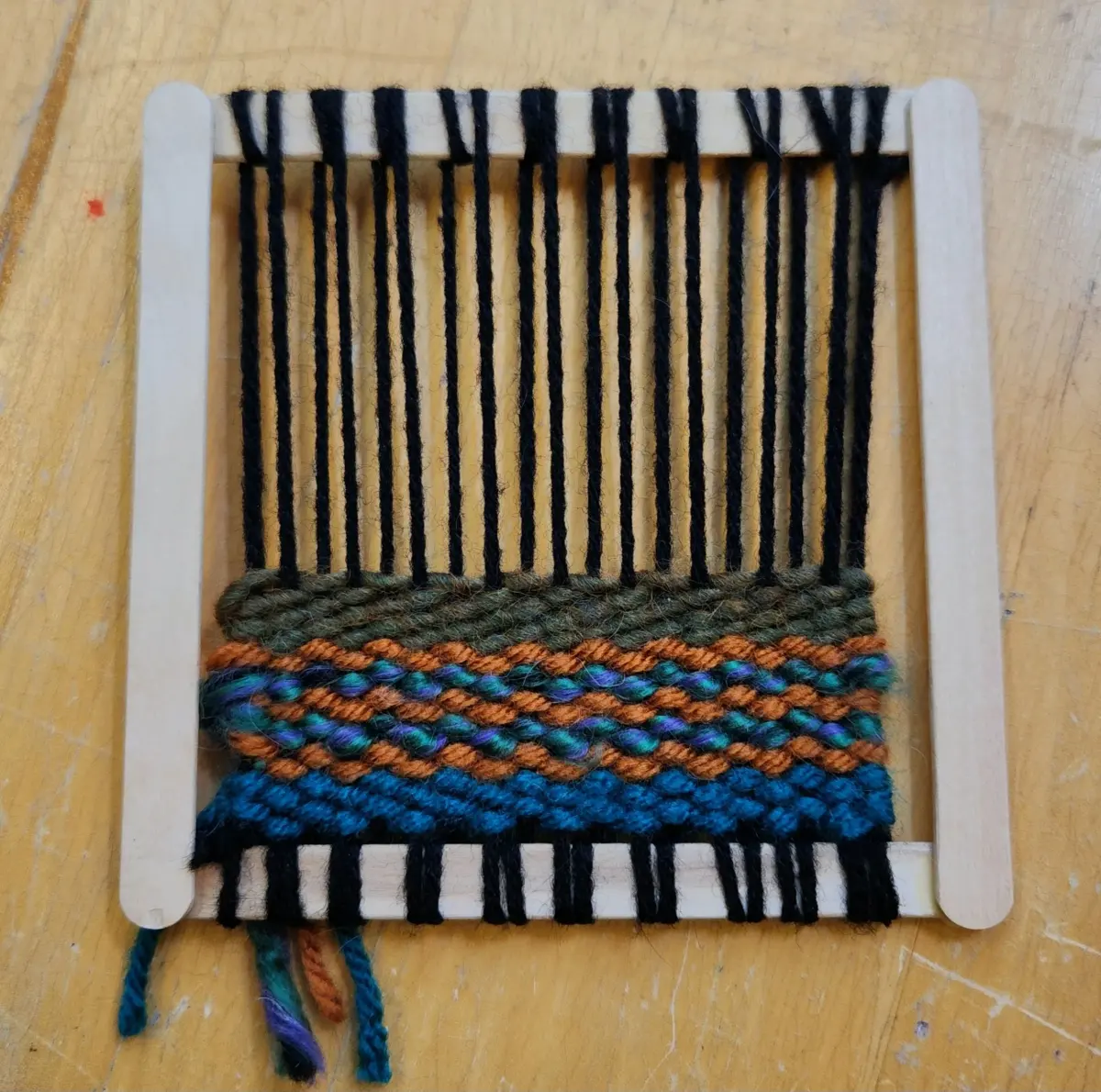
One of the most frequent errors for beginners is "drawing in," which happens when the weft thread is pulled too tightly, causing the edges of the fabric to curve inward. To prevent this, always lay your weft yarn in the shed at a 45-degree angle before beating it into place. This provides enough extra length for the thread to curve over and under the warp without pulling the edges.
Another common issue is skipped threads, often called "floats," which occur when the wrong shafts are lifted or the shuttle misses a warp end. If you notice a mistake, it is best to unweave immediately by pulling out the weft row by row. Trying to fix a mistake several inches later is difficult and often results in structural weaknesses or visible flaws in the finished textile.
- Uneven tension: Results in saggy or tight sections in the warp.
- Broken warp threads: Often caused by excessive friction or sharp edges on the loom.
- Crossed ends: Occur when warp threads become tangled behind the heddles.
How long does it take to weave
The time required to complete a project depends heavily on the complexity of the pattern and the width of the loom. A simple scarf on a rigid heddle loom might take a few hours to warp and another few hours to weave. Conversely, a complex rug or a multi-panel garment can take several weeks of dedicated daily work to finish.
Efficiency improves with practice, particularly in the warping stage, which is usually the most time-consuming part of the process. Beginners should focus on small, manageable projects like coasters or napkins to understand the mechanics before attempting larger yardage. By breaking the work into smaller sessions, you maintain better focus and physical comfort, which ultimately leads to a higher quality finished product and a more enjoyable creative experience.
Key facts
- Weaving is the process of interlacing two sets of threads: the warp, which runs vertically, and the weft, which runs horizontally.
- The loom holds the warp threads under tension, allowing the weaver to lift specific threads to create a gap called the shed.
- A shuttle is used to carry the weft thread through the shed, creating the woven fabric structure.
- The reed is a comb-like frame that pushes the newly placed weft thread firmly against the previous row, a process known as beating.
- Heddles are wires or cords with eyes that hold individual warp threads and are connected to shafts to control the lifting pattern.
- Proper tension is essential; if the warp threads are too loose, the fabric will be uneven, and if they are too tight, they may snap.
The bottom line
Weaving is a rhythmic craft that transforms simple fibers into structured cloth through the precise interlacing of warp and weft threads. By mastering the mechanics of the loom—specifically tension, shedding, and beating—you can create everything from functional household textiles to intricate artistic tapestries. Patience and consistent practice are the most important tools for any weaver looking to improve their technical accuracy and creative expression.
People also ask
What is the difference between a floor loom and a table loom?
A floor loom uses foot-operated treadles to lift the shafts, allowing for faster weaving and more complex patterns. Table looms use hand levers to lift the shafts, making them more portable but physically slower to operate.
How do I calculate how much warp yarn I need?
You must multiply the number of warp ends by the desired length of the project, then add extra length for loom waste and fringe. Loom waste is the portion of yarn that cannot be woven because it remains behind the reed or in front of the cloth beam.
Can I weave on a loom if I have never done it before?
Yes, beginners often start with a rigid heddle loom, which is simple to set up and operate. It uses a single heddle to create the shed, making it an ideal entry point for learning basic interlacing techniques.
What is the most common mistake for beginners?
The most frequent error is uneven tension, which results in wavy edges or "draw-in." This happens when the weaver pulls the weft thread too tightly through the shed, causing the warp threads to pull inward.
What materials are best for warp threads?
Warp threads must be strong and have low elasticity to withstand constant tension. Cotton, linen, and wool are popular choices, provided they are tightly spun and not prone to breaking.
How do I finish the edges of my fabric?
Most weavers use a hemstitch or a knotted fringe to secure the warp threads once the piece is removed from the loom. For garments, you may also use a sewing machine to zigzag stitch the edges before cutting the fabric from the loom.
This answer was created with the help of AI research tools and reference sources. Spotted an error? Let us know — we correct mistakes quickly. See our editorial policy.