How do you draw a window?
Short answer
Drawing a window involves establishing a rectangular frame, adding depth through perspective, and detailing the mullions or panes. Begin by sketching a basic box shape on your surface. Use vanishing points to ensure the sides recede correctly, then divide the interior space to represent the glass and the structural frame elements.
On this page
How to draw a window in perspective
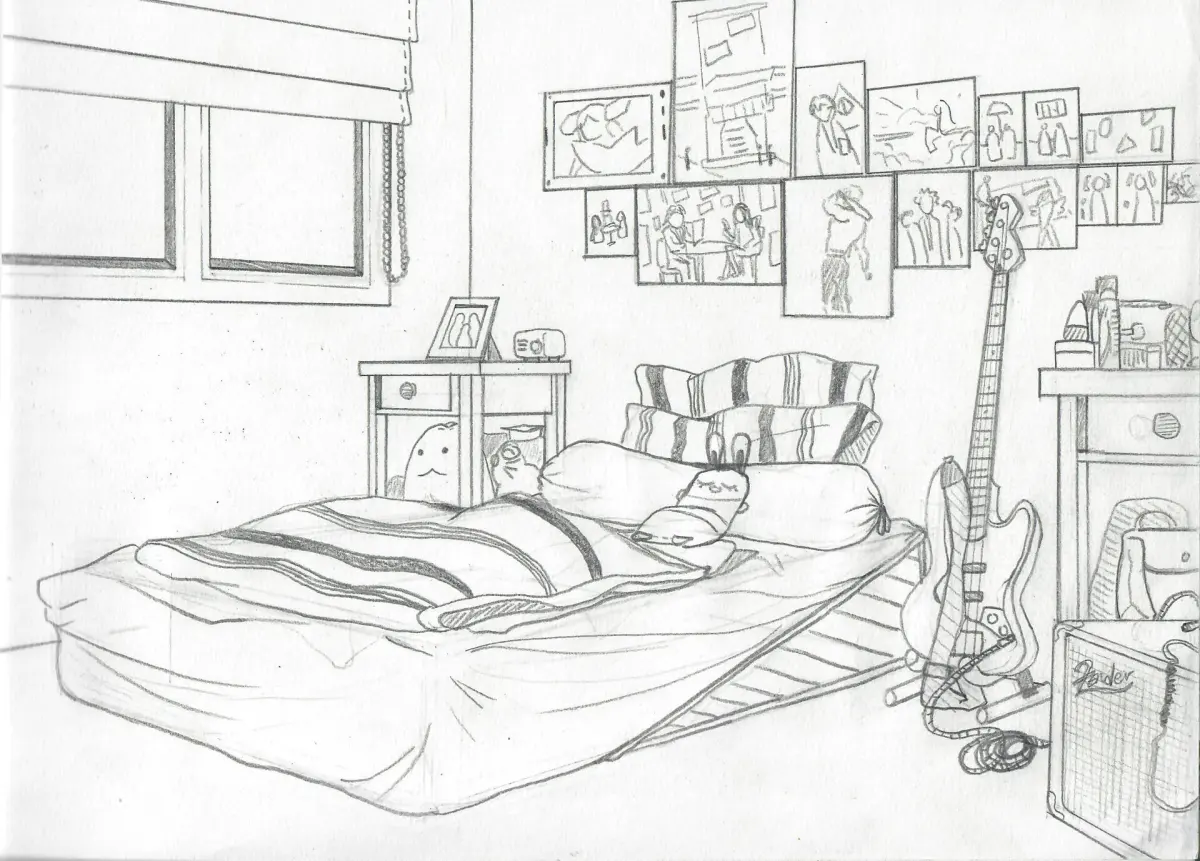
To draw a window that looks realistic on a wall, you must use linear perspective. First, draw a horizon line and place a vanishing point on it. If you are drawing a building, the sides of the window frame should align with lines radiating from this point. This technique ensures the window appears to recede into the wall rather than sitting flat on the surface.
When sketching the frame, remember that windows have thickness. Draw a secondary, smaller rectangle inside your initial outline and connect the corners of both rectangles. This creates the illusion of depth, showing the reveal where the window meets the wall. Avoid making the frame too thin, as this can make the structure appear fragile and unrealistic.
- Draw a light rectangle on your wall surface.
- Mark a vanishing point on your horizon line.
- Draw lines from the corners of the rectangle to the vanishing point.
- Cut these lines with horizontal and vertical lines to create the frame's depth.
- Erase the extra guidelines to leave a clean, three-dimensional frame.
Best tools for drawing windows
For beginners, a graphite pencil with an HB or 2B lead is ideal because it allows for light, erasable construction lines. A metal ruler or a clear plastic T-square is essential for achieving the perfectly straight lines required for architectural features. Using a hard-edged eraser, such as a vinyl block, helps clean up intersections without smudging the surrounding paper.
If you are working on a larger drawing, consider using a drafting compass if the window features an arched top. Fine-liner pens or technical pens are excellent for adding final details once the structure is finalized. These tools provide the consistent line weight necessary to distinguish between the window frame, the glass panes, and the surrounding masonry or siding.
- Graphite pencils (HB for sketching, 2B for shading)
- Metal ruler for crisp, straight edges
- Vinyl eraser for clean corrections
- Technical pens for final outlining
- Blending stump for creating shadows on the frame
Why windows look distorted in drawings
Distortion often occurs when the artist fails to align the window’s edges with the established vanishing points of the building. If a window is drawn with perfectly vertical sides on a wall that is angled away from the viewer, it will look like it is floating or detached from the structure. Always verify that the top and bottom edges of the window converge toward the same point as the roofline or the ground line.
Another common issue is improper scaling. Windows on a building usually follow a rhythmic pattern; if one window is significantly larger or placed at a different height than the others, the entire perspective will feel off. Use a light grid or horizontal guidelines across the entire face of the building to ensure every window remains consistent in size and placement.
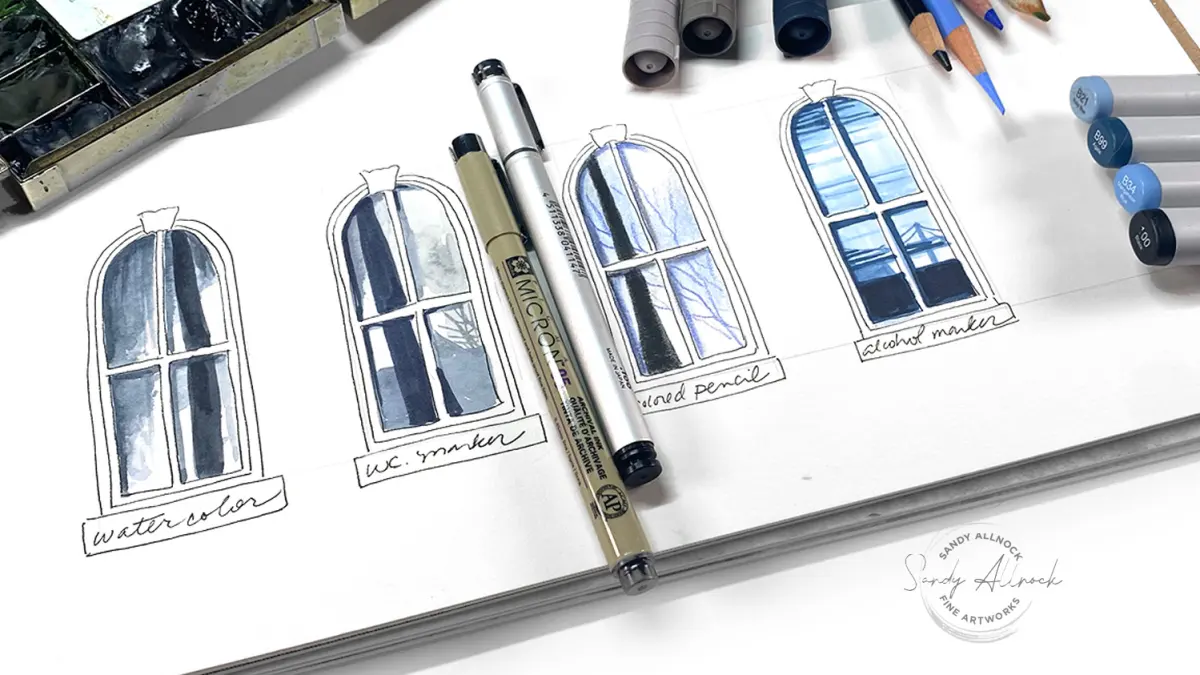
Common mistakes when drawing windows
One frequent error is failing to account for the thickness of the glass and the mullions. Beginners often draw a flat, two-dimensional box that lacks the structural weight of a real window. To fix this, add a slight shadow inside the frame to suggest that the glass is set back from the exterior wall. This simple addition immediately adds realism to the drawing.
Another mistake is over-detailing the reflection on the glass. While reflections add life to a window, drawing too many complex shapes can confuse the viewer and make the window look like a mirror rather than a transparent pane. Keep reflections simple, using a few diagonal lines or a subtle gradient to indicate the presence of light and the sky.
- Neglecting the thickness of the frame.
- Ignoring the vanishing points of the building.
- Making windows inconsistent in size or height.
- Over-complicating the glass reflections.
- Using lines that are too dark during the initial layout phase.
How to add detail to window frames
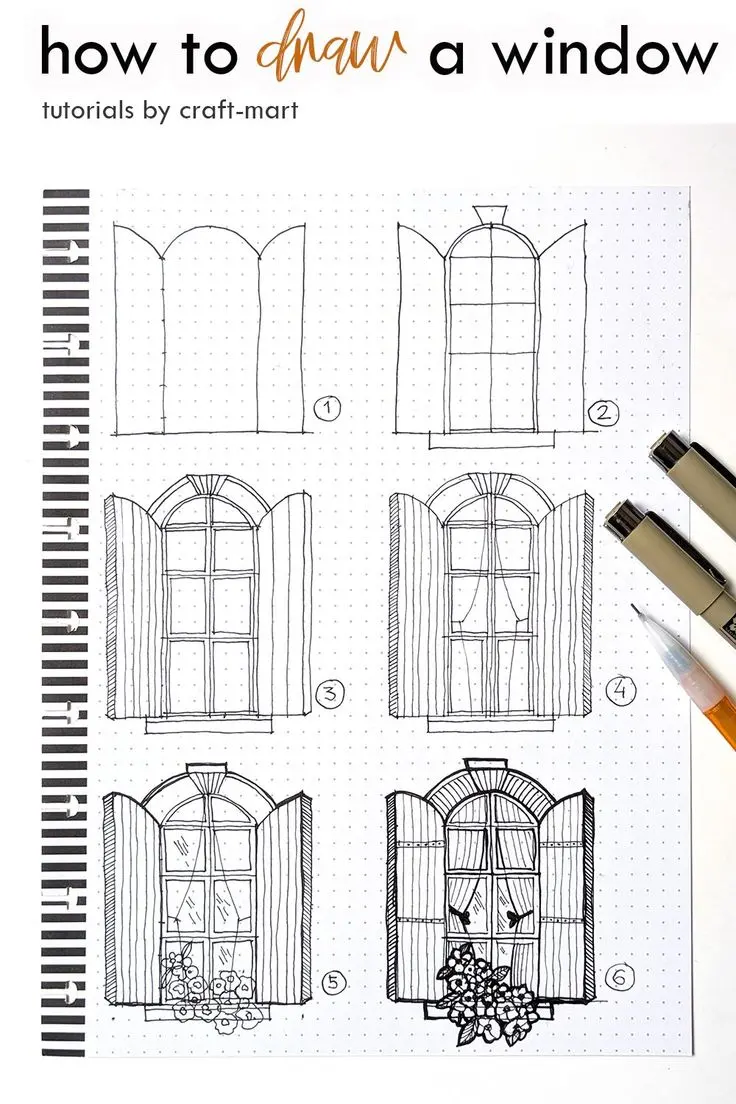
Once the basic perspective is correct, you can add character to the window. Add small notches or lines to represent the sash, the part of the window that holds the glass. If you are drawing a classic multi-pane window, use a grid to divide the interior space evenly. Ensure the lines representing the mullions have a slight width to indicate they are physical objects rather than just ink on paper.
Finally, consider the environment. Add a soft shadow cast by the window frame onto the interior or exterior wall to ground the object in space. If the window is open, draw the shutters or the sash shifted out of alignment to create a dynamic composition. These final touches transform a simple geometric shape into a convincing architectural element that enhances the overall quality of your artistic work.
Key facts
- A basic window is represented by a rectangle divided into four smaller panes, known as a "four-lite" window.
- Use a ruler to ensure your vertical and horizontal lines are perfectly parallel, as uneven frames look structurally unsound.
- Add a double line for the outer frame to represent the thickness of the wood or vinyl casing.
- Draw the central crossbar, or muntin, slightly thinner than the outer frame to create a realistic sense of depth.
- Incorporate a subtle diagonal line in one corner of each pane to suggest the reflective quality of glass.
- Perspective is crucial; if the window is on a side wall, use vanishing points to ensure the frame recedes correctly into the distance.
The bottom line
Drawing a convincing window requires a focus on geometric precision and structural depth. By starting with a clean rectangular frame and adding consistent thickness to the muntins, you create a solid foundation. Incorporating elements like sills, shading for depth, and subtle reflections transforms a simple flat shape into a realistic architectural feature. Always prioritize straight lines and correct perspective to ensure your drawing remains accurate and visually balanced.
People also ask
How do I make a window look three-dimensional?
Add a thin "depth line" inside the frame to represent the window sill or the recessed edge where the glass sits. Shading the interior side of the frame further enhances this effect.
Should I use a pencil or a pen for drawing architectural features?
Start with a light graphite pencil to lay out your proportions and vanishing points. Once the structure is accurate, go over the lines with a fine-liner pen for a clean, professional finish.
What is the best way to draw curtains on a window?
Draw vertical, wavy lines extending from the top corners toward the middle. Add horizontal folds near the curtain rod to suggest fabric gathering and weight.
How do I draw a window that is open?
Draw one pane slightly overlapping the other or tilted at an angle. This creates the illusion of movement and depth, showing that the glass is not fixed in place.
Why does my window look like it is floating on the wall?
You likely forgot to add a sill at the bottom or a header at the top. Adding these structural elements anchors the window to the wall surface.
How do I draw reflections on the glass?
Use light, jagged diagonal strokes across the panes. Keep these marks faint so they do not obscure the background visible through the window.
This answer was created with the help of AI research tools and reference sources. Spotted an error? Let us know — we correct mistakes quickly. See our editorial policy.