What was the Silk Road?
Short answer
The Silk Road was a vast network of interconnected trade routes linking China and the Far East with the Middle East and Europe. Operating from roughly 130 BCE to 1453 CE, it facilitated the exchange of goods, technologies, religions, and cultures, fundamentally shaping the development of civilizations across the Afro-Eurasian landmass.
On this page
What was the Silk Road exactly?
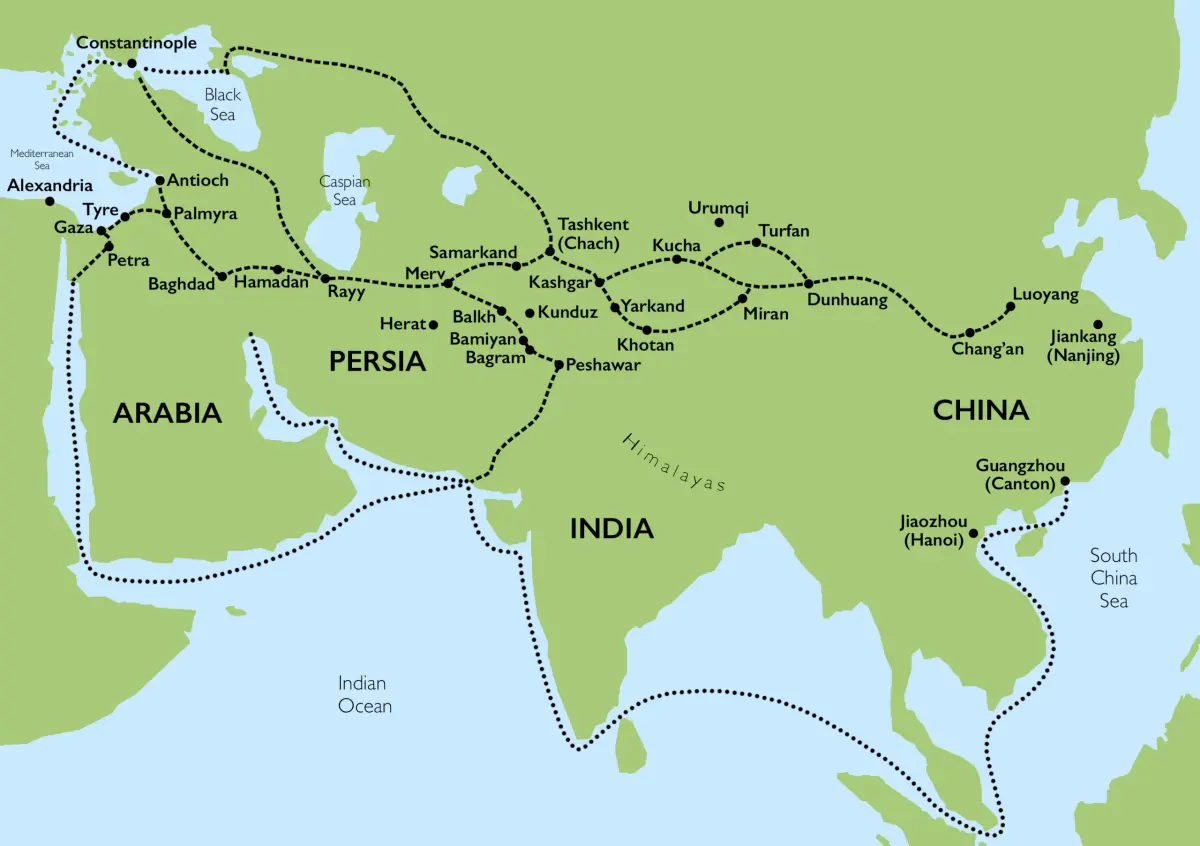
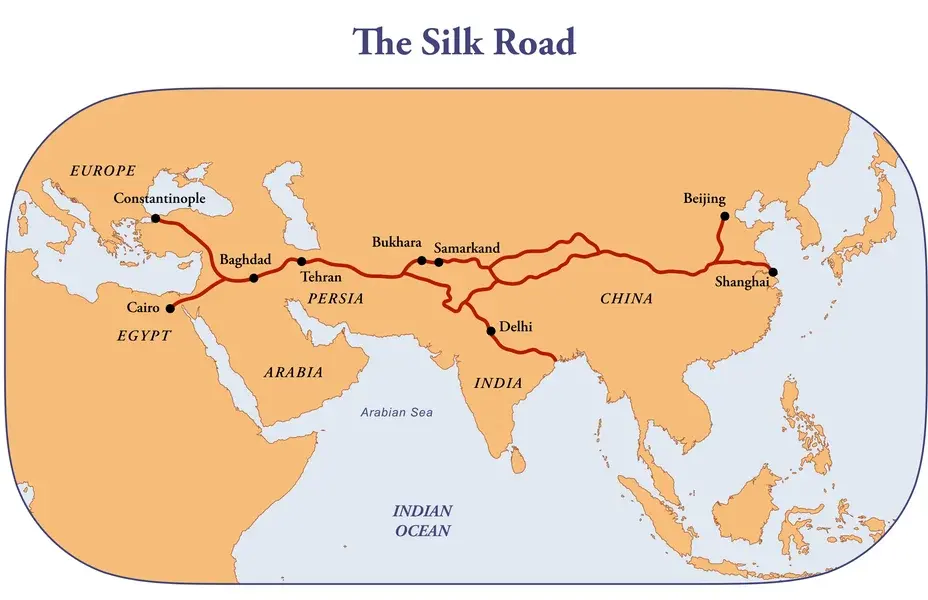
The Silk Road was not a single paved highway, but rather a shifting web of land and maritime paths spanning over 4,000 miles. It connected the Han dynasty of China to the Roman Empire and later the Islamic caliphates and the Mongol Empire. Merchants rarely traveled the entire length of the route; instead, goods passed through a series of middlemen at various trading hubs and caravanserais.
While silk was the most famous commodity exported from China, the routes carried a diverse array of goods. Traders moved spices, precious metals, glassware, paper, gunpowder, and medicinal herbs across harsh deserts and mountain ranges. This constant movement of people fostered intense cross-cultural interaction, making the Silk Road the world’s first major engine of globalization.
How did the Silk Road influence history?
The primary impact of the Silk Road was the rapid spread of ideas and innovations that transformed societies. Religions such as Buddhism, Christianity, Islam, and Zoroastrianism traveled along these paths, often finding new followers far from their places of origin. Scientific knowledge, including advancements in mathematics, astronomy, and medicine, was shared between the East and the West, accelerating progress in both regions.
Technological transfers were equally significant, as the migration of inventions altered the course of history:
- Papermaking and printing technology moved from China to the Islamic world and eventually to Europe, fueling the Renaissance.
- Gunpowder changed the nature of warfare globally, leading to the decline of feudal castles and the rise of centralized states.
- The magnetic compass revolutionized navigation, enabling the Age of Discovery.
- Agricultural techniques and crop varieties, such as grapes and carrots in China, diversified diets and improved food security.
Who traveled the Silk Road?
Travelers on the Silk Road included merchants, diplomats, soldiers, pilgrims, and explorers, each motivated by different goals. Merchants sought profit through the arbitrage of luxury goods, while diplomats traveled to establish alliances or negotiate trade terms. Pilgrims, such as the famous Chinese monk Xuanzang, traversed the routes to visit holy sites and acquire religious texts, while explorers like Marco Polo documented the wonders of distant lands for Western audiences.
Life on the road was dangerous and required careful planning. Travelers faced extreme weather, bandits, and the constant threat of disease. To manage these risks, they typically traveled in large caravans, relying on the protection of local rulers or nomadic tribes who controlled key segments of the terrain. The success of these journeys depended on the existence of a stable political environment, which is why the routes flourished most during periods of imperial stability, such as the Pax Mongolica.
Why did the Silk Road decline?
The decline of the Silk Road began in the 15th century, driven by the rise of maritime trade and geopolitical shifts. As European powers like Portugal and Spain developed advanced naval technologies, they sought direct sea routes to the spice markets of Asia to bypass the expensive middlemen of the overland routes. Vasco da Gama’s voyage around the Cape of Good Hope in 1498 proved that sea travel was more efficient and cost-effective than the arduous land journey.
Furthermore, the collapse of the Mongol Empire and the rise of the Ottoman Empire led to increased political instability and trade restrictions. The Ottomans imposed heavy taxes and eventually blocked access to traditional routes, forcing Europeans to look toward the Atlantic. This transition shifted the center of global economic power from the interior of Asia to the coastal cities of Europe, effectively ending the era of the Silk Road as the primary artery of international commerce.
Common mistakes when studying the Silk Road
When researching this topic, many people fall into the trap of viewing the Silk Road as a static, monolithic entity. It is important to avoid these common misconceptions:
- Assuming it was a single path: It was a dynamic, ever-changing network that expanded and contracted based on political and environmental factors.
- Believing it was only for silk: While silk was a major export, the trade in ideas, diseases, and cultural practices was arguably more impactful.
- Thinking it was exclusively land-based: The maritime Silk Road, which connected ports in the Indian Ocean and the South China Sea, was just as vital as the overland trails.
- Ignoring the role of nomadic tribes: Many assume the routes were controlled solely by empires, but nomadic groups provided essential security, logistics, and transportation services that made the trade possible.
By understanding these nuances, you can better appreciate how the Silk Road functioned as a complex, living system rather than a simple trade corridor. It remains a powerful example of how interconnectedness can drive human progress, even in the face of immense geographical and political challenges.
Key facts
- The Silk Road was not a single paved road but a vast, shifting network of land and sea trade routes connecting China to the Mediterranean.
- It spanned approximately 4,000 miles (6,400 kilometers), linking major hubs like Chang'an in China to Antioch and Constantinople.
- Trade flourished primarily during the Han Dynasty (206 BCE–220 CE) and reached its peak under the Mongol Empire in the 13th and 14th centuries.
- While silk was the most famous commodity, merchants also traded spices, tea, porcelain, precious metals, glassware, and paper.
- The route was a primary conduit for the spread of Buddhism, Islam, Christianity, and technologies like gunpowder and the compass.
- Travelers often moved in large caravans, hiring local guides to navigate dangerous terrain like the Taklamakan Desert and the Pamir Mountains.
The bottom line
The Silk Road stands as history’s most significant network of transcontinental trade, bridging diverse civilizations through the exchange of goods, technologies, and philosophies. By connecting the East and West, it fostered unprecedented economic growth and cultural diffusion. Although the physical routes eventually faded, the legacy of this interconnected system persists today as the foundational precursor to modern global trade, diplomacy, and our shared human heritage.
People also ask
Was silk the only item traded on the Silk Road?
No, the Silk Road facilitated the exchange of a vast array of goods including spices, precious stones, glassware, and textiles. It also served as a vital channel for the movement of ideas, religions, and scientific innovations between East and West.
How long did it take to travel the entire Silk Road?
A single merchant rarely traveled the entire length of the route. Instead, goods passed through many intermediaries, taking months or even years to move from one end of the network to the other.
What were the biggest dangers for travelers on the Silk Road?
Travelers faced extreme environmental challenges, such as blistering heat in deserts and freezing temperatures in high mountain passes. They also risked attacks from bandits and the spread of diseases, most notably the bubonic plague.
Why did the Silk Road eventually decline?
The rise of the Ottoman Empire, which restricted trade with the West, and the emergence of safer, more efficient maritime trade routes during the Age of Discovery led to the decline of land-based travel.
Did Marco Polo really travel the Silk Road?
Yes, the Venetian merchant Marco Polo traveled to China in the 13th century and served in the court of Kublai Khan. His detailed accounts later introduced many Europeans to the wonders of Asian culture and trade.
How did the Silk Road influence modern globalization?
The Silk Road established the first global economic system by proving that long-distance trade could be profitable and sustainable. It created the blueprint for international diplomacy and cultural exchange that defines our modern interconnected world.
This answer was created with the help of AI research tools and reference sources. Spotted an error? Let us know — we correct mistakes quickly. See our editorial policy.