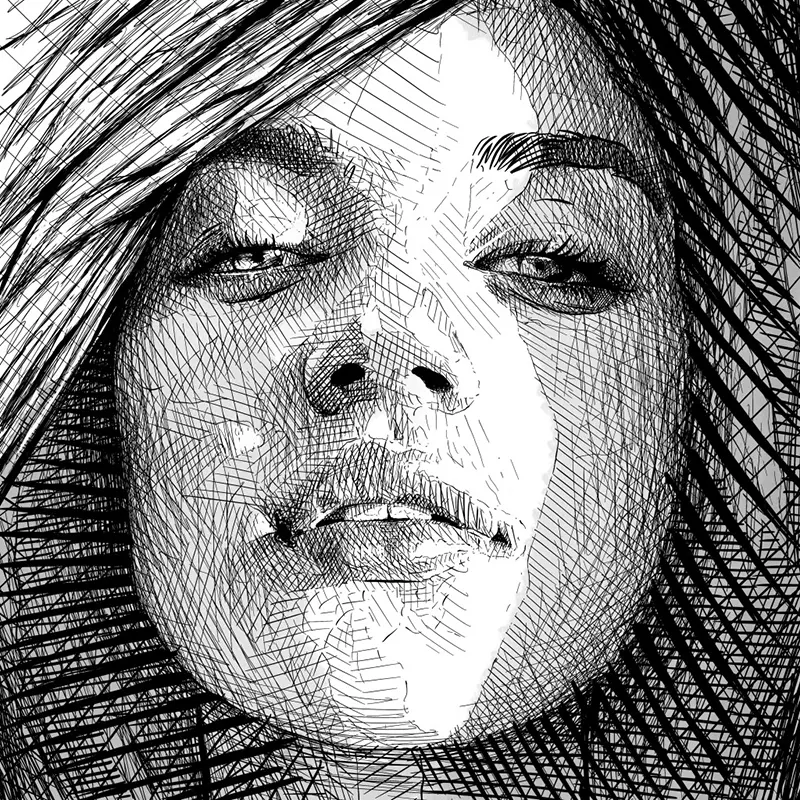
What is scribble shading?
Short answer
Scribble shading is a drawing technique that uses continuous, overlapping, and chaotic lines to create tone, texture, and depth. By varying the density and pressure of these marks, artists build up shadows and highlights. It is a versatile method often used in sketching to achieve expressive, energetic, and high-contrast visual effects.
On this page
What is scribble shading used for?
Scribble shading, often referred to as "scumbling" or "controlled scribbling," serves as a dynamic alternative to traditional smooth blending or cross-hatching. Instead of focusing on precise, parallel lines, the artist uses a series of irregular loops, squiggles, and overlapping marks. This technique is particularly effective for rendering organic textures, such as tangled hair, rough tree bark, or the chaotic foliage of a distant forest. Because the lines do not follow a rigid pattern, they impart a sense of movement and spontaneity to a drawing.
Beyond texture, this method is a powerful tool for establishing value and volume. By layering more scribbles in specific areas, an artist can create deep, rich shadows that feel tactile rather than flat. It is frequently employed in quick gesture drawings or expressive portraiture where the artist wants to capture the essence of a subject without getting bogged down in minute details. The resulting aesthetic is often described as raw or energetic, making it a favorite for illustrators who prioritize mood and atmosphere over photographic realism.
How to learn scribble shading techniques
Mastering this style requires a shift in how you hold and move your drawing tool. Rather than focusing on the individual mark, you must focus on the cumulative effect of the cluster. Beginners should start by practicing the density of their marks to understand how value changes across a surface.
- Begin by holding your pencil loosely to allow for fluid wrist movement.
- Create a light, airy layer of circular scribbles across a small square on your paper.
- Gradually add more layers of scribbles in one corner of the square to increase the darkness.
- Observe how the overlapping lines naturally create a gradient from light to dark.
- Experiment with different shapes, such as tight loops, jagged zig-zags, or elongated waves, to see how each changes the texture of the shading.
Once you are comfortable with basic density, try applying these marks to a simple sphere. Focus on keeping your scribbles tighter in the shadow areas and wider or more sparse in the highlights. This exercise helps you understand how to use line direction to suggest the curvature of an object.
Best tools for scribble shading
While you can use almost any drawing implement for this technique, certain tools offer distinct advantages depending on the desired outcome. Graphite pencils are the most common starting point because they allow for a wide range of pressure and tonal variation. Softer pencils, such as 4B or 6B, are ideal for achieving deep, dark shadows with minimal effort, while harder pencils like HB or 2H are better for subtle transitions and lighter areas.
- Graphite pencils: Versatile and easy to erase, perfect for learning the basics.
- Ink pens: Provide high-contrast, permanent lines that cannot be blended, forcing you to rely entirely on line density.
- Charcoal sticks: Excellent for large-scale, expressive work where you want to cover space quickly with bold, dark marks.
- Ballpoint pens: Allow for subtle value changes through light pressure and are excellent for small, detailed sketches.
If you are working with ink, remember that you cannot lighten your marks once they are placed. This forces you to be more intentional with your density, which is an excellent way to improve your overall drawing discipline.
Common mistakes when scribble shading
The most frequent error beginners make is losing control of the "chaos" in their lines. It is easy for a drawing to become a messy, unreadable tangle if the scribbles are too uniform or too aggressive across the entire page. To avoid this, ensure that you are varying the direction and size of your loops. If every mark is identical, the shading will look mechanical and flat rather than organic.
Another common mistake is applying too much pressure too early in the process. When you press hard with a pencil, you fill the tooth of the paper, making it difficult to add further layers or adjust the values later. Always start with a light touch and build your shadows slowly. If you find your drawing looks muddy or overworked, it is likely because you have flattened the texture by pressing too hard. Step back frequently to assess the overall balance of your composition, ensuring that the scribbled areas support the focal point rather than distracting from it.
Why scribble shading creates depth
The effectiveness of scribble shading lies in the optical illusion created by the overlapping lines. When you layer scribbles, you are essentially creating a complex web of marks that trap light and shadow within the gaps. The human eye tends to blend these dense clusters into a solid tone, while the individual lines provide a sense of surface quality that smooth shading simply cannot replicate. This dual nature allows an artist to define the form of an object while simultaneously describing its material properties.
Furthermore, the variation in line weight and speed contributes to a sense of depth. Scribbles that are larger and more spaced out tend to recede or appear closer to the viewer depending on the context, while tighter, darker scribbles create a clear sense of weight and gravity. By manipulating these variables, you can guide the viewer’s eye through the drawing, emphasizing the parts of the subject that are most important. This technique turns a simple drawing into a rich, multi-layered experience that rewards the viewer for looking closely at the intricate web of marks.
Key facts
- Scribble shading uses continuous, overlapping, and messy lines to build up tone and texture in a drawing.
- The density of the scribbles determines the darkness; more overlapping lines create deeper shadows.
- Artists often use circular or "random" motions to avoid creating recognizable patterns that distract the eye.
- This technique is highly expressive and is frequently used in gesture drawing and quick sketching.
- Varying the pressure of your pen or pencil allows for a wider range of values and contrast.
- Avoid lifting your drawing tool frequently to maintain the fluid, energetic quality of the lines.
The bottom line
Scribble shading is a dynamic drawing technique that utilizes continuous, overlapping lines to create depth, volume, and texture. By adjusting the density and pressure of these erratic strokes, artists can achieve a wide range of values without relying on traditional blending. This method is perfect for those seeking to add energy and raw emotion to their sketches, offering a liberating departure from rigid, formal shading styles.
People also ask
Is scribble shading the same as cross-hatching?
No, cross-hatching uses organized, intersecting straight lines to create value, whereas scribble shading relies on chaotic, looping, or non-linear strokes. Scribble shading is generally less structured and more fluid than the methodical approach of cross-hatching.
What tools work best for scribble shading?
Fine-liner pens, ballpoint pens, and soft graphite pencils are ideal because they allow for smooth, continuous movement. Pens are particularly popular because they provide consistent line weight, which emphasizes the texture of the scribbles.
How do I make an area look darker using this technique?
Increase the frequency of your scribbles in a specific area to create a denser web of ink or graphite. You can also press harder or layer more loops over the same spot to deepen the shadow.
Can scribble shading be used for realistic portraits?
Yes, it can be used to create stylized, high-energy portraits that focus on form rather than minute detail. By carefully controlling the density of the scribbles, artists can effectively map out the contours and shadows of a face.
What is the biggest mistake beginners make with scribble shading?
The most common error is creating lines that are too uniform or "patterned," which makes the drawing look mechanical. Beginners should focus on keeping their hand loose and varying the direction of their strokes to maintain a natural, organic appearance.
Does scribble shading require a specific paper type?
Smooth or medium-tooth paper is best because it allows the drawing tool to glide easily without catching. Textured paper can make it difficult to control the precision of the scribbles, especially when working with fine-tipped pens.
This answer was created with the help of AI research tools and reference sources. Spotted an error? Let us know — we correct mistakes quickly. See our editorial policy.