What is an oxymoron?
Short answer
An oxymoron is a figure of speech that combines two contradictory or opposing terms to create a unique, often paradoxical, meaning. By placing words like "deafening silence" or "organized chaos" side-by-side, writers highlight complexity or irony. This rhetorical device effectively grabs the reader's attention by forcing them to reconcile two incompatible concepts.
On this page
What is an oxymoron exactly?
An oxymoron is a specific linguistic construction where two seemingly opposite words are paired together to produce a new, often profound, effect. The term itself originates from the Greek words "oxys," meaning sharp, and "moros," meaning dull or foolish. This etymology reflects the nature of the device: a "sharp-dull" combination that challenges the reader to look closer at the intended meaning.
Unlike a paradox, which is a full sentence or statement that contradicts itself, an oxymoron is typically restricted to a two-word phrase. Writers use these combinations to add depth to their descriptions, emphasize a specific feeling, or inject a sense of irony into their work. By juxtaposing opposites, the speaker forces the audience to pause and consider the nuance of the situation being described.
Common examples of oxymorons
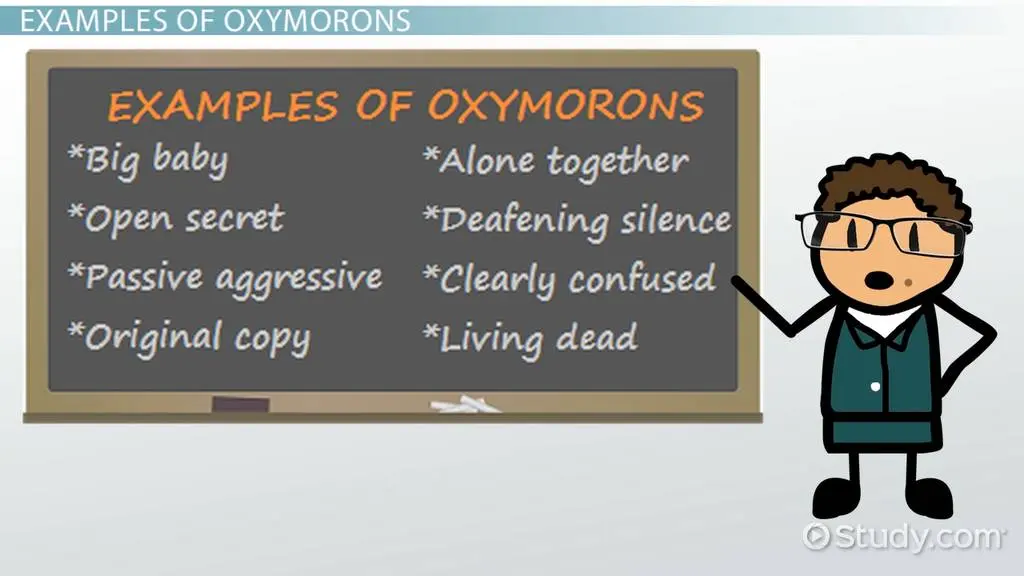
You likely encounter oxymorons frequently in everyday conversation and literature without realizing their technical classification. These phrases have become so ingrained in the English language that they often function as standard idioms rather than intentional literary flourishes. Recognizing them helps you understand how language evolves to capture complex human experiences.
Consider these common examples often found in both professional and casual writing:
- Bittersweet: A feeling of both happiness and sorrow.
- Jumbo shrimp: A pairing of size extremes used for humorous effect.
- Virtual reality: A digital simulation that is not physically real.
- Open secret: Information that is technically private but widely known.
- Passive-aggressive: A behavior that is both avoidant and hostile.
These examples illustrate how oxymorons serve as shorthand for states of being that would otherwise require long, cumbersome explanations. They condense complex emotions or physical contradictions into concise, punchy phrases that resonate quickly with an audience.
How to use oxymorons in writing
When incorporating oxymorons into your own writing, the goal is to enhance clarity rather than create confusion. Use them sparingly to emphasize a specific point or to add a layer of irony to your narrative. If you overuse them, your prose may begin to feel cluttered or overly dramatic, which can distract the reader from your core message.
Follow these steps to effectively integrate this device into your work:
- Identify the core emotion or concept you want to highlight.
- Brainstorm adjectives and nouns that possess opposite qualities.
- Pair the words to see if they create a meaningful, rather than nonsensical, image.
- Review the sentence to ensure the oxymoron does not contradict the logical flow of your paragraph.
By following this process, you ensure that the figure of speech serves the narrative rather than acting as a mere gimmick. A well-placed oxymoron can elevate a simple description into something more memorable and evocative for your reader.
Common mistakes when using oxymorons
The most frequent mistake writers make is confusing an oxymoron with a simple error in logic. If a phrase is contradictory but lacks a poetic or ironic purpose, it is likely just a mistake that confuses the reader. For instance, describing a "round square" is a logical impossibility that adds no rhetorical value, whereas "living dead" suggests a specific, recognizable state of being.
Avoid these common pitfalls to maintain the quality of your writing:
- Forcing a connection: Do not pair words just to sound clever if the result does not make sense in context.
- Over-saturation: Using too many oxymorons in a single paragraph can make your writing appear pretentious or difficult to follow.
- Ignoring tone: Ensure the oxymoron matches the overall tone of your piece; a humorous oxymoron may feel jarring in a serious, formal report.
Always prioritize the clarity of your message. If a phrase feels like it is trying too hard to be deep, it is often better to use straightforward language instead.
Why oxymorons are useful in communication
Oxymorons remain a powerful tool because they capture the inherent contradictions of the human experience. Life is rarely black and white, and these linguistic pairings allow us to express the "gray areas" where two opposing truths can exist simultaneously. They provide a bridge between logic and emotion, allowing for a more sophisticated level of expression.
In professional settings, they can be used to describe complex business dynamics, such as "planned spontaneity" or "controlled risk." In creative writing, they help build tension and atmosphere, such as describing a "cold fire" or "heavy lightness." Ultimately, the oxymoron is a testament to the flexibility of language, proving that sometimes the best way to describe reality is by acknowledging that it is full of beautiful, necessary contradictions that defy simple definition.
Key facts
- An oxymoron is a figure of speech that combines two contradictory terms to create a new, often ironic, meaning.
- The term originates from the Greek words "oxys," meaning sharp, and "moros," meaning dull or foolish.
- Oxymorons are frequently used in literature, such as William Shakespeare’s "parting is such sweet sorrow" in Romeo and Juliet.
- They serve to emphasize a complex feeling or highlight a paradox that simple descriptions cannot capture.
- Common everyday examples include "deafening silence," "jumbo shrimp," and "original copy."
- To avoid confusion, ensure your audience understands the irony; using too many in one sentence can make writing sound cluttered.
The bottom line
An oxymoron is a powerful rhetorical tool that pairs contradictory terms to create unique, evocative expressions. By blending opposites, writers can highlight irony, emphasize emotional depth, or add wit to their prose. While effective in creative writing, use these figures of speech intentionally and sparingly. Mastering this device allows you to communicate complex ideas with brevity and flair, making your language significantly more memorable and impactful.
People also ask
Is an oxymoron the same thing as a paradox?
While both involve contradictions, a paradox is a longer statement or situation that seems self-contradictory but may reveal a deeper truth. An oxymoron is specifically the pairing of two contradictory words side-by-side.
Can an oxymoron be used in professional writing?
Yes, but use them sparingly to add emphasis or color. In formal reports, avoid them if they cause ambiguity or distract from your primary message.
Are all contradictory phrases considered oxymorons?
No, some contradictions are simply errors in logic or phrasing. An oxymoron is intentional and serves a rhetorical purpose, whereas a logical error is usually accidental and confusing.
Why do authors use oxymorons?
Authors use them to provoke thought, create vivid imagery, or capture the complexity of human emotions. They force the reader to pause and consider the relationship between two opposing concepts.
What is a common mistake when using oxymorons?
A common error is using an oxymoron that has become a cliché, such as "act naturally" or "clearly confused." Overused phrases lose their rhetorical impact and can make writing appear unoriginal.
How can I create my own oxymoron?
Identify two words with opposite meanings that, when joined, describe a specific state of being. For example, "organized chaos" effectively describes a workspace that looks messy but functions efficiently.
This answer was created with the help of AI research tools and reference sources. Spotted an error? Let us know — we correct mistakes quickly. See our editorial policy.