How do you draw a sloth step by step?
Short answer
Drawing a sloth involves capturing its characteristic slow, relaxed posture and distinct facial features. Begin by sketching a large, rounded shape for the body and a smaller circle for the head. Add long, curved limbs with prominent claws, then refine the face with a mask-like patch around the eyes for realism.
On this page
How to draw a sloth body shape
The foundation of a realistic sloth drawing is the silhouette, which should emphasize a hunched, rounded posture. Start by drawing a large, soft oval that leans slightly forward, representing the torso. Sloths are arboreal mammals, so their bodies are naturally curved to grip branches. Avoid making the body too rigid or upright, as this contradicts their relaxed, sedentary nature.
Once the torso is established, add a smaller circle on top, slightly overlapping the body to create the neck area. Because sloths have very limited neck mobility, keep the head close to the shoulders. Use light pencil strokes for these initial shapes so you can easily erase guidelines later. Focusing on these simple geometric forms ensures your drawing maintains the correct proportions before adding complex details like fur or facial features.
How to draw sloth limbs and claws
Sloths are famous for their long, powerful limbs designed for hanging. When drawing the arms, make them disproportionately long compared to the body. Connect them to the top of the torso and bend the elbows outward to suggest the animal is clinging to a tree branch. Ensure the limbs appear slightly loose rather than tense, reflecting the sloth's low-energy lifestyle.
The most iconic feature of a sloth is its curved, hook-like claws. These are essential for their survival in the canopy. Follow these steps to draw them accurately:
- Draw three distinct, elongated hooks at the end of each limb.
- Curve the hooks inward toward the center of the branch you are drawing.
- Add thickness to the base of each claw where it attaches to the paw.
- Use sharp, pointed tips to emphasize the strength of the grip.
How to draw a sloth face
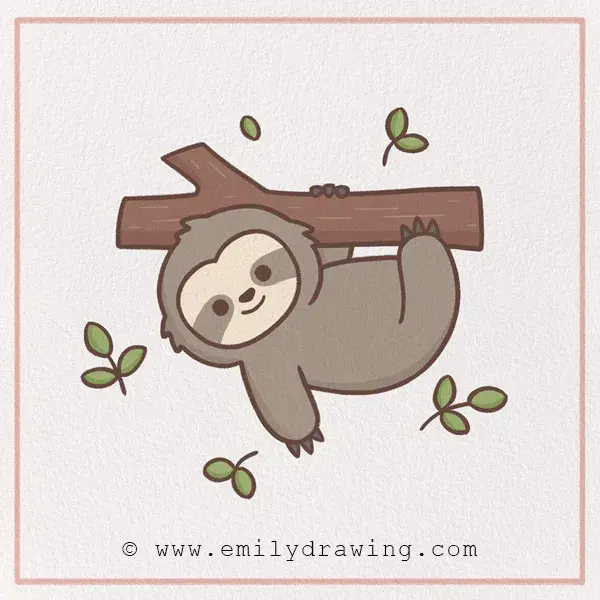
The face of a sloth is defined by a mask-like patch of dark fur surrounding the eyes. Start by drawing two small, dark circles for the eyes within a larger, almond-shaped outline on the face. This mask helps the sloth blend into the shadows of the rainforest canopy. Keep the nose small and centered, positioned just below the eye line.
Add a simple, slightly curved line for the mouth to give the sloth its signature "smiling" expression. Sloths have small ears that are often hidden by fur, so keep them subtle or omit them entirely if you are drawing a long-haired variety. The key is to keep the facial features centered and slightly clustered, which enhances the animal's endearing, gentle appearance. Adding a bit of texture around the face will differentiate the facial fur from the rest of the body.
Best drawing techniques for fur texture
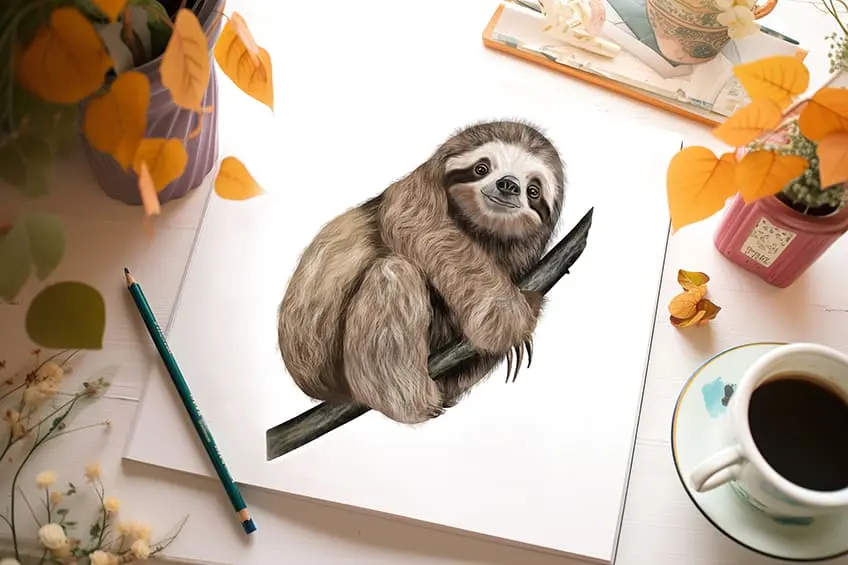
Capturing the coarse, shaggy fur of a sloth adds depth and realism to your sketch. Instead of drawing individual hairs, use short, directional strokes that follow the contours of the body. Start from the center of the chest and work outward, as sloth fur often parts in a unique way to allow rainwater to run off while they hang upside down. Vary the pressure of your pencil to create shadows in the crevices of the fur.
To achieve a realistic look, consider these tips:
- Use a cross-hatching technique in the darker areas under the arms and neck.
- Leave small gaps between strokes to suggest the thickness of the coat.
- Use a kneaded eraser to lift highlights on the top of the head and shoulders.
- Apply darker shading near the limbs to create a sense of volume and weight.
Common mistakes when drawing sloths
A frequent error is drawing the limbs too short or too straight. Sloths rely on their long, dangling arms to move through the trees, so shortening them makes the animal look more like a bear or a monkey. Another mistake is ignoring the branch; the interaction between the claws and the wood is what defines the sloth's environment. Always draw the branch first or simultaneously with the claws to ensure the perspective is accurate.
Additionally, avoid making the eyes too large or expressive. Sloths have small, dark, and somewhat vacant-looking eyes that contribute to their mysterious, slow-moving demeanor. Over-detailing the eyes with human-like features can make the drawing look cartoonish rather than naturalistic. Finally, ensure the body is not perfectly symmetrical, as sloths often hang at odd, asymmetrical angles. By observing the natural, gravity-defying posture of these creatures, you can create a drawing that feels authentic and captures the essence of their unique existence in the wild.
Key facts
- Sloths have very long, curved limbs designed for hanging, so draw the arms longer than the legs.
- Focus on the signature "mask" pattern around the eyes, which is a dark patch of fur unique to many species.
- Keep the body shape rounded or pear-shaped to emphasize the sloth's relaxed, sedentary posture.
- Use three-toed sloths as a reference if you want to draw the characteristic long, hook-like claws.
- Avoid drawing a perfectly straight spine; sloths have a curved, hunched back when hanging from branches.
- Add texture to the fur by using short, overlapping strokes rather than long, continuous lines.
The bottom line
Drawing a sloth effectively requires capturing its unique, hunched silhouette and long, hooked limbs. By focusing on the dark facial mask, rounded body shape, and the way its claws grip a branch, you can create a recognizable illustration. Remember to keep the head small and the fur texture soft. With these simple proportions and attention to anatomical detail, you can easily depict this fascinating, slow-moving creature.
People also ask
How do I make the sloth look like it is hanging from a branch?
Draw a thick, horizontal line across your paper to represent the branch. Position the sloth’s claws so they hook over the top and wrap slightly around the underside of the wood.
What is the most common mistake when drawing a sloth's face?
Many beginners draw the eyes too far apart or too small. Sloths have relatively large, forward-facing eyes set within a distinct, dark facial patch that gives them their iconic expression.
Should I draw the sloth with three or two toes?
This depends on the species, as three-toed sloths have three digits on their front limbs, while two-toed sloths have two. Research the specific anatomy of the species you are depicting to ensure accuracy.
How do I draw the fur to look realistic?
Use short, directional strokes that follow the contour of the body. Sloth fur grows in a unique direction, parting at the stomach, so drawing the hair flowing toward the limbs adds authenticity.
Are there specific proportions I should follow for the head?
Sloths have very small, rounded heads in proportion to their large, bulky bodies. Keep the head small and place it close to the shoulders to capture their compact, hunched appearance.
How can I show the sloth's slow movement?
You can suggest slow movement by drawing the sloth in a slightly curled position with limbs dangling loosely. Avoid sharp, angular lines, opting instead for soft, rounded shapes that imply a relaxed state.
This answer was created with the help of AI research tools and reference sources. Spotted an error? Let us know — we correct mistakes quickly. See our editorial policy.