Who invented origami?
Short answer
Origami does not have a single inventor. It emerged organically in Japan following the introduction of paper from China in the 6th century. Initially restricted to religious and ceremonial use due to the high cost of paper, the craft evolved into a popular secular art form during the Edo period.
On this page
How did origami originate?
The origins of origami are deeply intertwined with the introduction of papermaking to Japan by Buddhist monks around 600 CE. Because paper was a rare and expensive commodity, its initial use was reserved for religious rituals and formal ceremonies. Shinto priests used paper folds, known as shide, to decorate sacred spaces and shrines. These early folded forms were symbolic rather than recreational, serving as offerings to the gods.
As paper production methods improved and costs declined, the practice transitioned into the aristocratic sphere. During the Heian period, samurai utilized folded paper as a formal gift-wrapping technique, often attaching a noshi—a folded strip of dried abalone—to gifts to signify good fortune. These traditions established the foundation for paper folding as a disciplined, aesthetic practice in Japanese culture. It was not until the 17th century that paper became affordable enough for the general public to experiment with folding for leisure.
When did origami become a hobby?
The transition of origami from a ritualistic practice to a popular pastime occurred during the Edo period (1603–1867). As mass-produced paper became widely available, the public began creating decorative figures for entertainment. The first known written instructions for a paper model appeared in the 1797 book Hiden Senbazuru Orikata (The Secret to Folding One Thousand Cranes), which detailed how to create connected cranes from a single sheet of paper.
This era marked the shift toward the modern understanding of origami as a creative art form. By the late 19th century, the craft began to influence educational systems, particularly through the work of Friedrich Froebel in Germany. His "kindergarten" movement incorporated paper folding as a tool for teaching geometry and spatial awareness to children. This cross-cultural exchange helped formalize the techniques that define contemporary origami, leading to the establishment of global organizations dedicated to the craft in the mid-20th century.
How to fold your first model
Starting with origami requires minimal equipment, but choosing the right materials is essential for success. Beginners should use "kami" paper, which is specifically designed for folding. It is typically thin, square, and colored on one side with a white underside, making it easier to track the progress of folds. Avoid using thick construction paper or cardstock, as these materials crack at the creases and lack the necessary flexibility for complex shapes.
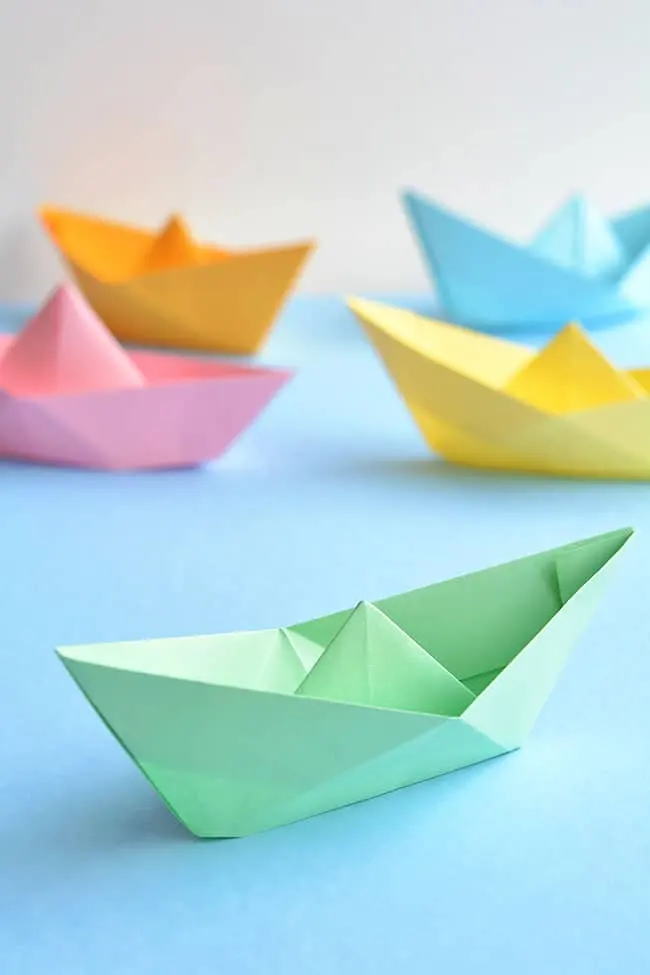
To begin your first project, such as the classic crane or a simple boat, follow these steps:
- Start with a perfectly square piece of paper; if your paper is rectangular, fold one corner to the opposite edge and trim the excess.
- Make your creases sharp by running your fingernail along the folded edge to ensure the paper lies flat.
- Work on a hard, flat surface like a table rather than your lap to maintain precision.
- Align edges carefully before pressing down, as even a millimeter of deviation can cause the final model to look uneven.
Common mistakes when folding paper
Even experienced folders encounter issues when attempting to translate two-dimensional paper into three-dimensional structures. One of the most frequent errors is failing to align corners accurately at the start of a sequence. If the initial folds are misaligned, the errors compound as the model progresses, resulting in a distorted final shape. Always take the time to verify that your points meet exactly before committing to a firm crease.
Another common pitfall is using excessive force or over-handling the paper. Repeatedly folding and unfolding the same section can weaken the fibers, causing the paper to tear prematurely. If you find yourself struggling with a specific step, it is often better to restart with a fresh sheet rather than forcing a fold that does not want to align. Remember that origami is a practice of patience; rushing through the steps often leads to sloppy results and frustration.
Why is origami still popular today?
Origami remains a globally recognized art form because it bridges the gap between artistic expression and mathematical precision. Modern origami artists, such as Akira Yoshizawa, who created the "wet-folding" technique, have pushed the boundaries of what is possible with a single sheet of paper. By dampening the paper, artists can create softer, organic curves that mimic the anatomy of animals and human figures, moving beyond the rigid, geometric shapes of traditional designs.
Beyond aesthetics, the principles of origami have significant practical applications in science and engineering. Researchers utilize folding patterns to design compact, deployable structures for space exploration, such as solar panels that unfold in orbit. The study of paper folding also contributes to advancements in medical technology, including the development of miniature stents that can be inserted into arteries and expanded once in place. This enduring relevance ensures that the ancient craft of paper folding continues to evolve, serving as both a meditative hobby and a sophisticated tool for solving complex structural problems in the modern world.
Key facts
- Origami originated in Japan following the introduction of paper from China in the 6th century.
- The term "origami" combines the Japanese words "ori" (folding) and "kami" (paper).
- Early paper folding was primarily reserved for religious ceremonies and formal gift-giving due to the high cost of paper.
- Akira Yoshizawa is considered the grandmaster of modern origami, having created over 50,000 models.
- The Yoshizawa-Randlett system, established in the 1950s, created a universal language of diagrams using arrows and dotted lines.
- To avoid tearing paper, always use a bone folder or your fingernail to create sharp, precise creases on a flat surface.
The bottom line
Origami evolved from ancient Japanese ceremonial traditions into a sophisticated global art form and scientific discipline. While no single inventor can be named, the practice flourished through centuries of cultural refinement and the 20th-century standardization of diagramming techniques. By mastering basic folds and precise alignment, anyone can transform a simple square of paper into complex geometric structures, bridging the gap between artistic expression and mathematical engineering.
People also ask
What is the best type of paper for beginners to use?
Standard origami paper is ideal because it is thin, square, and often colored on one side. Beginners should avoid thick cardstock, which is difficult to fold precisely and prone to cracking at the seams.
Why are most origami models made from a single square sheet?
Traditional origami emphasizes the challenge of creating complex shapes without cutting, gluing, or taping. This constraint encourages creativity and ensures the structural integrity of the final model.
Is origami considered a form of mathematics?
Yes, origami is a recognized field of study in computational geometry. Mathematicians use folding patterns to solve complex problems, such as how to pack solar panels into small spaces for space travel.
What is the most famous origami model?
The Japanese paper crane, or orizuru, is the most iconic design. It is a symbol of peace and longevity, often folded in groups of 1,000 to grant a special wish.
How can I prevent my folds from becoming misaligned?
Always align your corners perfectly before pressing down on the crease. If your initial folds are off by even a millimeter, the error will compound as the model becomes more complex.
Can origami be used for medical purposes?
Engineers have applied origami principles to design heart stents that can be inserted into arteries in a collapsed state and then expanded. This technology allows for minimally invasive surgical procedures.
This answer was created with the help of AI research tools and reference sources. Spotted an error? Let us know — we correct mistakes quickly. See our editorial policy.