What is Emily Carr's most famous painting?
Short answer
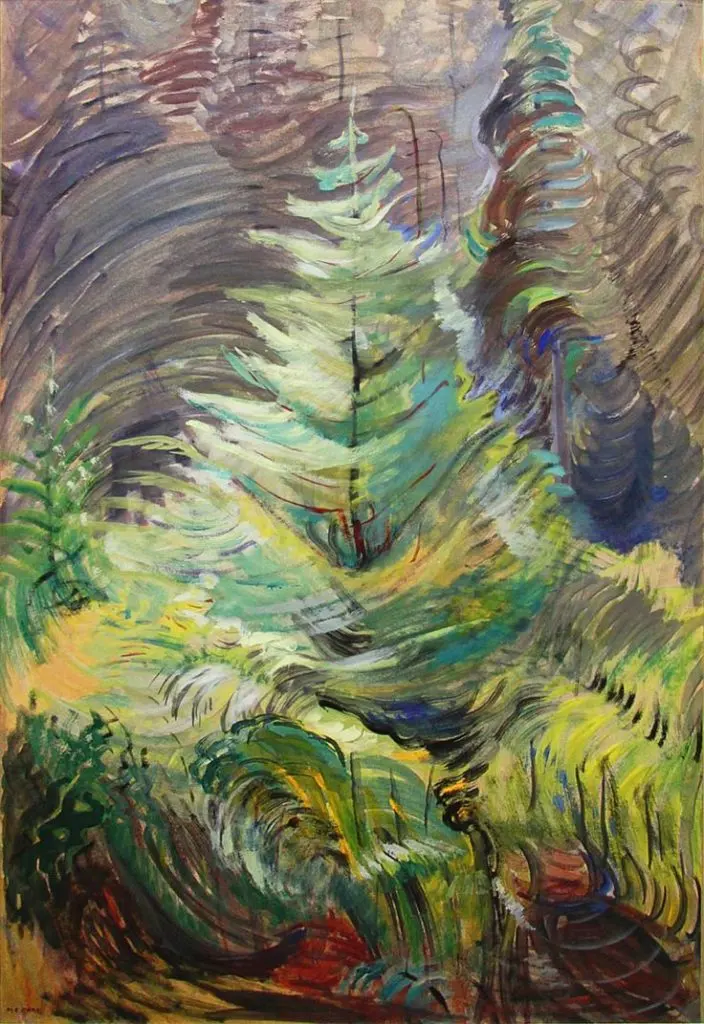
Forest, British Columbia (1932) is widely considered Emily Carr’s most famous painting. This iconic work captures the dense, spiritual intensity of the Pacific Northwest rainforest. While Carr produced many celebrated canvases, this specific piece remains the definitive example of her mature style, characterized by rhythmic brushwork and deep, expressive color palettes.
On this page
Why is Forest, British Columbia her most famous work?
Forest, British Columbia is celebrated because it perfectly encapsulates Carr’s artistic evolution. By the early 1930s, she had moved away from the documentary style of her earlier totem pole paintings to focus on the emotional resonance of the landscape. This painting features a towering, cathedral-like forest interior that emphasizes the verticality and ancient power of the trees. It is often cited by art historians as the moment she achieved a truly unique Canadian modernism.
The painting is significant because it demonstrates her signature "rhythmic" style. Carr used looping, swirling brushstrokes to suggest the movement of wind and the vital energy inherent in nature. By prioritizing the "spirit" of the woods over photographic realism, she transformed the Canadian wilderness into a subject of profound psychological depth. Today, it stands as a cornerstone of the collection at the Vancouver Art Gallery, representing the pinnacle of her career.
How to identify an authentic Emily Carr painting
Identifying a genuine Carr painting requires an understanding of her distinct phases and materials. She often worked on unconventional surfaces, such as brown paper or cardboard, particularly during her earlier years when professional canvases were expensive or difficult to transport into the woods. Her later works from the 1930s often utilize oil on paper, which she would then mount onto board for stability.
When examining her work, look for these key visual characteristics:
- A heavy reliance on dark, moody greens, deep browns, and vibrant sky blues.
- Thick, sculptural application of paint that creates a textured, almost carved appearance.
- A focus on solitary subjects, such as a single totem pole or a massive, isolated tree.
- A lack of human figures, as she believed the wilderness was most powerful when undisturbed.
Be cautious of unsigned works or pieces that lack provenance. Many of her sketches were sold or gifted during her lifetime, so documentation is essential for verifying authenticity.
Where can you see Emily Carr's art today?
The primary repository for Carr’s work is the Vancouver Art Gallery, which holds the largest collection of her paintings, drawings, and sketchbooks. Other major Canadian institutions also house significant portions of her output, ensuring that her legacy remains accessible to the public. Visiting these galleries is the best way to appreciate the scale and texture that photographs often fail to convey.
If you are planning a visit, keep these tips in mind:
- Check the gallery’s online database before arriving to see which specific pieces are currently on display.
- Look for the "Carr and the Group of Seven" exhibits, which provide vital context regarding her professional influences.
- Visit the Emily Carr House in Victoria, British Columbia, to see her childhood home and learn about her early life.
- Pay attention to the lighting in the gallery, as it is designed to highlight the thick impasto technique she favored.
Common mistakes when interpreting her work
A frequent error is assuming that Carr’s paintings are merely landscapes. While they depict the physical world, Carr viewed her work as a spiritual endeavor, attempting to capture the "life force" of the forest. Viewing her paintings solely through a traditional landscape lens ignores the deep emotional and metaphysical intentions she brought to her easel.
Another mistake is misattributing the influence of the Group of Seven. While she was friends with Lawren Harris and was encouraged by the Group, her style was largely developed in isolation in the woods of British Columbia. Her work is distinctively more organic and fluid than the often rigid, geometric forms favored by the Group of Seven. Understanding this distinction is crucial for anyone trying to categorize her place within the history of Canadian art.
How to learn more about Emily Carr
For those interested in a deeper dive, reading her own writings is essential. Carr was a talented author, and her books, such as Klee Wyck, offer a window into her experiences living and painting in remote Indigenous villages. Her journals, published posthumously, reveal the intense struggles she faced as a female artist working in a male-dominated field during the early 20th century.
To further your education on her life and techniques, consider these steps:
- Read Klee Wyck to understand her deep respect for Indigenous cultures and the natural world.
- Study the archival photographs of her in the forest to see the actual locations that inspired her most famous compositions.
- Follow the "Emily Carr Trail" in Victoria, which maps out the significant locations from her formative years.
- Watch documentary films produced by the National Film Board of Canada that feature interviews with curators and historians.
By engaging with both her written words and her visual masterpieces, you gain a comprehensive understanding of why she remains Canada’s most iconic female painter.
Key facts
- Emily Carr’s most celebrated painting is widely considered to be Big Raven, created in 1931.
- The work depicts a large, stylized raven perched atop a totem pole, reflecting her deep connection to Indigenous culture.
- Carr is best known for her expressive landscapes of British Columbia’s forests and totem poles.
- She was a member of the Group of Seven, a famous collective of Canadian landscape painters.
- Her signature style features bold, swirling brushstrokes and a deep, moody color palette.
- When viewing her work, look for how she uses light to give trees and carvings a sense of spiritual presence.
The bottom line
Emily Carr remains a foundational figure in Canadian art, with Big Raven standing as her most iconic masterpiece. Her powerful, rhythmic depictions of the Pacific Northwest landscape transformed how the world views the Canadian wilderness. By blending modernist techniques with profound respect for Indigenous history, she created a unique visual language. Her legacy continues to inspire artists and historians who value her deep connection to nature.
People also ask
Where can I see Emily Carr's original paintings?
The Vancouver Art Gallery holds the largest collection of her work. Many pieces are also displayed at the Art Gallery of Greater Victoria and the National Gallery of Canada.
Did Emily Carr write books as well as paint?
Yes, she was a successful author later in life. Her book Klee Wyck, published in 1941, won the Governor General's Award for non-fiction.
What was the inspiration behind her totem pole paintings?
She was inspired by the Indigenous cultures of the Pacific Northwest coast. She spent years traveling to remote villages to document these carvings before they deteriorated.
Was Emily Carr immediately successful as an artist?
No, she struggled for much of her career. She did not receive significant national recognition until she was in her late 50s.
What materials did Emily Carr use for her paintings?
She often used oil paints on canvas, but she also experimented with house paint and gasoline-thinned oil on paper. This technique allowed her to work faster and create more fluid, expressive lines.
How can I distinguish a genuine Emily Carr painting from a copy?
Authentic works are held in institutional collections or have documented provenance. If you suspect you have an original, consult a professional appraiser or an accredited art gallery for authentication.
This answer was created with the help of AI research tools and reference sources. Spotted an error? Let us know — we correct mistakes quickly. See our editorial policy.