How is clay made?
Short answer
Clay is a natural, fine-grained earth material formed through the chemical weathering of silicate-bearing rocks, such as feldspar, over millions of years. Geological processes break down these rocks into microscopic mineral particles. When mixed with water, these particles become malleable and plastic, allowing them to be shaped and eventually fired into ceramic.

On this page
How is clay formed in nature?
Clay originates primarily from the long-term chemical decomposition of igneous rocks, particularly granite. As water, carbon dioxide, and organic acids seep into rock crevices, they trigger a process called hydrolysis. This reaction alters the crystalline structure of minerals like feldspar, mica, and quartz, transforming them into secondary clay minerals such as kaolinite, illite, or montmorillonite.
The specific properties of the resulting clay depend on the parent rock and the environmental conditions during its formation. Primary clays, or kaolins, are found at the site where the parent rock decomposed, making them relatively pure and white. Secondary clays are transported by wind, water, or glaciers to new locations. During this journey, they collect impurities like iron oxide, sand, and organic matter, which influence the clay's color, melting point, and plasticity.
- Kaolinite: A high-purity, white-burning clay used for fine porcelain.
- Ball Clay: Highly plastic and fine-grained, often added to other clays to improve workability.
- Fire Clay: Resistant to high temperatures, essential for lining kilns and industrial furnaces.
- Earthenware: Contains iron and other minerals, maturing at lower temperatures to produce red or brown colors.
How do manufacturers process raw clay?
Once extracted from deposits, raw clay is rarely ready for immediate use. It must undergo a rigorous refining process to remove debris, rocks, and uneven mineral concentrations. Manufacturers typically use a process called "levigation," where the clay is mixed with water to create a slurry. Because clay particles are microscopic, they remain suspended in the water, while heavier impurities like sand and stones sink to the bottom.
After separation, the clay slurry is passed through fine screens to ensure a uniform particle size. The water is then removed through evaporation or filter presses until the material reaches a workable, dough-like consistency. For commercial use, different types of clay are often blended to achieve specific characteristics, such as increased strength, desired firing temperature, or a particular color.
- Extraction: Raw earth is mined from pits or riverbeds.
- Refining: The clay is washed and screened to remove grit and organic contaminants.
- Blending: Different clay types are mixed to balance plasticity and shrinkage.
- Conditioning: The mixture is de-aired and pugged to create a consistent, uniform body.
What makes clay plastic and workable?
The unique workability of clay, known as plasticity, is a result of its microscopic, plate-like crystalline structure. When water is added to clay, it forms a thin film between these tiny, flat plates. This film acts as a lubricant, allowing the particles to slide over one another without losing their cohesive bond. This allows a potter to stretch and form the material into complex shapes without it crumbling.
The degree of plasticity varies significantly between clay types. Fine-grained clays, such as bentonite, have high surface areas and hold more water, making them extremely plastic. Conversely, clays with larger particle sizes or high sand content are less plastic and more prone to cracking. Understanding this balance is essential for artists who must adjust their clay bodies to suit specific techniques like throwing on a wheel or hand-building sculptures.
Common mistakes when preparing clay
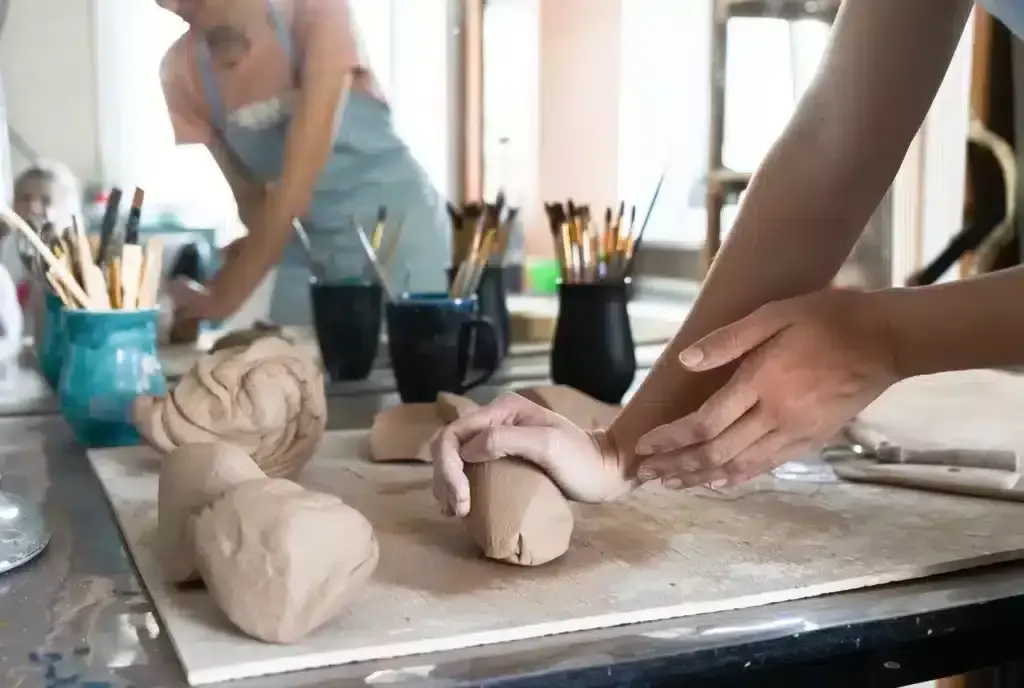
One of the most frequent errors for beginners is failing to properly "wedge" the clay before use. Wedging is the process of kneading the clay to remove trapped air bubbles and ensure the moisture content is uniform throughout the mass. If air remains trapped inside the clay, it can expand rapidly during the firing process, causing the piece to explode or crack inside the kiln.
Another common mistake is adding too much water during the shaping process. While water increases plasticity, excessive moisture weakens the structural integrity of the clay wall, leading to sagging or collapse. Additionally, improper drying causes uneven shrinkage. If one part of a piece dries faster than another, the internal stress will inevitably lead to cracks. Always cover pieces with plastic to ensure slow, uniform moisture loss throughout the entire structure.
How to identify high-quality clay
High-quality clay is defined by its consistency, purity, and suitability for its intended purpose. When selecting clay, professionals look for a predictable "shrinkage rate," which is the percentage of size lost as water evaporates and the clay is fired. A consistent clay body will have a uniform mineral composition, ensuring that it does not warp or develop unexpected structural weaknesses during the firing cycle.
To test the quality of a clay body, perform a simple "coil test." Roll a small amount of clay into a coil about the thickness of a pencil and wrap it around a finger. If the clay cracks significantly while bending, it lacks sufficient plasticity. If it remains smooth and shows no fissures, it is well-balanced and ready for use. Always store clay in airtight containers to prevent it from hardening, as dried-out clay is difficult to rehydrate to its original, optimal state.
Key facts
- Clay is primarily composed of hydrated aluminum phyllosilicates, which are minerals formed by the chemical weathering of rocks like feldspar.
- Particle size defines clay; for a material to be classified as clay, its particles must be smaller than 0.002 millimeters in diameter.
- The plasticity of clay, which allows it to be molded, is caused by the thin, plate-like shape of its particles and their ability to slide over one another when wet.
- To prepare raw clay for use, it must be refined through "levigation," a process of mixing it with water so that heavier impurities like sand and stones settle to the bottom.
- Adding too much water during the preparation phase will weaken the structural integrity of the clay, leading to cracks during the drying process.
- Always wedge your clay—a process of kneading it like dough—to remove air bubbles, which can cause the clay to explode in a kiln.
The bottom line
Clay is a naturally occurring mineral product created through the geological weathering of rocks over millennia. By understanding its microscopic plate-like structure, you can manipulate it into durable forms. Whether you are sourcing raw material from the earth or purchasing processed clay, success depends on thorough preparation, careful wedging to remove air, and a slow, controlled drying process to ensure your final ceramic work remains structurally sound.
People also ask
What is the difference between earthenware, stoneware, and porcelain?
Earthenware is porous and fired at lower temperatures, while stoneware is denser and fired at higher heat. Porcelain is a refined, white clay fired at extremely high temperatures to achieve a glass-like, translucent finish.
Can you make clay from dirt in your backyard?
Yes, you can process backyard soil by removing organic matter and rocks through a water-based settling process. However, soil often lacks the specific mineral content required for high-quality pottery, so it may need additives to improve plasticity.
Why does clay crack when it dries?
Cracking usually occurs because the clay dries too quickly or unevenly, causing internal stress. To prevent this, cover your projects with plastic to slow the evaporation process and ensure even moisture distribution.
How do you know when clay is "bone dry"?
Bone dry clay is room temperature to the touch and no longer feels cool or damp. This stage is critical because any remaining moisture will turn into steam in the kiln and cause the piece to shatter.
What is the purpose of "wedging" clay?
Wedging eliminates air pockets and ensures a uniform consistency throughout the clay body. If air remains trapped, it expands during firing, which can cause the ceramic piece to crack or explode.
Is all clay toxic?
Most natural clays are non-toxic, but some contain minerals like silica, which is harmful if inhaled as dust. Always work in a well-ventilated area and clean surfaces with a wet sponge to avoid kicking up dry particles.
This answer was created with the help of AI research tools and reference sources. Spotted an error? Let us know — we correct mistakes quickly. See our editorial policy.